


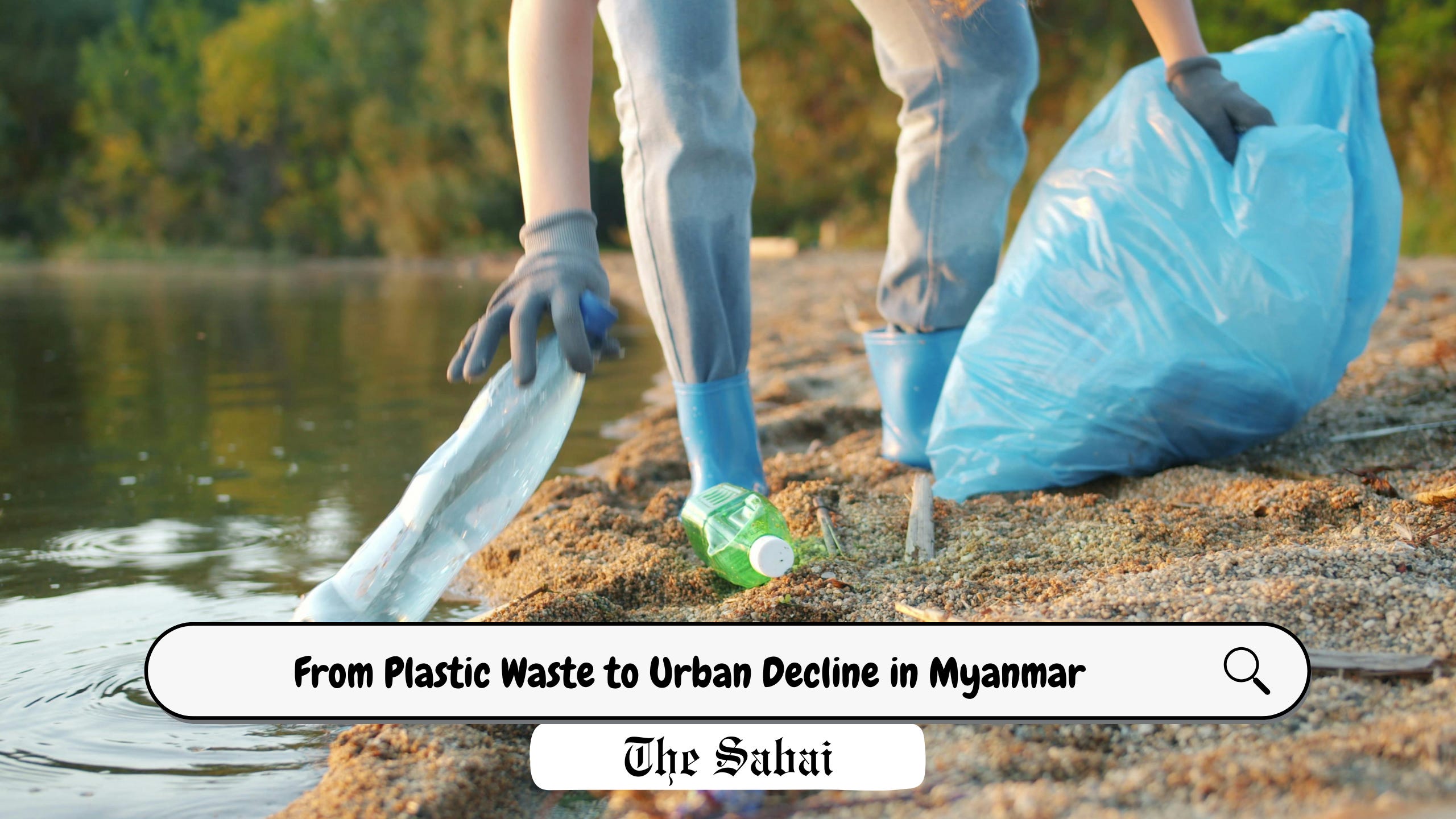
Disposable waste is material or an item that is discarded after use and is no longer wanted or usable. The national waste generation rate in Myanmar is reported to be about 0.56 kg per person per day (World Bank). Plastic waste is the most visible and most harmful waste type as it easily gets into drains, rivers, and open spaces. Most of the plastic waste is polluting water, soil, and the environment. Thus, waste management systems and the reduction of urban living space in Myanmar are interrelated to social, economic, and institutional welfare.
Key Takeaways
Plastic waste in Myanmar is now more than an environmental issue. It also points to deeper problems of urban governance, waste disposal and the safeguarding of public health.
Littering has become a common habit, environmental awareness is still low and civic responsibility is often weak or ignored, which continues to result in improper disposal of waste.
Cities struggle to effectively manage their waste due to poor municipal infrastructure, limited investment and weak enforcement of waste management regulations. This often results in garbage piling up on the streets, blocking drains and polluting rivers and waterways.
This results in blocked drainage, recurrent flooding of urban areas, increased mosquito breeding and a greater risk of disease outbreaks, all of which diminish the quality of life and resilience of urban communities of Myanmar.
Why do plastic waste and urban decline matter?
Plastic waste matters because it links everyday disposal habits to broader urban failure. The waste sector in Myanmar continues to be hindered by low collection coverage, inadequate disposal systems, and institutional challenges. At the same time, blocked drains and poor solid-waste management worsen flooding in cities and make the public more vulnerable to health problems.
This is also important because it points to a deeper social problem, where a lack of environmental awareness, normalised careless disposal and limited civic responsibility allow waste to keep reappearing on streets, drains and open spaces. This trend is reinforced in Myanmar by the demand for public education and increased cooperation between individuals and municipal authorities.
Rooted Mindset on waste management in Myanmar
Cultural Stigma and Misconceptions
In the Myanmar context, poor waste disposal practices are not merely a matter of convenience, but are deeply intertwined with social status and cultural misconceptions. On one hand, a persistent social stigma causes individuals to feel ashamed to collect public litter, as handling trash is culturally stigmatized. On the other hand, affluent societal groups often operate under the misconception that wealth absolves them from micro-level environmental responsibility, operating under the assumption that someone else can always be paid to clean up after them. Together, these social-psychological norms perpetuate a cycle where littering is normalized and personal accountability is discarded. To foster genuine community participation, public messaging has begun directly confronting these cultural attitudes, rallying around slogans like “Picking up litter is not shameful; littering is shameful” to redefine public responsibility across all socioeconomic classes.
Low environmental awareness & Weak policy enforcement
Low environmental awareness remains a central obstacle to effective waste management in Myanmar, because many residents still do not fully connect improper disposal with drainage blockage, pollution, and disease. At the same time, weak policy enforcement allows poor practices to continue, since environmental authorities face limited resources, weak institutional capacity, and waste management is often treated as a lower priority than other development needs.
Public-awareness campaigns and local cleanup efforts show that education is still necessary, but lasting improvement requires stronger regulations, better implementation, and sustainable community cooperation. Despite the National Plastic Management Action Plan (2026-2035), municipal authorities are non-elected officials who answer exclusively to higher government hierarchies rather than to the public they serve. The removal of elected municipal councilors following the 2021 military coup further dismantled local democratic accountability, leaving residents with no formal channels to influence municipal decisions or demand better public services. Also, Myanmar’s Urban Waste Management System lacks financial incentives for technology development, such as limited funding and no subsidies for developing waste management technologies.
Environmental Degradation and Daily Economic Struggles
In Myanmar, environmental degradation is deeply linked to everyday economic hardship, and for many households and local authorities, immediate survival is a greater concern than the long-term health of the environment.. A fundamental social value in Myanmar society is summarized by the saying “Only when the stomach is full can one keep the moral precepts”. Pollution, waste accumulation and ecological decline have been driven by economic pressure, over-exploitation of natural resources and densely populated urban areas, with further pressure exerted by conflict and instability.
Poor municipal services worsen the problem, as weak collection systems, inadequate drainage maintenance, and limited sanitation capacity allow waste to remain in streets and back lanes. To shift away from open dumping and transition to a sustainable circular economy, the government established the National Plastic Management Action Plan and the National Waste Management Strategy and Master Plan. However, Municipal systems are not capable of fully responding, which leads to sanitation burdens falling on residents and worsening living conditions.
Urban Environmental Shift under the NLD Government (2016–2021)
In the National League for Democracy (NLD)’s electoral victory in 2015, urban environmental stewardship became a visible symbol of public service and civic responsibility. One symbolic event occurred in December 2015, when Daw Aung San Suu Kyi participated in a public garbage-collecting activity in Kawhmu Township, together with residents. From the movement, similar clean-up campaigns and the alley gardens projects were expanded across different townships in Yangon, involving local communities, youth groups, and civil society organizations like Doh Eain.
Crucially, this civic momentum was underpinned by institutional reforms in local governance. While Myanmar’s municipal governance was historically illustrated by the restricted 2014 Yangon municipal election where voting was limited to one ballot per household, the NLD administration enacted the 2018 Yangon City Development Law. This led to the landmark March 2019 YCDC elections, the first held under universal suffrage. These activities reflected a progressive environmental movement by promoting public awareness about waste disposal, urban hygiene, and shared responsibility for public spaces. However, this progress was abruptly halted by the 2021 military coup, which stripped local councils of their democratic mandate and reinstated top-down military administration.
U-turn in Post-Coup
The 2021 military coup made a significant U-turn in Myanmar’s urban environmental progress, reversing earlier movements toward cleaner public spaces and community-based urban management. In Yangon, the rapid increase of internally displaced people (IDPs) has placed additional pressure on urban areas as people move to cities and surrounding townships for safety, housing, and economic opportunities. Local media have reported that overcrowded urban spaces, limited infrastructure, and insufficient public green areas have intensified sanitation challenges.
Furthermore, the structural firing of elected local officials, paired with broader post-coup instability, paralyzed urban planning and environmental enforcement across major cities like Yangon and Mandalay. Without elected councilors to advocate for local needs or facilitate community participation, state-civic cooperation collapsed. Conflict, economic hardship, and declining institutional coordination limited effective infrastructure development and long-term city management. Studies on post-coup Myanmar emphasize widespread governance disruption, insecurity, and reduced public confidence, which affected many aspects of daily urban life.
Consequences
Drainage Blockage and Mosquito Breeding
The decline of urban environmental management has created contingent challenges affecting public health, sanitation, and the quality of living spaces. One major consequence is drainage blockage and increased mosquito breeding. Although municipal authorities in cities such as Yangon and Mandalay continue to carry out waste collection and drain-cleaning activities, these efforts are often constrained by limited resources, rapid urbanization, and the increasing volume of plastic waste. The accumulation of plastic waste and unmanaged garbage has clogged drainage systems, creating stagnant water areas that provide suitable breeding environments for mosquitoes. This situation has increased the risk of mosquito-borne diseases, particularly during the rainy season.
Spread of Disease
The public-health impact extends beyond flooding and mosquito breeding. Studies on waste disposal in Myanmar show that poor sanitation practices are associated with higher diarrheal risk, while recent reporting on dengue and malaria confirms that mosquito-borne disease remains a major concern in the country. In 2025, Myanmar reportedly recorded 5,066 dengue cases and 26 deaths by July 19, underscoring the seriousness of the threat
Impact on Clean Living Spaces
The decline in urban cleanliness has damaged green living spaces and community well-being. Public areas that were previously maintained through community participation have become more vulnerable to neglect, reducing residents’ sense of safety, comfort, and civic responsibility. The combination of weak governance, poor waste management, and declining urban services has transformed environmental issues into broader social and public health challenges.
Conclusion
The combination of weak waste management, blocked drainage, and declining urban governance has transformed environmental problems into broader public health and social challenges, making urban areas less safe, less healthy, and less sustainable.
Implications and Recommendations
Encourage youth groups, schools, and communities to lead clean-up campaigns, recycling activities, and environmental education to build long-term civic responsibility.
Provide accessible public bins for convenience, waste-separation points, regular collection services, and recycling facilities so citizens can easily follow waste-management rules.
Re-Install municipal Elections to encourage civil society participation with municipal accountability
Expand Reduce, Reuse, and Recycle programs by involving both formal businesses and informal waste workers in the recycling system.
Execute a functional Waste Management System by Municipal Authorities to maintain clean and accessible public spaces.
Khant Eaint Hmoo is a Research Assistant at the Sustainability Lab of the Shwetaungthagathu Reform Initiative Centre (SRIc) and a Bachelor of Economics (Hons) student from Albukhary International University, Malaysia.