

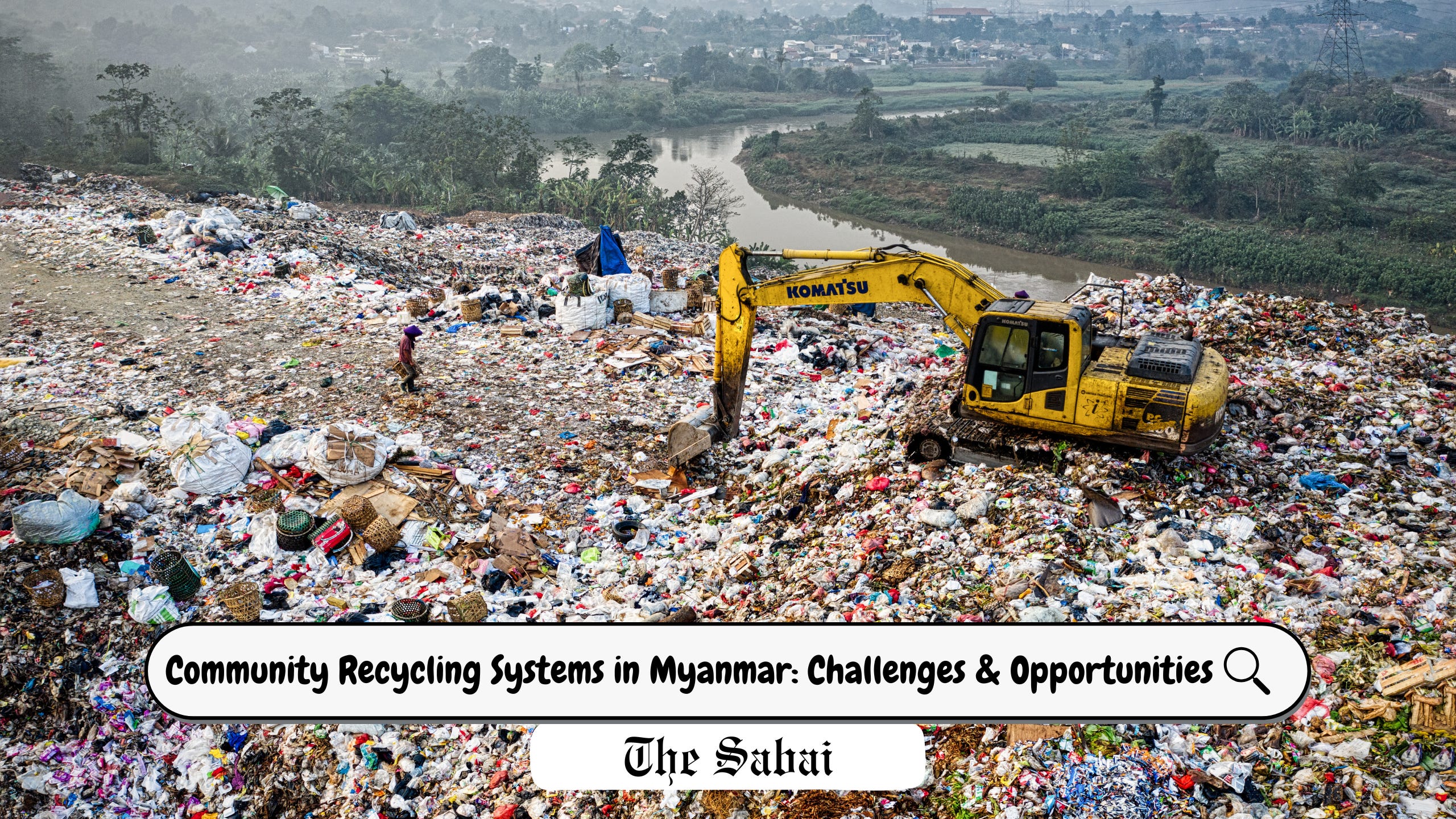
Strengthening community-based recycling and integrating the informal sector is key to improving waste management and advancing a circular economy in Myanmar.
Myanmar has been facing the challenge of solid waste management, especially plastic, which is flowing into landfills, waterways, and informal channels at a concerning pace. At the same time, in the current context of economic decline, political instability, and polycrisis, the practice of “repair, reuse, recycle” is familiar to many Myanmar households and communities.
These everyday practices, such as repairing old appliances, reusing containers, or selling recyclables to small junk shops, reflect long-standing cultural habits shaped by necessity. Because of weak national infrastructure and governance, community-level recycling systems can be a viable route for waste governance and circular economy growth. However, with limited infrastructure, heavy reliance on the informal sector, and a fragile institutional environment, building strong community recycling systems in Myanmar is urgent and necessary for sustainable development.
Current State of Community Recycling in Myanmar
Municipal waste collection in Myanmar remains inconsistent, particularly outside major cities, and many wastes end up in unmanaged dumps or open landfills. Recycling is mostly driven by the informal sector, and waste-pickers, scrap collectors, and small buyers dominate the system. For example, according to a survey in 2017 in Yangon, approximately 86 tonnes of recyclable materials were recovered daily from landfill sites, and 57% was glass, 15% paper/cardboard, 13% cardboard/paper, 7% plastic and 7% tin cans (Premakumara et al., 2017).
Neighbourhood drop-off points and small junk shops are common community-level practices, but there is no standardised recycling system applied across townships. Data on recycling volumes and source-segregation are scarce, making strategic planning difficult (Premakumara et al., 2017; Prevent Plastics Myanmar, 2021). Public awareness of waste sorting is low overall, although many households recognise high-value materials (such as aluminium cans, plastic bottles, cardboard) because they can be sold to informal collectors. This awareness of “value in waste” offers a foundation for community engagement.
Key Challenges
Weak infrastructure: Myanmar has very few dedicated materials-recovery facilities (MRFs) and limited municipal recycling services. Collection schedules are often unreliable, and transport vehicles and equipment are insufficient
Policy and enforcement gaps: Although some bans (for example, on thin plastic bags) exist in city areas, enforcement is weak, and incentives for households or communities are unclear. For example, the recycling value chain remains informal with little official policy integration (ECD & MONREC, 2018; Premakumara et al., 2017).
Informal sector vulnerabilities: While the informal waste-picker network is fundamental and contributes significantly to recycling, workers often face unsafe working conditions, unstable prices for recyclables, and a lack of social protections. A recent mapping in Yangon and Hpa-An found that waste-picker livelihoods depend heavily on fluctuating scrap values and minimal regulation (Win et al., 2024).
Social and behavioural barriers: Cultural habits such as dumping, burning or littering remain widespread in many communities. Convenience-driven disposal practices (throwing all waste into one bin) persist, and source separation is rarely practised. These habits hinder effective recycling at the community level.
Economic barriers: Community-led recycling projects receive limited financial support, and many recycling markets in Myanmar are low-profit, especially for plastic types with little resale value. For example, research notes that even though Myanmar’s informal sector achieves high rates of recovery for “valuable” materials, single-use plastics with low resale value often escape collection (Jeske, 2023).
Opportunities for Strengthening Community Systems
Integrate and recognise the informal sector: Recognising the role of informal actors is key. Policymakers should provide protective equipment, training programs, and partnerships between municipal authorities and waste-picker groups. The United Nations Development Programme (UNDP) highlights that recognising informal waste workers improves efficiency and inclusion of recycling systems (Chen, 2023).
Community-based collection models: Neighbourhood sorting centres, school or monastery-led recycling hubs, and incentive-based systems (points, rebates for recyclables) can encourage recycling locally. Because many households already resell high-value materials, a more formal collection network can build on this behaviour.
Improving public awareness: Campaigns targeted at the household and quarter level, and youth-led initiatives, can tap into Myanmar’s culture of reuse and repair (for example, repair shops for umbrellas or electronic appliances) and increase recycling habits. Since many communities already engage in reuse due to resource scarcity, this is an ideal environment for behaviour change.
Policy recommendations:
• Introduce local-level bylaws mandating separation at source, tailored to township realities.
• Offer financial incentives or subsidies to recycling SMEs to make community recycling viable.
• Provide subsidies for purchasing materials with recycled content, stimulating demand for recyclables and closing the loop.
Conclusion
Community-level recycling systems offer a strong entry point for Myanmar’s transition toward a circular economy and stronger waste governance in the current context of Myanmar. By establishing collection, sorting, and education in neighbourhoods and by integrating the informal sector into formal systems, Myanmar can build resilience despite its governance and infrastructure constraints. Strengthening these local systems also helps communities take ownership of environmental challenges at a time when national-level attention to waste management remains limited. Moreover, as economic pressures continue to shape household behaviour, community recycling can build on existing cultural practices of reuse and repair, making sustainability both practical and accessible. With inclusive policies, targeted investments, and local innovation, community recycling can scale up, offering a hopeful path forward for both people and the environment, even amid Myanmar’s ongoing uncertainties.
References:
Chen, S. (2023, December 28). Unsung Heroes: Four Things Policymakers Can Do to Empower Informal Waste Workers. UNDP. https://www.undp.org/blog/unsung-heroes-four-things-policymakers-can-do-empower-informal-waste-workers
ECD, & MONREC. (2018). National Waste Management Strategy and Master Plan for Myanmar (2018-2030). https://optoce.no/wp-content/uploads/2019/04/Myanmar-National-Waste-Management-Strategy_Mar-2018.pdf
Jeske, F. (2023, March 10). Plastic Waste in Myanmar: How Poverty (Paradoxically) Can Drive Circularity. Regional Knowledge Centre for Marine Plastic Debris. https://rkcmpd-eria.org/zero-in-on-plastic/plastic-waste-in-myanmar-how-poverty-paradoxically-can-drive-circularity
Premakumara, D. G. J., Hengesbaugh, M., Onogawa, K., & Horizono, S. (2017). Waste Management in Myanmar: Current Status, Key Challenges and Recommendations for National and City Waste Management Strategies. United Nations Environment Programme.
Prevent Plastics Myanmar. (2021). Best Practices: Waste Management Systems in Myanmar. Prevent Plastic. https://preventplastics.org/wp-content/uploads/2021/09/Waste-management-best-practices.Eng-.pdf
Win, N. N., Thu, Y., Yee, H. L., & Jeske, F. (2024). Waste Picker mapping in Myanmar. Thant Myanmar.
Hsu Latt Phyu is a Junior Research Fellow at the Sustainability Lab of the Shwetaungthagathu Reform Initiative Centre (SRIc). She holds a Master’s degree in Social Innovation and Sustainability from Thammasat University, Thailand.
“Advocating Sustainability, Shaping Our Future”
Help Sustain The Sabai - Myanmar’s Voice for Sustainability Support The Sabai