


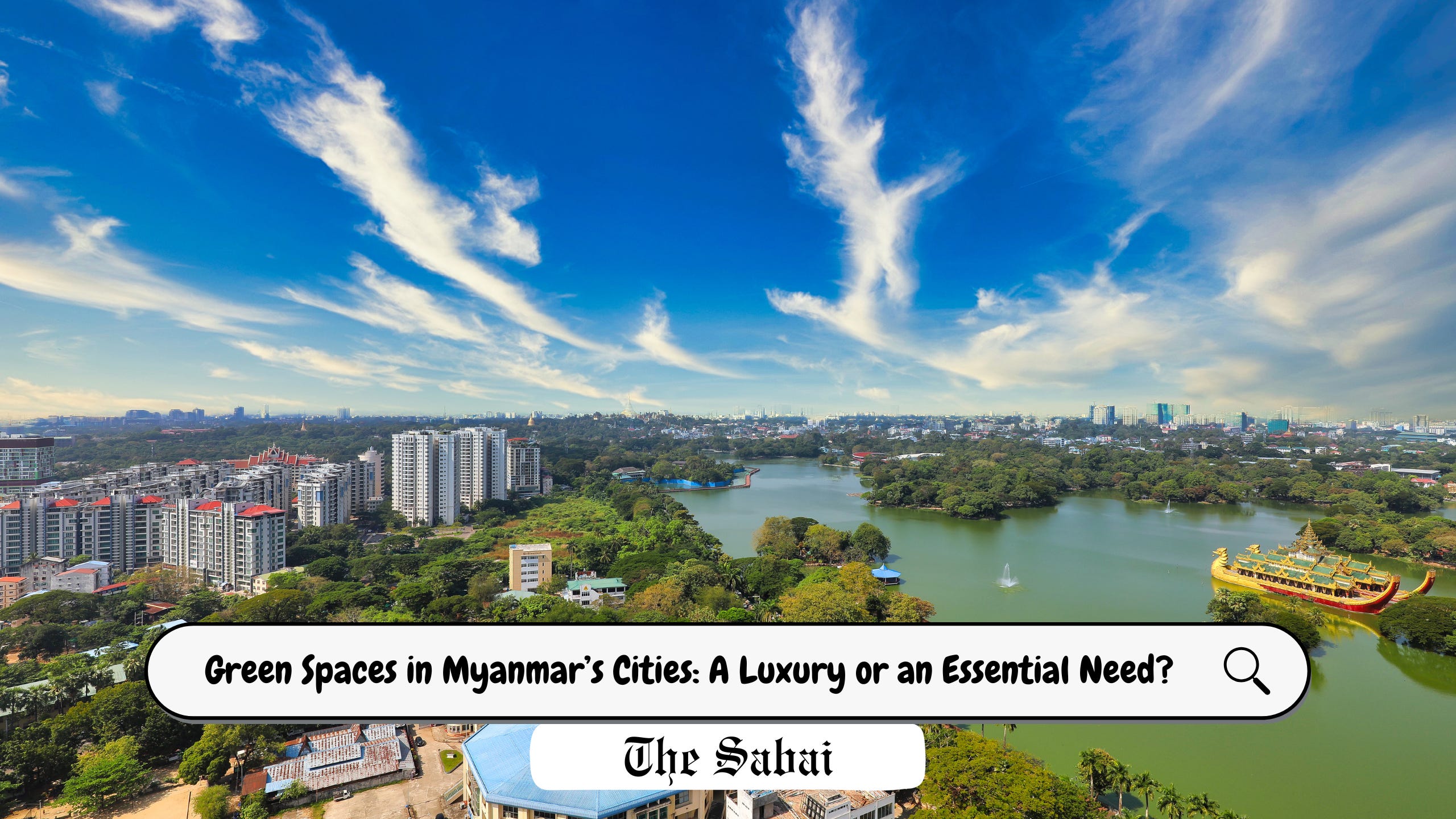
In many cities across Myanmar, it is becoming increasingly difficult to find accessible public green spaces where people can relax, exercise, or escape from crowded urban environments.
Key Takeaways:
Rapid urbanization and population growth are increasing pressure on public spaces in Myanmar’s cities.
Unequal access to green spaces affects social well-being, public health, and urban resilience.
Green spaces should be recognized as essential urban infrastructure rather than optional amenities.
Parks, playgrounds, and community recreational spaces remain limited, while commercial buildings and housing developments continue to expand. During the last few years, major cities such as Yangon and Mandalay have experienced rapid population growth due to economic, social, and political pressures. According to the census data, Yangon’s population increased from 2.7 million in 1983 to around 5 million in 2024. Despite growing urban density, green spaces are still often treated as optional amenities rather than essential public infrastructure.
Factors behind Populated Cities
Migration to urban areas in Myanmar is driven by several economic, social, and political factors. One of the main reasons is that employment opportunities, education, and public services are concentrated in major cities such as Yangon. Migration from other states and regions to Yangon in search of economic and social opportunities has significantly contributed to the city’s high population density.
Rural-to-urban migration has accelerated since 2010, especially in Yangon, where internal migration represented a more significant trend than international migration. However, political instability following the 2021 military coup, combined with economic decline, inflation, and the impacts of the COVID-19 pandemic, further added pressure to economic hardship and displacement pressures across the country. As a result, cities are facing growing demands for housing, transportation, and public infrastructure, while overcrowding and pressure on public spaces continue to increase.
Social Life in Myanmar
Myanmar society has traditionally been community-oriented, with strong social practices centred around religious events, cultural festivals, tea shops, markets, and neighbourhood spaces. These informal gathering places have long played an important role in building social cohesion and a sense of belonging. Social participation and community bonding are essential parts of social sustainability and urban resilience, particularly during periods of crisis and uncertainty. Communities with stronger social ties are often better able to support one another during disasters, economic hardship, and other social stresses.
Despite rapid urbanization, social trust and neighbourhood relationships remained relatively strong in Myanmar’s cities before the crises. However, urban density, privatization, and changing lifestyles are reducing communal interaction spaces. Housing limitations in Yangon, particularly in small apartments and informal rental accommodation, can reduce opportunities for community interaction and shared social life. Moreover, there are limited accessible public spaces where people can gather and socialize without needing to spend money.
Accessible public green spaces can therefore play an important role in strengthening community engagement, social inclusion, and mental well-being. Well-maintained public spaces with social and cultural activities can encourage interaction between diverse communities while reducing social isolation.
Urban Planning Failure and Its Impacts
Rapid urbanization in Yangon has taken place without systematic and long-term urban planning. Since 2021, many people have moved in search of safety and livelihood opportunities due to conflict, insecurity, and displacement . This could also have added pressure to Yangon’s housing, infrastructure, public services, and public spaces. As the population increased, traditional low-rise housing was gradually replaced by high-density apartments to accommodate growing urban populations. Moreover, this transition has also reduced open spaces and social infrastructure within the city.
Urban expansion has increasingly prioritized commercial and residential development over public welfare and environmental sustainability. In some cases, governance challenges and corruption have undermined the protection of public spaces, allowing commercial interests to take precedence over community and environmental needs. Urbanization in Yangon has expanded into agricultural land and open spaces, contributing to the gradual decline of public green areas. Public open spaces have also been privatized through real estate and commercial projects over the past two decades. For example, 10 acres of Kanthaya Park in North Okkalapa Township, Yangon, were replaced by a supermarket development.
At the same time, many low-income residents, migrants, and industrial workers are moving into suburban areas with limited infrastructure and public amenities. Residents living in dense apartment communities can experience stress related to the lack of recreational and social spaces, negatively affecting quality of life and community resilience. As green spaces continue to decline, cities face growing environmental challenges such as urban heat, flooding, air pollution, and overcrowding, while social cohesion and overall urban well-being are increasingly weakened.
The Need for Green Spaces
Green spaces are important not only for environmental purposes but also for social well-being, public health, and community resilience. In the context of urban sustainability, access to open spaces, local amenities, and green areas is considered important tangible elements that support quality of life, while social cohesion, inclusion, and a sense of belonging are equally important intangible aspects of social sustainability. In rapidly urbanizing cities like Yangon, the lack of green spaces and community facilities can weaken social participation and reduce opportunities for traditional and social activities.
As urban populations continue to grow, the need for accessible public spaces is becoming increasingly urgent. Yangon’s population is projected to continue rising significantly in the coming decades, increasing pressure on already limited public spaces. Without proactive efforts to preserve and develop green areas, the scarcity of communal spaces is likely to increase further.
Green spaces also provide multiple health benefits. Research has shown that access to nature and urban greenery can reduce stress, improve mental well-being, encourage physical activity, and strengthen social cohesion. Exposure to natural environments has been associated with lower stress levels and reduced symptoms of anxiety and depression. Parks and walkable green areas can also encourage recreational activities such as walking, jogging, and community exercise, which contribute to healthier lifestyles.
In addition, green spaces can help improve air quality, reduce urban heat, buffer noise pollution, and mitigate flooding risks. Well-maintained public spaces can also encourage community interaction and reduce social isolation, particularly among children, elderly people, and low-income residents. In this sense, green spaces should be viewed not as luxury amenities, but as essential urban infrastructure that supports healthier, more inclusive, and more resilient cities.
Current Gaps and Inequalities
Despite the growing importance of public green spaces, access to them remains highly limited and unequal, especially in Yangon. Yangon currently has far less green space per person than the minimum standard recommended by the World Health Organization. According to an official statement by the Yangon City Development Committee (YCDC) in 2016, Yangon’s parks covered a total of 211.25 hectares, providing only 1.74 square meters of green space per person. Several townships still have no public parks at all, while many existing parks are concentrated in the Central Business District and Inner Urban City Zone. As a result, access to green spaces often depends on where people live and their socioeconomic conditions.
In densely populated areas, the shortage of public recreational facilities can further limit opportunities for social interaction and leisure. Some public parks and recreational spaces are also perceived as unsafe or poorly maintained, particularly for women and vulnerable groups. In addition, certain green areas such as private golf courses and open areas are located within exclusive zones or semi-private developments with limited public accessibility.
Although Yangon was once known as the “Garden of the East,” rapid urbanization since 2012 has intensified pressure on public spaces while urban planning has struggled to keep pace with population growth. Real estate development and commercial expansion continue to reduce accessible green areas, while clear standards for creating new parks and public spaces remain limited. At the same time, the unequal distribution of green spaces reflects broader social and spatial inequalities within the city.
Nevertheless, some local organizations and urban initiatives have started advocating for the preservation and revitalization of public spaces in Yangon, including heritage restoration and community-focused urban regeneration projects.
Recommendations
Addressing the shortage of green spaces in Myanmar’s cities requires stronger urban planning, long-term policy commitment and enforcement, and community participation. Public awareness campaigns can also play an important role in changing perceptions of green spaces from optional amenities to essential urban infrastructure. At the same time, stronger advocacy and collaboration with relevant government departments are needed to ensure that green space preservation and development become priorities in urban planning and decision-making. Existing public and urban greenery should be protected from commercial conversion, while future urban development plans should include accessible parks, community spaces, and pedestrian-friendly environments. This requires stronger governance, transparent and corruption-free permitting processes, and effective enforcement to prevent the loss of public spaces to unsustainable development. Neglected and underutilized urban spaces could also be transformed into community green spaces that encourage recreation, social interaction, and creative activities. One example is the Yangon Alley Garden Project led by Doh Eain, which revitalized previously neglected alleyways into community spaces with gardens, playgrounds, seating areas, and street art. At the same time, regularly evaluating existing projects can help identify challenges, learn from past experiences , and inform the design of future green space initiatives.
Moreover, public spaces should be safe, inclusive, and accessible to different groups, including women, children, elderly people, and low-income communities. Maintaining public parks and organizing social and cultural activities can also strengthen community engagement and social cohesion.
Conclusion
As Myanmar’s cities continue to grow under economic, political, and social pressures, the need for accessible public green spaces is becoming increasingly urgent and essential. Rapid urbanization, population growth, and unplanned development have reduced many communal and recreational spaces, particularly in densely populated urban areas. At the same time, growing urban stress, overcrowding, and environmental challenges have highlighted the importance of healthier and more inclusive urban environments.
Green spaces should not be viewed as luxury amenities available only to certain communities. They are essential urban infrastructure that supports social cohesion, mental and physical well-being, environmental sustainability, and community resilience. Accessible public spaces can create opportunities for social interaction, relaxation, and community engagement, especially during periods of uncertainty and crisis.
Building more sustainable and livable cities in Myanmar will require recognizing that green spaces are not optional additions to urban development, but an essential part of urban life and public well-being.
Hsu Latt Phyu is a Junior Research Fellow at the Sustainability Lab of the Shwetaungthagathu Reform Initiative Centre (SRIc). She holds a Master’s degree in Social Innovation and Sustainability from Thammasat University, Thailand.
“Advocating Sustainability, Shaping Our Future”
Help Sustain The Sabai - Myanmar’s Voice for Sustainability Support The Sabai