

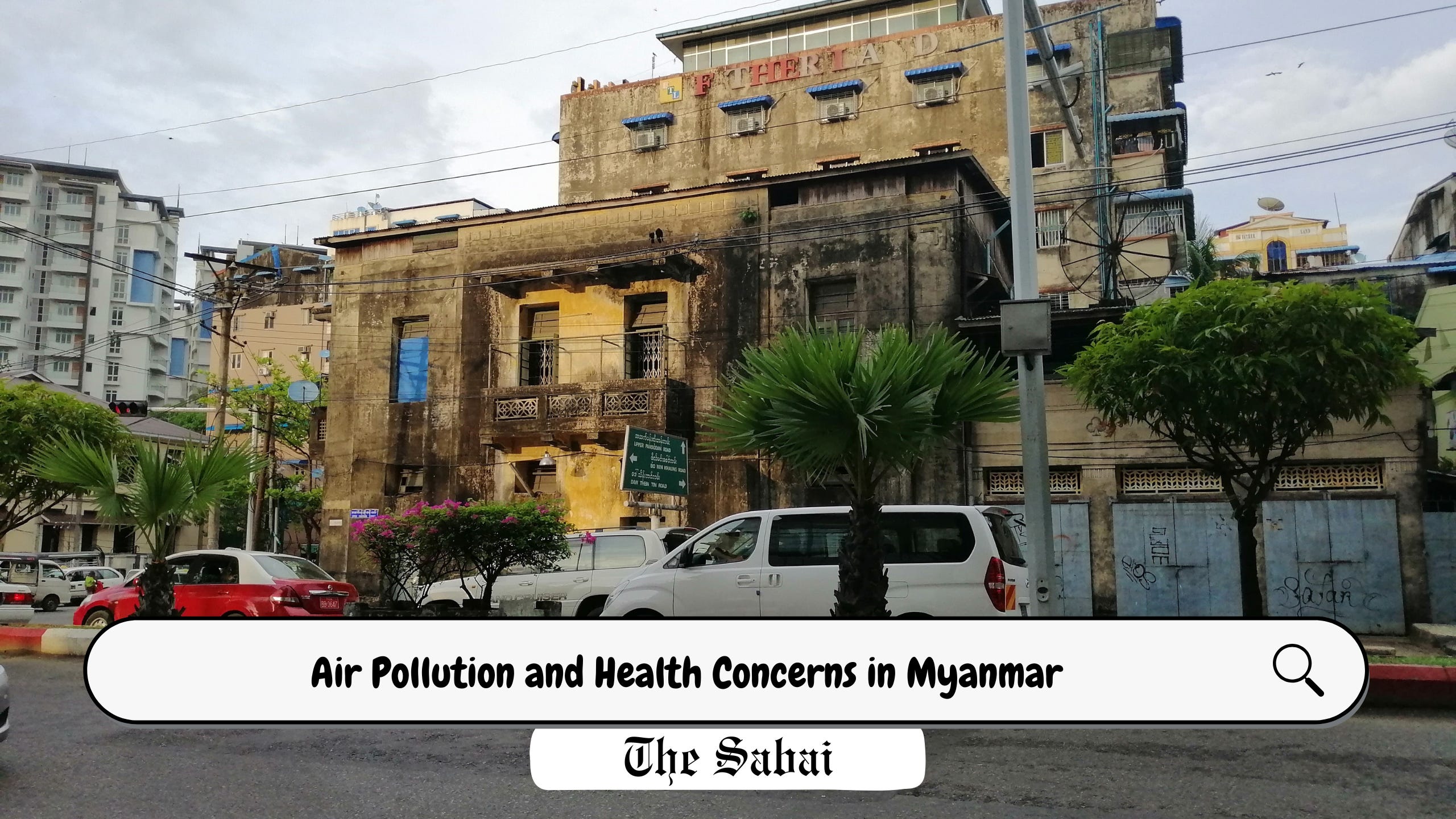
Severe air pollution in Yangon, driven by traffic, coal power, and weak regulation, has become a major public-health and social-justice crisis, threatening lives, livelihoods, and Myanmar’s sustainable development.
In the bustling streets of Yangon, the city’s skyline is often hazy and filled with fog. It can be recognised as dangerously polluted air in the city. Therefore, breathing clean air has become a daily challenge for the residents. It is not just an environmental issue but also a public‑health and social‑justice concern, deeply connected with Myanmar’s path toward sustainable development.
It is observed that Yangon’s air quality often reaches levels categorised as “unhealthy”. Burmese News International (BNI) (2025) recorded the city as one of the most polluted cities globally, with an Air Quality Index (AQI) of 165, on 27 January 2025. In addition, another report noted that AQI values in Yangon vary between 50 and 200, with levels around 200 considered harmful to health1.
The main reasons that contribute to the rise in air pollution in Yangon are increasing vehicle traffic, industrial emissions, trash burning, reliance on diesel generators (especially during power outages), and coal‑based energy generation, together with urbanisation and a weak regulatory framework¹. According to the Greenpeace report (2019)2, six out of 14 monitored towns in Myanmar exceeded the World Health Organisation guideline for annual average PM₁₀ levels, and none met the standard.
Air pollution imposes tangible burdens on people’s lives. With air pollution, fine particulate matter (PM₂.₅) and other airborne toxins seep into lungs, bloodstream and can trigger chronic diseases and complications. The 2019 Greenpeace report estimated that coal‑derived emissions alone could cause about 7,100 premature deaths per year in Myanmar if planned coal‑fired power plants go ahead. Furthermore, a report3 by Ohnmar from the University of Medicine 1, Yangon have found that exposure to dust, soot, lead and other pollutants reduces lung function, raises the prevalence of chronic bronchitis, and impairs cognitive or developmental health. Meanwhile, doctors in Yangon suggest that vulnerable groups, such as children, the elderly, and those with predisposed lung or heart conditions, stay indoors during high pollution periods and use masks when outdoors4.
Air pollution in Myanmar has impacts on the environmental, economic and social sectors. Firstly, polluted air degrades ecosystems, soils and water resources, especially when particulate matter settles, or when emissions come from coal‑plants that also affect nearby farmland and water supplies. Secondly, health impacts will result in lost productivity, higher healthcare costs and lower quality of life. Communities near polluting installations may lose livelihoods (e.g., farmers whose animals fall ill). Finally, pollution disproportionately affects the vulnerable group, those living in poorer districts or working in dusty jobs, deepening inequalities, as people with fewer resources have less ability to protect themselves (e.g., cannot avoid exposure or access care). Thus, addressing air pollution is not only about achieving cleaner air but also enabling healthier, fairer development.
Despite the urgency of the situation, Myanmar faces several significant obstacles, including a lack of regulatory standards for many coal‑fired power plants, making control of SO₂, NOₓ and multiple pollution sources. Because of resource constraints and infrastructure, investment for clean energy alternatives, improved waste management, air monitoring networks and health services are needed. To reduce the data gaps, reliable long‑term air quality data (especially PM₂.₅) and health‑impact studies, which are currently scarce in Myanmar, should be supported by the government and international networks, to make tracking progress and targeting interventions harder. As well as that, public awareness and behavioural change should be promoted in the community.
For Myanmar, the fight against air pollution is a critical chapter in sustainable development. It is not just an environmental challenge but a matter of public health, social justice and the future prosperity of cities like Yangon and beyond. By combining better data, stronger policy, cleaner energy, smarter transport, and active communities, Myanmar can move toward cleaner air, healthier people, stronger economies and more resilient societies.
Footnotes:
Xinhua. 2025. Air pollution hits Myanmar’s Yangon, raising health concerns.
Greenpeace / Harvard University. 2019. A Public Health Crisis in Myanmar: Coal: Possible Environmental Impacts of Running a 120‑Megawatt Coal‑Fired Power Plant at Tigyit on the local community.
Ohnmar. 2022. Environmental pollutants and their health effects in Myanmar. University of Medicine 1, Yangon & NIES Japan.
BNI (Burma News International). 2025. Yangon faces unhealthy air pollution; doctors urge precautions.
Dr Poe Poe is a medical graduate from Myanmar who recently attended a course in Political and Social Science at the Institute of Human Rights and Peace Studies, Mahidol University, Thailand
“Advocating Sustainability, Shaping Our Future”
Help Sustain The Sabai - Myanmar’s Voice for Sustainable Development Support The Sabai