


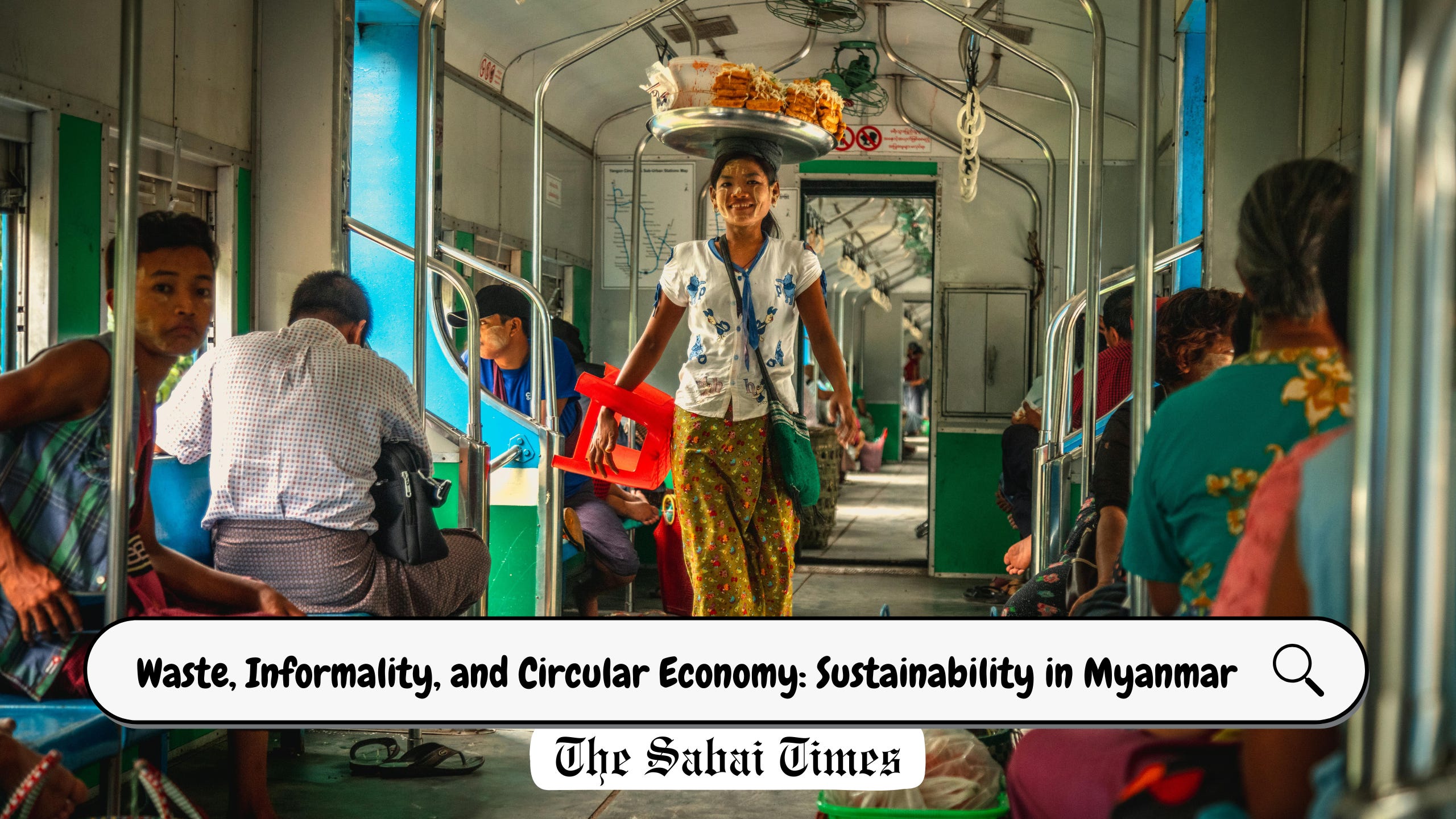
Myanmar is increasingly dealing with environmental challenges as a result of urbanisation, a poorly functioning government, and an inadequate waste management system. However, an informal community of garbage collectors and junk shop operators offers minimal support for Myanmar’s recycling sector. In this context, the article takes a look at informal garbage collectors in Myanmar in terms of the circular economy concepts they have already adopted, the obstacles they confront, and how they may be integrated into a country’s sustainability strategy. This is a call for an inclusive circular economy that balances sustainability and social equality.
Key Takeawys:
Myanmar faces a significant waste and plastic pollution crisis in metropolitan areas due to insufficient municipal capacity, poor infrastructure, and regulatory gaps.
Informal workers (collected, scrap dealers, junk shops) play a crucial role in recycling and material recovery, reducing landfill use, pollution, and poverty. However, they are not recognised or protected under official CE regulations.
An efficient circular economy in Myanmar requires social inclusion through recognition, formal integration, and targeted support for informal workers. Towards environmental sustainability, good employment, equity, and resilience, “A just transition approach” can lead to ecologically sustainable growth and development.
Introduction: Circular Economy in the Myanmar Context
A Circular Economy (CE) can be defined as a high-tech, advanced economy that is common in industrialised countries. In simple terms, it is about using resources efficiently, which includes reducing waste, recycling, and reusing materials so that nothing gets wasted unnecessarily. In a transitory nation like Myanmar, the Circular Economy takes on a whole different form.
Myanmar does not follow a ‘take, make, dispose’ model. In fact, they have to deal with informal structures. The country produces about 0.44 kg of garbage per person each day, which is lower than the global average. However, there is a major issue with managing their waste. A serious waste management issue develops in major cities such as Yangon and Mandalay, where traditional trash management systems are overworked, and dump sites are already full.
In developing countries, CE ideals are well-suited to local culture and informal work. In the Chatham House Briefing, Preston & Lehne argue that CE can help reduce the requirement for landfills, creating green jobs, particularly for low-income people, improving resource security if local production capability is restricted, and strengthening climate resilience through waste reduction and recycling.
According to international sources such as UNEP research on the circular economy in Asia and the Pacific, informal trash industries are a significant driver of recycling markets in low- and middle-income nations.
Myanmar’s waste management network has significant obstacles. There are major gaps in waste collection, with city authorities unable to provide waste management services properly. As a result, solid trash is left in streets and canals or burned, affecting both air and water quality. Plastic solid trash is becoming increasingly prevalent, accounting for 13% of total solid garbage. Plastic garbage in coastal areas accounts for up to 87% of sea waste. Because of a lack of proper recycling stations, most processed materials are exported or supplied to local small companies.
How Informal Workers Contribute to Circularity
A highly effective recycling network is formed by informal waste workers, such as street collectors, travelling buyers, scrap dealers, and junk shop owners. They gather, sort, and market recyclables like glass, paper, metals, and plastics in both domestic and international recycling markets.
Informal collectors keep garbage out of disposal sites by reusing goods that would otherwise end up there. Although this promotes material reuse and recycling, lowering demand for new materials and thus reducing garbage generation, it can also be perceived negatively because it leads to littering and pollution in areas where informal collectors dispose of waste. Informal recycling reduces greenhouse gas emissions by reducing the need for new resources. In a fragile economy, informal recycling provides a source of income for those living in poverty.
Problems and Exclusion Experienced by Informal Wasteworkers
Although they perform an effective job, informal garbage collectors are occasionally ignored. Two significant challenges are:
1. Lack of Recognition and Policy Support.
They go unreported in formal waste policies and are viewed as a problem rather than a benefit. They cannot access waste streams or profit from national CE plans unless legally recognised.
2. Poor Working Conditions and Social Stigma.
Working circumstances for informal recycler groups are frequently unsafe, exposing them to potentially harmful substances without protective equipment and leaving them subject to exploitation. Criticised communities with waste-related jobs are less likely to get communal social services.
Social Inclusion: The Missing Link in Circularity
A circular economy will require social inclusion, with a focus on countries like Myanmar. When it comes to informal players like rubbish pickers who help keep cities clean, a significant issue in the present rules is disregarded. To achieve a just and sustainable conclusion, Myanmar can implement a “Just Transition” strategy, including the following elements:
1. Recognition: Waste pickers play an important role in city cleaning and recycling. As a result, individuals will be empowered rather than excluded and will play an essential role in trash management.
2. Integration: Provide a means for informal sector employees to be integrated into official waste management systems. It may involve reaching an agreement with cooperatives to employ rubbish pickers in a fair and controlled manner in a formal environment. It will increase employment certainty and make waste management a collective responsibility, leading to more favorable environmental outcomes.
3. Support: Providing specific assistance to ensure integration success. This consists of providing safety equipment, health insurance, and assistance in establishing equitable markets for recycled products. This will improve the quality of life for trash workers. With these approaches, Myanmar can start to shift to a more inclusive and sustainable circular economy in which all waste sector workers’ contributions are valued.
Barriers to Implementation
In Myanmar, several hurdles to an inclusive circular economy include legislative flaws, financial limits, and a lack of information. The existing regulation fails to handle the informal sector, which contributes significantly to the management of waste. The installation of infrastructure for processing hazardous waste is expensive, which serves as a constraint. Finally, information about waste and the informal sector is inaccurate, making it difficult to handle effectively.
Conclusion
Workers in Myanmar’s informal economy have intimate contact with the circular economy. The circular economy exists, but it faces numerous challenges. To enable this economic transition into the future, sustainability must be linked to social inclusion through measures such as formalising the informal economy, raising safety standards, and investing in community projects. Such approaches can help to maximise resource utilisation and recognise the vital role of waste pickers in building a sustainable future.
Pyae Phyoe Mon is a Junior Research Fellow at the Sustainability Lab of the Shwetaungthagathu Reform Initiative Centre (SRIc) and an M.A. Candidate in Social Sciences at the Faculty of Social Sciences, Chiang Mai University, Thailand.
“Advocating Sustainability, Shaping Our Future”
Help Sustain The Sabai Times - Myanmar’s Voice for Sustainable Development Support The Sabai Times