


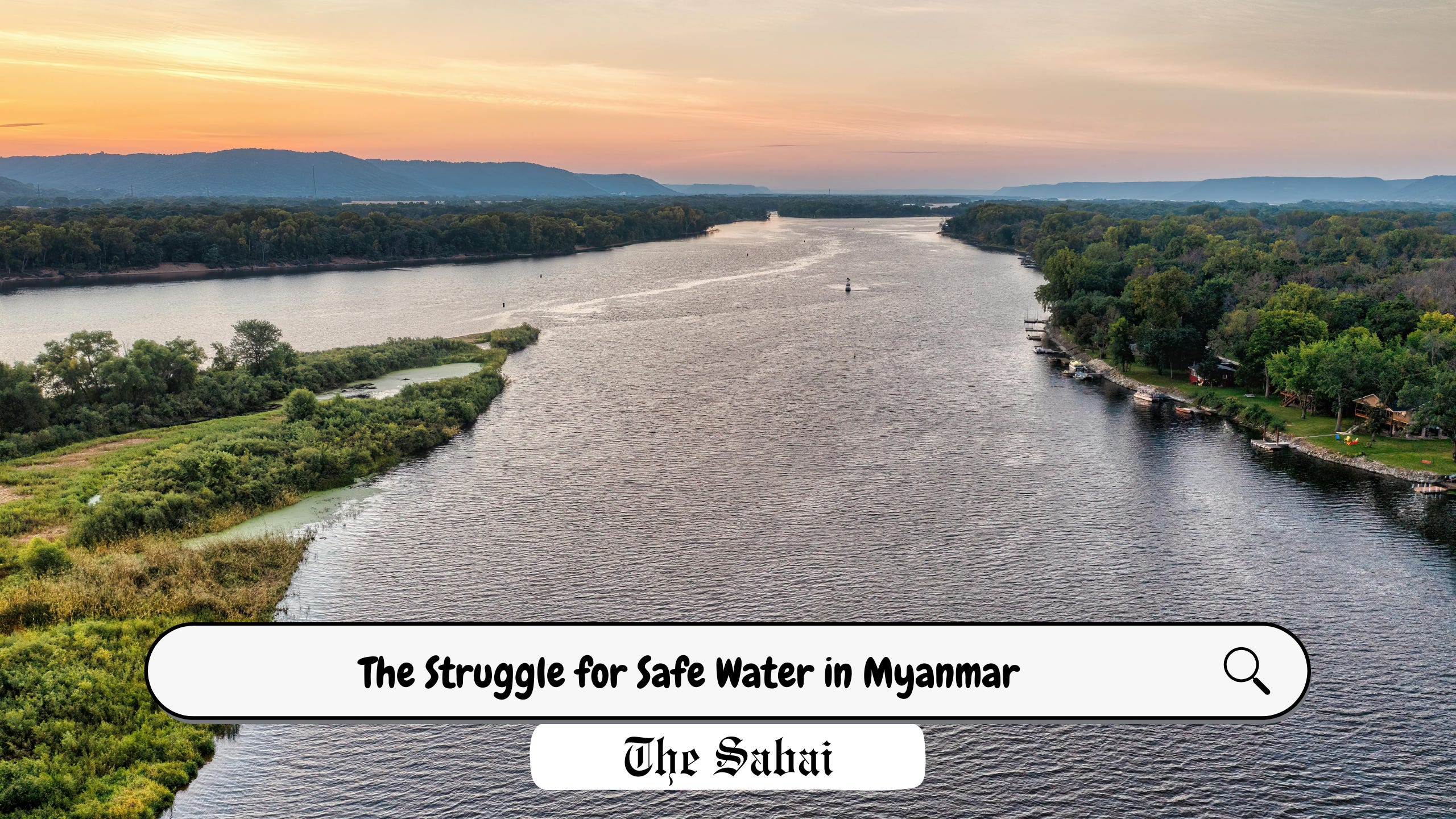
Water insecurity in Myanmar is a multifaceted crisis driven by environmental change, weak governance, economic decline, and social inequality, requiring coordinated infrastructure, community, and policy solutions to ensure sustainable access to safe water.
Key Takeaways
Water insecurity in Myanmar is driven by environmental factors, governance failures, economic decline, and social inequalities.
Limited access to safe water impacts on health, education, livelihoods, ecosystems, and institutional capacity.
Addressing the crisis requires integrated solutions combining infrastructure investment, community capacity building, and stronger governance coordination.
Introduction
Although water covers 70% of the planet, only about 3% is freshwater that we can drink or use to irrigate our farm fields. In Myanmar, access to safely managed drinking water has improved over the past two decades, rising from 27.11% in 2000 to 58.83% in 2020, yet water insecurity remains a critical challenge. Water insecurity happens when water is insufficient for human daily needs. More than 60% of households still lack safely managed drinking water services, and over 3 million internally displaced persons (IDPs) require WASH assistance.
Drivers of Water Insecurity
1. Environmental Factors
According to meteorologist U Tun Lwin, rising temperatures and deforestation are two key environmental causes of water scarcity, with impacts further intensified by disasters. Climate change has contributed to increasingly erratic rainfall, shifting monsoon cycles, and prolonged dry seasons. In addition, over the past three decades, the Central Dry Zone has experienced an approximate 2.4°C increase in baseline temperature, contributing to prolonged dry seasons and more frequent droughts. These climatic shifts have reduced the reliability of surface water sources. For example, in Rakhine State, ponds and small lakes are drying up, limiting water available for drinking and cooking. Similarly, in Htoke Kaw Koe Village in Karen State, wells that traditionally sustained local communities now fail during peak dry months. Consequently, households have to rely on shallow, unprotected, and often contaminated water sources. Extreme weather events further intensify these vulnerabilities. For example, Cyclone Mocha in May 2023 caused storm surges that contaminated unprotected community ponds with saline water. Moreover, earthquakes can disrupt groundwater systems, causing fluctuations in groundwater levels and damage to wells. Following the 2025 Sagaing earthquake in Myanmar, many tubes and dug wells were displaced or damaged.
2. Governance Failures
Weak policy implementation, limited regulatory enforcement, and insufficient investment in water infrastructure have undermined water management systems and disaster preparedness. In some areas, poor oversight has contributed to declining water quality, including arsenic contamination in some areas. Institutional weaknesses also limit effective disaster response. Limited preparedness and coordination can delay recovery efforts, leaving affected communities without reliable access to safe water following disasters. For example, in April 2025, approximately 1.6 million people in Myanmar lost access to clean water following disaster-related disruptions.
Governance failures are further compounded by weak intersectoral coordination and restrictions on humanitarian assistance. Since the 2021 military takeover, access limitations have hindered the delivery of humanitarian assistance, particularly for IDPs. Conflict has also damaged critical water infrastructure. Reports indicate that wells, water tanks, and supply routes have been destroyed in some areas during armed confrontations. Such actions disrupt water supply systems and affect civilian populations who depend on these sources for daily survival.
Mass displacement represents another governance-linked driver of water insecurity. Ongoing political instability has displaced nearly 3.5 million people nationwide. Many displaced populations live in overcrowded camps where water supply systems are limited. In such environments, residents frequently rely on unsafe sources such as collected rainwater stored in temporary containers, highlighting the link between governance failures and water insecurity.
3. Economic Decline
Since the 2021 political crisis, the national economy has contracted while inflation has surged to approximately 28.6%, pushing the poverty rate to 32.1%, reducing both government capacity to invest in water infrastructure and household ability to secure safe water. At the structural level, economic decline limits public spending on water infrastructure, maintenance, and service delivery. Water utilities face shrinking operational budgets, constraining system expansion and repair. Economic shocks, including natural disasters, such as the, 2025 earthquake, have further damaged water systems and intensified supply disruptions. At the household level, declining incomes reduce the ability of families to afford safe water. Many low-income households have to depend on private water vendors. Although wholesale mineral water prices range between US$0.42 and US$1.64 per kilogram (minimum wage US$1.9 per day), these costs represent a significant burden for low-income families. As a result, 16.3% of households lack sufficient water for daily needs.
4. Social Inequalities
Rural–urban disparities remain significant. Urban populations benefit more frequently from piped water systems and municipal treatment facilities, while rural communities often rely on natural sources such as ponds, rivers, and shallow wells. With roughly two-thirds of Myanmar’s population living in rural areas, uneven infrastructure development creates structural disparities in water access.
Education and awareness also influence water practices. Limited knowledge of safe water storage and sanitation practices contributes to the use of untreated water and poor hygiene behaviours. Social marginalisation further intensifies vulnerability. Communities located in border regions, mountainous areas, and conflict-affected zones often face infrastructure neglect and barriers to humanitarian assistance. Government restrictions on aid delivery, together with regulatory pressures and operational risks, have constrained humanitarian operations and led many international non-governmental organisations (INGOs) to scale down or relocate their activities. As a result, communities that previously depended on externally supported WASH services face reduced assistance, while many displaced communities rely on temporary camps and aid-dependent water systems with limited storage capacity.
Impacts of Water Insecurity
1. Economic Impacts
At the household level, families often spend additional income purchasing water from vendors. Health risks associated with unsafe water can also increase medical expenses and reduce working time due to illness. In water-scarce areas, households may spend several hours per day collecting water, reducing opportunities for income-generating activities. At the national level, widespread water insecurity can affect workforce productivity and place additional pressure on healthcare systems. Reduced agricultural productivity and labor capacity can slow economic growth and lower overall economic performance.
2. Social Impacts
Unsafe water increases the spread of waterborne diseases. In late 2025, approximately 300 people were affected by a cholera outbreak in Myanmar, with several confirmed deaths. Displacement camps have reported widespread cases of diarrhea and other illnesses associated with contaminated water sources. These risks have been further exacerbated by the reduction of international humanitarian support following the withdrawal or relocation of many INGOs, which has disrupted WASH service provision and weakened disease prevention and response capacity in vulnerable communities. Children face particularly high vulnerability. In fragile contexts, children under five are significantly more likely to die from diarrheal diseases linked to unsafe water. Long-term exposure to contaminated groundwater also poses serious health threats, including arsenic contamination in regions such as the Ayeyarwady Delta. Beyond disease, the physical burden of carrying water over long distances contributes to musculoskeletal pain. Education outcomes are also affected. School attendance is closely linked to proximity to water sources, where collection requires long hours, and absenteeism and dropout rates increase. Water collection responsibilities also reinforce gender inequality. Women and girls are typically responsible for collecting water and may travel long distances to reach water sources. In conflict-affected areas, these journeys expose them to risks of harassment, assault, and violence.
3. Environmental Impacts
Reduced water availability disrupts plant physiological processes, limiting nutrient uptake, slowing photosynthesis, and restricting plant growth. Declining soil moisture reduces crop yields and agricultural productivity. Prolonged drought conditions can also degrade soil health by reducing microbial activity and weakening soil structure. Groundwater over-extraction can further accelerate environmental degradation. Excessive pumping lowers water tables and reduces groundwater discharge to connected rivers and streams, diminishing water availability in surrounding ecosystems. These pressures are evident in urban areas such as Yangon, where population growth and post-2021 displacement have increased water demand. More than half of the city’s population relies on groundwater, with widespread extraction through private wells. Studies indicate that actual groundwater abstraction far exceeds official estimates, placing severe stress on aquifer systems. Excessive extraction has been linked to declining groundwater levels, increased risk of land subsidence, saltwater intrusion, and broader environmental degradation.
4. Governance Impacts
Waterborne diseases, sanitation-related illnesses, and outbreaks linked to unsafe water significantly increase patient loads, stretching already limited medical resources. Water insecurity can place additional strain on existing water, sanitation, and hygiene (WASH) systems. Furthermore, inadequate water infrastructure in rural and displacement settings makes consistent service delivery difficult. These pressures extend beyond the health sector. Reduced productivity due to illness and time spent collecting water can influence economic performance and public sector functioning.
Recommendations
1. Infrastructure and Technical Solutions
Strengthening physical water infrastructure is essential to ensure a reliable and climate-resilient water supply in Myanmar. At the national and municipal levels, governments should invest in dual-purpose water infrastructure systems that provide reliable water services while enhancing resilience to natural hazards. This includes the protection and management of raw water sources, as well as investment in water treatment plants, storage facilities, pumping stations, and distribution networks, supported by robust monitoring, control, and maintenance systems.
In rural and drought-prone regions, decentralized technical solutions, often implemented through community initiatives or by NGOs, can play a key role. Solar-powered water systems are particularly suitable in these areas, where solar panels can power groundwater pumps while reducing dependence on fuel. Rehabilitation of dug wells, including roofing, aprons, and proper drainage, can improve water quality and reduce contamination risks. In upland areas, gravity-flow systems that channel water from higher elevation streams into village storage tanks offer a low-cost and low-maintenance solution.
At the community and household levels, smaller-scale interventions can further enhance water security. These include rainwater harvesting systems, basic water treatment technologies such as chlorination, pond rehabilitation, restoration of wells and boreholes, salinity barriers in coastal areas, emergency water tankering, and improved household water storage facilities.
2. Institutional and Community Capacity
Infrastructure alone is insufficient without institutional and community capacity. At the community level, WASH education programs should be implemented in villages and schools to improve hygiene practices and safe water storage. Training residents in the operation and maintenance of water systems can strengthen local ownership and ensure long-term sustainability. At the governance level, decentralized water management should be strengthened at village and township levels through the establishment or reinforcement of local water management committees with clear responsibilities and accountability mechanisms. Restoring damaged public water systems is particularly critical in conflict-affected areas. Integrating water management planning into broader climate adaptation and environmental policies will further enhance resilience.
In addition, the governance bodies have to facilitate humanitarian access to ensure emergency WASH assistance reaches internally displaced and vulnerable populations. At the same time, INGOs should maintain engagement in Myanmar by adopting more adaptive and locally grounded approaches despite ongoing regulatory constraints and security risks. In particular, they should strengthen collaboration with civil society organisations, which have access and contextual knowledge to reach hard-to-reach and conflict-affected areas. INGOs should also support and accelerate the 2023 UN-led localization strategy by expanding consultation and support for locally led aid operations, thereby improving the effectiveness and reach of humanitarian assistance.
3. Financial Support
The national government should prioritise budget allocation for water infrastructure development, system maintenance, and rural water supply programs. Targeted subsidies can help vulnerable households overcome affordability barriers to safe water access. Public–private partnerships may mobilize additional resources to support water system expansion and service delivery. At the same time, international financial assistance should be adapted to the current operational context in Myanmar. Given existing governance and access constraints, reliance on traditional delivery channels alone may limit the effectiveness of aid distribution. Thus, donors should expand direct and flexible funding to civil society organisations, such as increased risk-sharing, simplified compliance requirements, and the use of pooled funding mechanisms to ensure that financial resources reach vulnerable populations more efficiently.
Conclusion
Water insecurity in Myanmar is a complex problem caused by environmental changes, social inequalities, and weak institutional systems. Climate change, groundwater depletion, and disasters have made water sources less reliable, while unequal infrastructure and conflict have made access more difficult. The withdrawal or reduced presence of international actors and ongoing access restrictions have also limited the delivery of WASH services, especially for vulnerable communities.
To address this crisis, practical and coordinated actions are needed. Improving climate-resilient infrastructure, promoting community-based water systems, and supporting civil society organisations can help improve access to safe water. At the same time, more flexible and localised funding approaches are important to ensure that assistance reaches those most in need. Without sustained efforts, water insecurity will continue to affect human well-being and future development in Myanmar.
Dr. Jeslyn is a Junior Research Fellow at the Sustainability Lab of the Shwetaungthagathu Reform Initiative Centre (SRIc). She holds a Master of Public Health and has experience in research analysis, remote healthcare services, and community outreach programs.
“Advocating Sustainability, Shaping Our Future”
Help Sustain The Sabai - Myanmar’s Voice for Sustainability Support The Sabai