


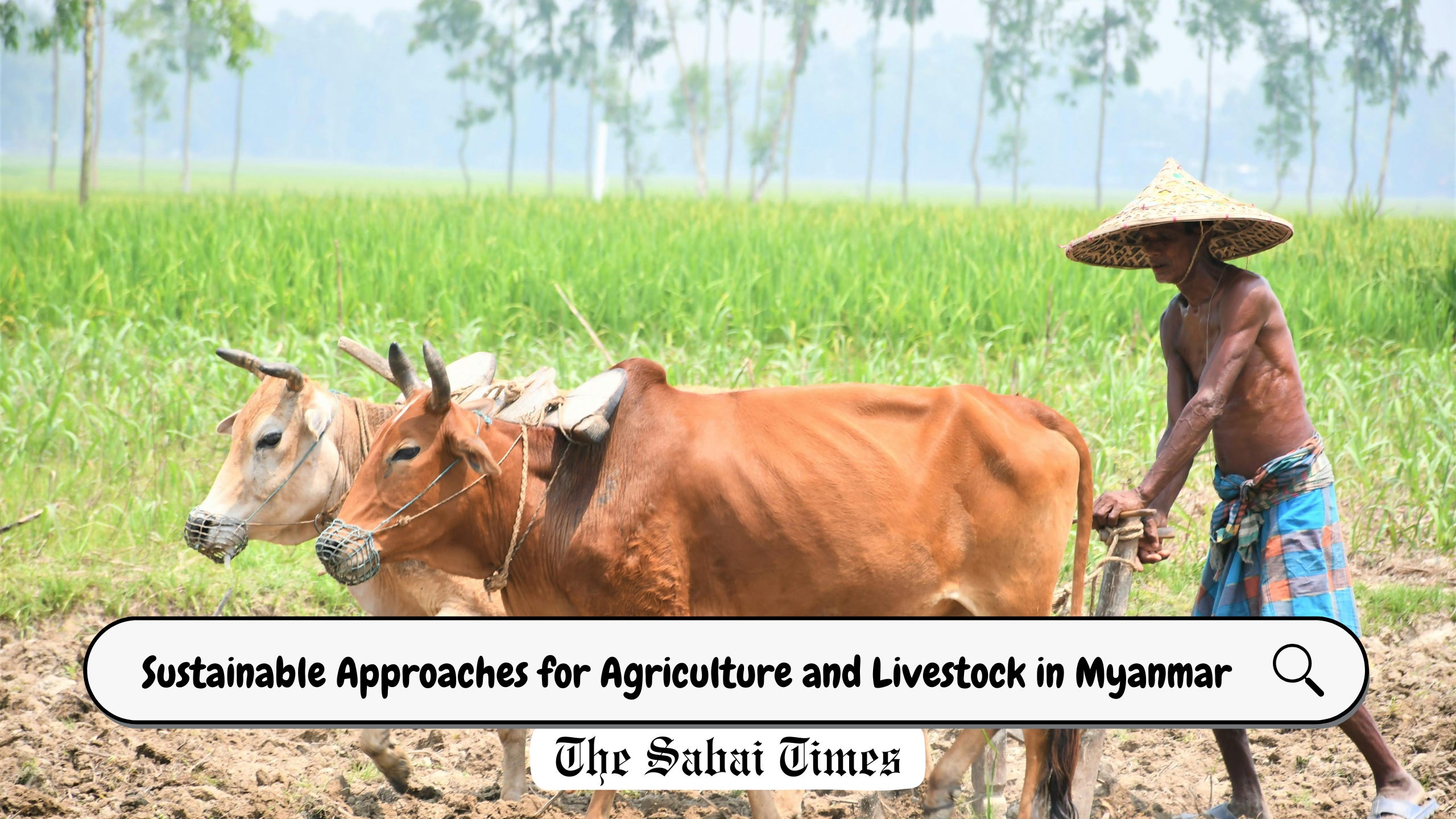
Myanmar, particularly more than half of the population dependent on the livestock and agriculture sector, is now struggling with the prolonged polycrisis: the impact of the COVID-19 pandemic, ongoing political conflict, severe economic downturn, severe human rights violations, and environmental degradation.
Key Takeaways:
The lack of technical and financial assistance from the government is a major challenge for rural livestock and agricultural farmers.
Circular feeding could be a significant agrarian change in the husbandry sector and help to improve sustainable development.
The ongoing civil war continues to hinder agricultural sector development, limiting market access and livelihood opportunities.
Already developed agricultural countries depend largely on machines and technology. However, least-developing and fragile countries like Myanmar rely heavily on conventional agriculture and traditional animal husbandry. According to the data from 2021, waste and by-products from the agriculture sectors around the world contribute approximately 11.7% of global greenhouse gas emissions. Since agriculture, including livestock farming, is the second largest source of GHG emissions worldwide, it is crucial to promote sustainable livestock farming practices that support long-term environmental sustainability and development.
Furthermore, agricultural practices in Myanmar are a major driver of climate change. An estimated 83 to 90% of the country’s total greenhouse gas emissions come from the agriculture, forestry, and other land use (AFOLU) sector. That is significantly higher than the global average, where AFOLU contributes roughly one-quarter of total emissions.
The Impact of Varieties of Disasters on Farmers in Myanmar
Climate change is one of the challenges in achieving Sustainable Development Goals (SDGs) across the globe. Even small changes in temperature, as well as extreme weather conditions, have severe impacts on crop growth and the yields. In addition, resilient crop varieties and sustainable farming practices are one of the adaptation strategies for farmers to cope with climate change.
In Myanmar, disasters driven by climate change, such as floods, storms and earthquakes, have already affected crop and livestock production severely. In addition, the consequences of the 2021 military coup caused socio-economic disaster, especially in disadvantaged rural areas. Many villages were displaced, leading to the loss of farmland and the unsustainable expansion of new farmland in another area. At the same time, farmers are experiencing biological threats such as Apple snail infestations, which have destroyed several acres of paddy fields. In some cases, farmers are unable to re-cultivate paddy after the fields have been damaged. Moreover, pesticides are often ineffective, as the snails have adapted and developed resistance to commonly used chemicals.
On top of that, during the ongoing civil war, farmers have no access to receive any technical assistance from the government in a politically unstable country like Myanmar. And internationally funded projects can only be found in relatively stable regions. However, most of these projects prioritise humanitarian aid and disaster response rather than long-term sustainable livelihood development. Following the recent Mandalay earthquake in March 2025, even the livelihood-focused organisations such as LIFT also shifted their attention to post-earthquake relief efforts. Additionally, many project areas now overlap because NGOs are unable to reach conflict-affected regions due to restrictions from the Myanmar military government.
Current Agricultural and Livestock Farming Practice
Most farmers in Myanmar continue to rely on traditional (conventional) agricultural methods and outdated post-harvest technologies. Livestock production is also extensive and traditional, with nearly all rural households raising animals, particularly poultry and swine, for home consumption or supplementary income. Practices such as burning crop residues, overusing chemical fertilisers, disposing of animal manure improperly, and over-relying on commercial feed contribute significantly to environmental degradation. Waste and by-products from farms release methane, ammonia and nitrous oxide, all potent greenhouse gases which intensify climate change and global warming.
More than 60% of Myanmar’s labour force is employed in the agriculture and livestock sectors. Livestock farmers heavily rely on commercial feed, which is often expensive. Farmers prepare their feed with no knowledge of the quality of feed formulation and nutritional value. They particularly use carbohydrate-rich broken rice, rice bran, paddy seeds and groundnut cake.
Additionally, feeding costs have become a major challenge for farmers due to severe inflation. As of March 2025, Myanmar’s inflation rate has reached 28.67%, a significant increase from 0.75% in December 2020, two months before the military coup. From then on, the country’s socio-economic situation has further deteriorated since the 2021 military coup. During this period, the prices of livestock feed, chemical fertilisers, and other essential farm inputs have skyrocketed, causing a financial burden on farmers. In contrast, the farm-gate prices of paddy have not increased properly, resulting in leaving farmers with very low profits. Hence, farmers depend more on livestock farming for supplementary income. However, many smallholders struggle to afford commercial feed, ultimately threatening both their livelihoods and the long-term sustainability of the husbandry sector. This widening gap between production costs and income threatens farmers’ livelihoods and undermines the long-term sustainability and resilience of Myanmar’s agriculture and livestock sectors.
On top of that, nearly 300 agricultural students graduate annually from Yezin Agricultural University, making the imbalance ratio of agricultural professionals to the 7 million farmers. It further hinders the development of the agricultural sector.
Feasible Solutions for Agrarian Change
Since approximately 70% of the population in Myanmar resides in rural areas, livelihoods heavily depend on livestock and agriculture. These subsectors provide both income opportunities and access to nutrient-rich food. However, they also contribute to resource depletion, overuse of biomass, and over-rely on commercial feed, chemical fertilisers, and pesticides, resulting in greenhouse gas emissions and environmental degradation.
There are many potential solutions for sustainability in livestock farming, but one of the most effective approaches is circular feeding practice. Circular feeding not only reduces feeding costs but also contributes to SDG 2 (Zero Hunger), SDG 8 (Economic Growth), SDG 12 (Sustainable Consumption and Production), and SDG 13 (Climate Action). Commercial feed can be partially replaced with high-protein, farm-made alternatives, such as banana or hyacinth silage, fodder plants like duckweed, azolla and wolffia, and protein-rich insects like mealworm and BSF larvae. Additionally, by-products from livestock farming, such as animal manure, can be composted, used to produce biogas, or fed to Black Soldier Fly (BSF) larvae as protein conversion. To implement this effectively, farmers need both financial assistance and technical assistance.
The main nutrients required for poultry and swine are protein, minerals, vitamins, and carbohydrates. High protein can be obtained from insects and from fodder plants such as azolla, duckweed, and Wolffia, which also provide minerals. Banana and water hyacinth silage supply not only protein but also fibre, while carbohydrates can be sourced from farm by-products such as rice bran, broken rice, and maize bran.
Black Soldier Fly (BSF) larvae are highly protein-rich insects, containing 30–35% crude protein. Fodder plants such as azolla and Wolffia provide at least 20% protein and 20-30% of other minerals and vitamins. The advantage of it is that it can be cultivated in small spaces, even in the household farmyard. In addition, water hyacinth and banana silage, very easy to find in our surroundings and simple to process, have a higher crude protein content and fibre content than the fresh. During fermentation, water and carbohydrates decrease, concentration of the crude protein and fibre increases.
In addition, feed, in the livestock sector, accounts for around 83 % of total energy consumption through raw material sourcing, feed production, packaging and transport. By reducing reliance on commercial feed and replacing it with circular feed, farmers can lower greenhouse gas emissions from production and transport, reduce farm waste, and improve the feed conversion ratio (FCR) and increase income, ultimately enhancing both environmental sustainability and farm efficiency.
Another feasible and sustainable approach for both livestock and agriculture is the practice of polycultural agriculture, such as rice-duck farming and rice-fish farming, which are suitable for Myanmar’s agro-climatic context. Both farming systems are environmentally friendly as they reduce the need for chemical fertilisers and pesticides, thereby improving natural pest control, enhancing overall productivity and providing farmers with an additional source of income. Additional benefits include enhanced food security for smallholder households during the crisis and, over the long term, a reduction in methane emissions. Therefore, these farming methods in lowland rice production are recommended as an effective climate adaptation and mitigation strategy and supporting economic resilience.
Conclusion
To conclude, the lack of agricultural and livestock technicians is also a significant challenge in Myanmar. Ongoing civil conflicts have further hindered the development of sustainable agricultural practices, as foreign-funded NGO projects often cannot reach the least developed and conflict-affected areas. Promoting sustainable changes in animal husbandry, such as circular feeding, offers a viable solution to reduce environmental degradation while enhancing economic resilience. By adopting these practices, farmers can achieve a balance between environmental responsibility and economic stability, strengthening their capacity to withstand socio-economic shocks during periods of crisis.
Hnin Eaindra Khine is a Junior Research Fellow at the Sustainability Lab of the Shwetaungthagathu Reform Initiative Centre (SRIc). She is also currently interning at RecyGlo Myanmar, where she supports various environmental sustainability projects.
“Advocating Sustainability, Shaping Our Future”
Help Sustain The Sabai Times - Myanmar’s Voice for Sustainable Development Support The Sabai Times