

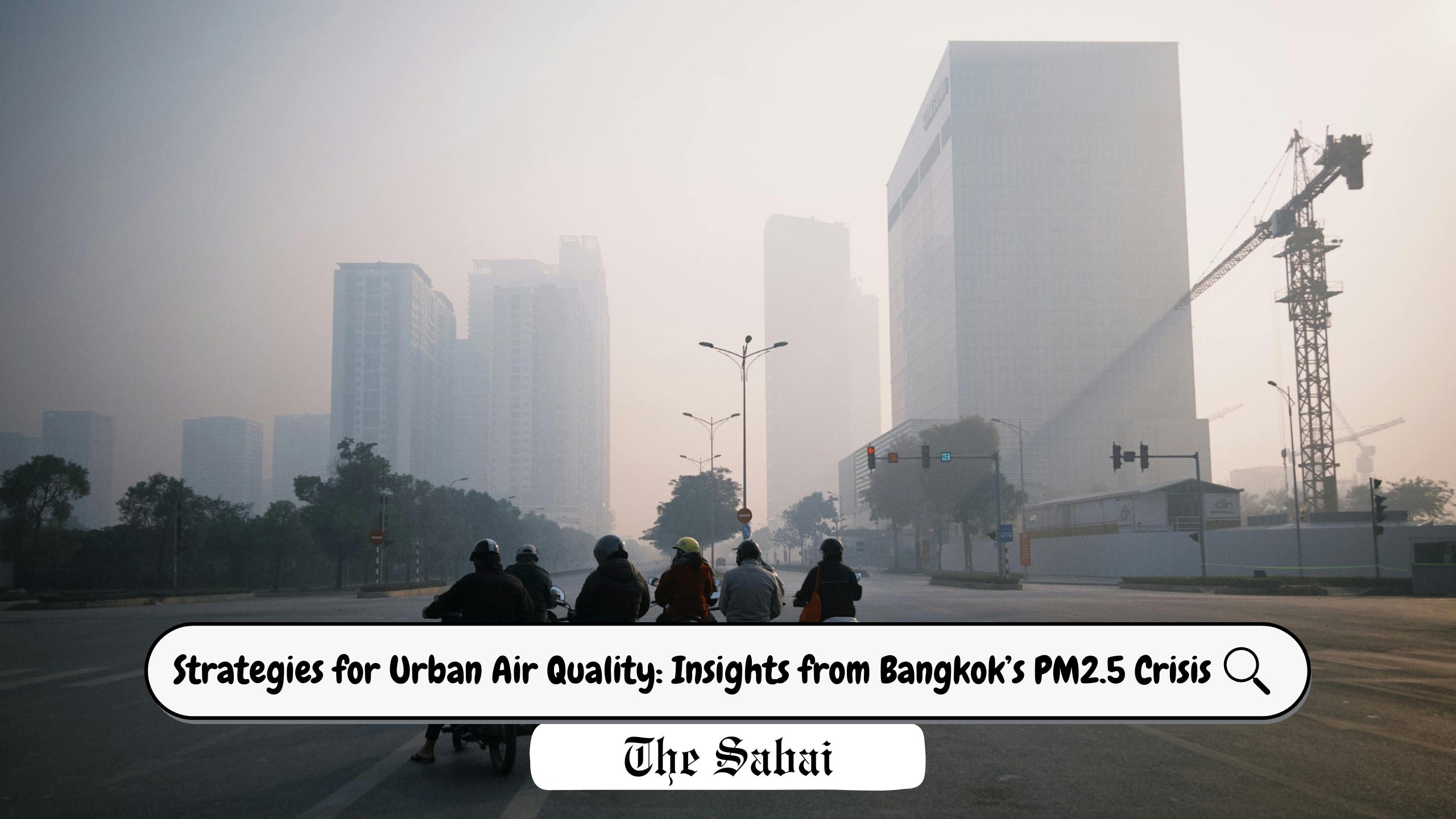
This article explores Bangkok’s PM2.5 crisis, emphasising sustainable policies, clean transport, and community action to protect public health and urban resilience.
Background
The worldwide increase in urbanisation and industrial activity has made air pollution a major sustainability problem, endangering both environmental health and human health. The danger of PM2.5 arises because its tiny particles can penetrate deep into the lungs and bloodstream, causing severe respiratory and cardiovascular diseases. Bangkok illustrates this problem through its ongoing violation of international PM2.5 safety limits due to rising vehicle traffic, industrial activity, and rapid urban growth. The high pollution levels in the city threaten human health while damaging its long-term sustainability. Sustainable urban development depends on PM2.5 pollution control through unified policy efforts, technological advancements, and public participation. The city of Bangkok can build a sustainable future with improved health and environmental quality by successfully reducing PM2.5 pollution.
Why Air Quality Matters
A sustainable city needs to maintain clean air because it serves as the base for residents to live, work and breathe safely. The health of public populations depends on clean air, while urban communities need it to build sustainable economic and social systems. The presence of poor air pollution reveals multiple problems in transportation systems, urban planning and environmental justice systems, which create disproportionate harm to vulnerable communities. The protection of air quality enables sustainable cities to reach their climate action targets through the promotion of clean transportation systems and efficient urban development. The protection of clean air serves as a sustainability duty because it guarantees future generations will receive a habitable world instead of dealing with rising health expenses and environmental deterioration from present-day pollution.
Analysis of Current Approaches
Bangkok demonstrates recognition of air pollution problems through its management efforts, yet these initiatives have not produced substantial decreases in PM2.5 concentrations. The main source of Bangkok's pollution stems from vehicle emissions, which generate 60% of the total pollution. The city has established Euro V/VI engine upgrade programs and expanded emission checkpoint networks and low-emission zones, but these initiatives have not produced substantial results. The process of implementing higher emission standards has encountered multiple delays because of insufficient personnel, excessive vehicle numbers, and non-compliant drivers. The majority of polluting vehicles operate without facing any enforcement actions.
The construction and industrial sectors have established rules to manage dust and emissions, but their monitoring systems are unreliable, and new environmentally friendly technologies have not gained widespread acceptance. The combination of construction activities and factory operations produces major PM2.5 pollution events throughout the year, but these events become more severe during dry months because of reduced atmospheric dispersion.
The city of Bangkok works to establish permanent solutions through its electric vehicle promotion program and public transportation system improvements. The current lack of sufficient charging stations and insufficient mass transit coverage in various city areas hinders electric vehicle adoption. The growing public interest in sustainable transportation faces a major obstacle because people lack access to practical alternative transportation options.
The success of Bangkok's air quality policies depends on better enforcement, more defined rules, additional infrastructure funding, and public participation instead of depending on regulations alone.
Solutions
The solution to Bangkok's air quality problems needs transportation solutions, urban planning solutions, and community participation to achieve lasting improvements. The city needs to transform its transportation system because this approach will deliver the most significant results. The combination of financial benefits with defined rules and a complete electric vehicle charging system will help Bangkok residents switch from fossil fuel-based transportation to electric vehicles. The public transportation system needs enhancement through better connectivity for underserved areas and the adoption of electric buses and motorcycles to reduce private vehicle usage. The combination of safer cycling lanes with pedestrian-friendly infrastructure will promote low-emission travel while improving public health.
Sustainable urban planning stands as an essential factor for success. The implementation of expanded low-emission zones together with enhanced pollution controls in areas with high air pollution levels will help control the movement of vehicles that produce significant emissions. The implementation of stronger buffer zones between industrial facilities and residential areas protects residential areas from particulate pollution exposure. The implementation of these measures throughout Bangkok's urban development plan will maintain air quality protection as a fundamental element of the city's growth path.
Conclusion
The success of long-term sustainability depends on active involvement from both the public and essential stakeholders. The combination of environmental NGO partnerships with health impact education and awareness programs will help people understand the benefits of using cleaner transportation methods. The combination of vehicle scrapping rebates and technology adoption subsidies for households and businesses creates positive behavioural change. The combination of these coordinated efforts will enhance Bangkok's ability to create a sustainable urban space that promotes environmental health and community wellness.
This article is based on my public policy and planning analysis titled ‘Better Policies, Cleaner Air: Strengthening Bangkok Metropolitan Area’s Pollution Control’ (2025).
Dr Jeslyn is a Junior Research Fellow at the Sustainability Lab of the Shwetaungthagathu Reform Initiative Centre (SRIc). She holds a Master of Public Health and has experience in research analysis, remote healthcare services, and community outreach programs.
“Advocating Sustainability, Shaping Our Future”
Help Sustain The Sabai - Myanmar’s Voice for Sustainability Support The Sabai