


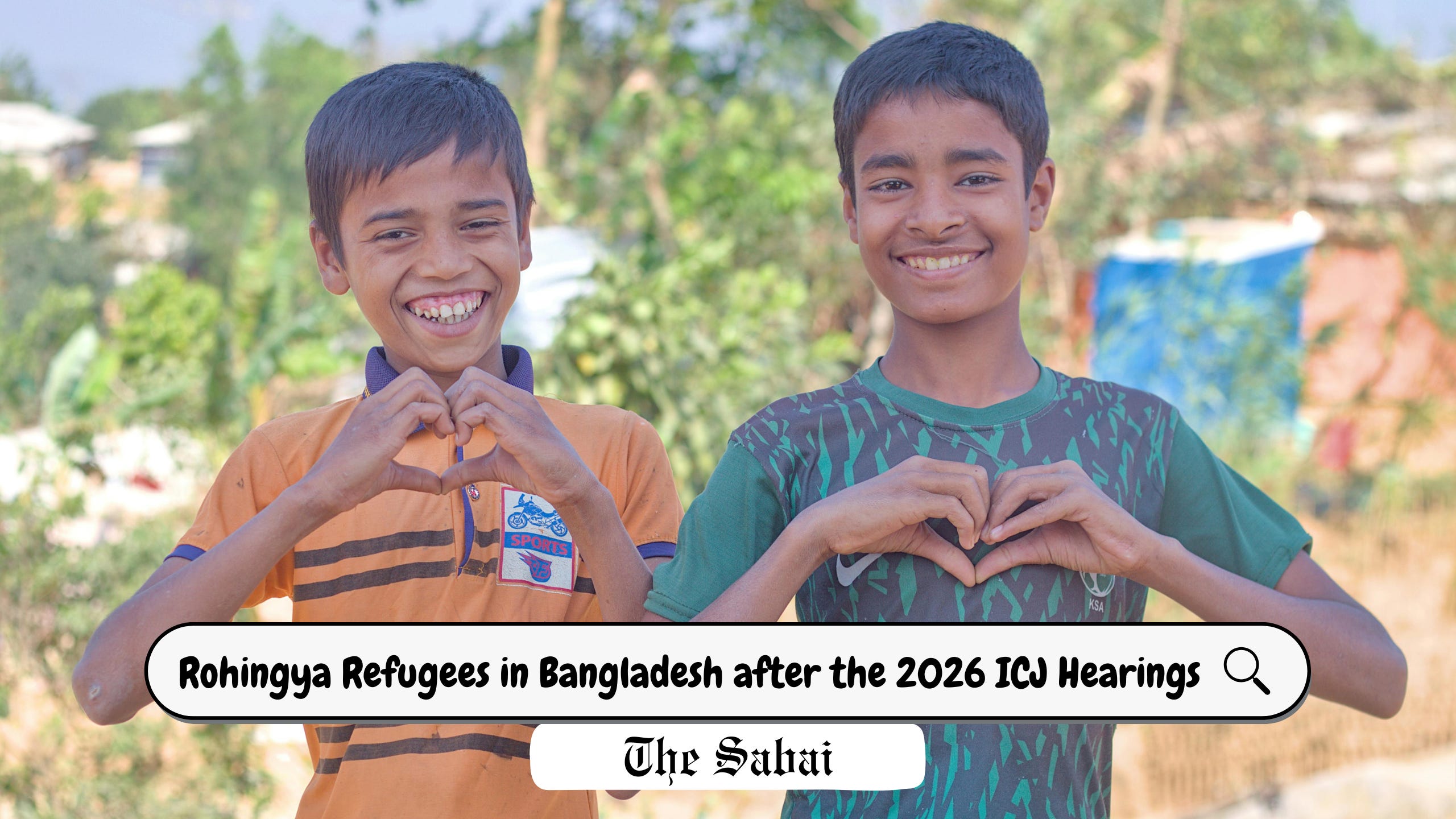
Around one million Rohingya refugees have been living in Bangladesh’s Cox’s Bazar district since the large-scale persecution by Myanmar’s armed forces in Rakhine State in 2017. However, the camps are facing significant reductions in international humanitarian aid, increasing Bangladesh’s burden to sustain the livelihoods and security of the refugee population. This article examines the policy challenges surrounding Rohingya repatriation and explores options for the long-term and sustainable management of the refugee camps.
Key Takeaways
The 2026 hearings at the International Court of Justice increase international accountability for the persecution of the Rohingya. Still, they do not address the current long-term humanitarian conditions faced by Rohingya refugees living in camps in Cox’s Bazar.
Rohingya refugee camps are experiencing significant reductions in international humanitarian aid, creating growing challenges for both the refugees and the host country, Bangladesh.
Bangladesh continues to advocate for the repatriation of Rohingya refugees to Rakhine State, but any sustainable solution will require strong international coordination and guarantees of safety and rights for returnees.
The Rohingya: the background
The Rohingya are a Muslim ethnic minority who are primarily located in the Rakhine State (formerly Arakan State) in western Myanmar, particularly in the northern townships bordering Bangladesh. Despite their long presence in the country, they have been denied citizenship under Myanmar’s 1982 Citizenship Law, which excludes them from the list of officially recognised ethnic groups. As a result, the Rohingya have been rendered effectively stateless and have faced decades of discrimination, restrictions on movement, and periodic violence by the Tatmadaw, the armed forces.
Most Rohingya lived in Rakhine State, a coastal region bordering Bangladesh and the Bay of Bengal. The situation escalated dramatically in August 2017 when the Myanmar military launched large-scale “clearance operations.” These operations resulted in mass killings, sexual violence, and the destruction of villages. Estimates suggest that at least 6,700 people were killed in the first month alone, while more than 730,000 Rohingya fled to Bangladesh.
According to the United Nations, the Rohingya are widely described as the “most persecuted minority in the world.” Today, the Cox’s Bazar region hosts the largest refugee settlement globally, with more than one million Rohingya living in camps. Meanwhile, approximately 600,000 Rohingya remain in Rakhine State, where they continue to face severe restrictions on movement, access to healthcare, and economic opportunities.
Refugees in Bangladesh also experience significant challenges, including restrictions on employment, limited access to education, growing security concerns, and increasing exposure to climate-related disasters. As international humanitarian funding declines partly due to shifting global priorities and evolving donor policies, particularly under the second administration of Donald Trump, which has emphasised reduced foreign aid commitments and an “America First” approach, Bangladesh faces mounting pressure regarding the long-term hosting of Rohingya refugees. Consequently, a key policy debate has emerged: whether Bangladesh should pursue the repatriation of Rohingya refugees to Myanmar or continue hosting them while seeking alternative, durable solutions.
International Legal Context: The ICJ Case
The year 2026 marked an important moment for the Rohingya community as proceedings continued before the International Court of Justice in The Hague. The case, The Gambia v. Myanmar, concerns alleged violations of the Convention on the Prevention and Punishment of the Crime of Genocide.
The case was filed by The Gambia, which argues that Myanmar committed acts of genocide against the Rohingya population during the military operations of 2016 and 2017. During hearings, Gambian representatives presented witness testimony describing widespread violence, including killings, sexual assault, and the burning of villages.
Myanmar, however, rejects these allegations. Its representatives argue that the military operations were legitimate counter-terrorism measures carried out in response to attacks by armed groups in northern Rakhine State. Myanmar also disputes the reliability of evidence presented by international investigators and maintains that questions related to citizenship and identity are unrelated to genocide claims.
The NUG claims to represent the democratic will of the Myanmar people and has distanced itself from the military’s policies toward the Rohingya. It generally supports accountability for crimes committed during the military operations. It has expressed concern that allowing the junta to represent Myanmar in international courts could undermine the principles of the United Nations and the rule of law.
Domestic attitudes toward the Rohingya in Myanmar
Another complication in the case concerns who legitimately represents Myanmar before international institutions. Following the 2021 Myanmar military coup, a parallel government known as the National Unity Government (NUG) was formed by elected lawmakers and activists.
Domestic public opinion in Myanmar has also played a significant role in shaping attitudes toward the Rohingya and the genocide case. Among many within the Buddhist majority, perceptions of the Rohingya are strongly influenced by religious nationalism and Islamophobia. These concerns have been amplified by nationalist movements such as the 969 Movement and organisations like Ma Ba Tha.
In addition, the Rohingya are widely portrayed as illegal immigrants from Bangladesh, often referred to as “Bengalis,” rather than as an indigenous ethnic group. Influential monks, including Ashin Wirathu, have helped spread anti-Muslim narratives through sermons and social media campaigns. These narratives have contributed to the denial or justification of violence against the Rohingya, with military operations often framed domestically as necessary counter-terrorism measures.
Camps in Bangladesh: humanitarian, environmental, and security concerns
Despite increasing international legal attention to the Rohingya crisis, legal proceedings do little to address the immediate humanitarian conditions faced by refugees in Bangladesh. The camps in Cox’s Bazar remain extremely overcrowded and are highly dependent on international humanitarian aid.
Refugees face severe restrictions on employment and education, while access to healthcare and formal schooling remains limited. At the same time, Bangladesh faces growing financial and security pressures related to the long-term hosting of such a large displaced population.
Environmental risks further complicate the situation. Both Bangladesh and Myanmar rank among the countries most vulnerable to extreme weather events. Cox’s Bazar is particularly prone to cyclones, floods, and landslides. The Cyclone Mocha damaged thousands of shelters and affected millions of people across the region.
Another relocation site, Bhasan Char, currently hosts around 32,574 Rohingya refugees but lies only about two meters above sea level, making it highly vulnerable to storm surges and sea-level rise.
These environmental risks contribute to secondary displacement and have pushed some Rohingya to undertake dangerous maritime journeys. In 2023 alone, around 4,500 Rohingya attempted irregular sea crossings, with more than 569 reported missing or dead. According to UNHCR, the number of Rohingya fleeing by boat increased to 9,195 in 2024, which is more than double the number recorded the previous year.
In addition to humanitarian and environmental challenges, the prolonged presence of a large refugee population has generated growing security concerns both for the refugees and for Bangladesh. The camps in Cox’s Bazar creatе conditions that increase vulnerability to crime, trafficking, and the activities of armed groups. One group that has drawn particular attention is the Arakan Rohingya Salvation Army (ARSA), an armed organisation that originally emerged in Rakhine State. Although the majority of Rohingya refugees are civilians with no involvement in militant activities, the presence of armed factions and criminal groups has contributed to instability within the camps and raised national security concerns, urging Bangladesh to start the repatriation.
Bangladesh’s leadership has increasingly framed the protracted refugee situation as a long-term security and governance challenge. During discussions with the United Nations High Commissioner for Refugees (UNHCR), Bangladesh’s interim Chief Adviser Muhammad Yunus reiterated the government’s position that “the repatriation of Rohingya refugees to Myanmar remains the only sustainable solution to the crisis.” Bangladesh is not a signatory to the 1951 Refugee Convention and its 1967 Protocol, which means that it is not legally bound by the international framework that defines refugee rights and state obligations, thus hosting the Rohingya primarily on humanitarian grounds.
Implications and Recommendations
Prioritise safe and voluntary repatriation with international guarantees.
Bangladesh should continue advocating for safe, voluntary, and dignified repatriation of Rohingya refugees back to Myanmar. However, the repatriation should occur only under internationally monitored conditions, guaranteeing security, citizenship rights, and freedom of movement or a safe zone for refugees.
Increase international responsibility sharing
The Rohingya crisis should not be solely Bangladesh’s burden. Donor states and international organisations must increase financial humanitarian contributions to Cox Bazar’s camps and support long-term assistance programs that target disaster risk prevention and access to livelihood opportunities.
Strengthen security governance in camps
Bangladesh should strengthen security governance in camps to address criminal networks, human trafficking, and armed group activity. However, security policies should not go against the human rights of refugees.
Reassess engagement with Myanmar’s evolving political landscape
Recent political developments in Myanmar, including a military-organised election led by Min Aung Hlaing following the 2021 Myanmar coup, may signal a shift from direct military rule to a nominally civilian government. While this transition could be presented internationally as a step toward legitimacy, in practice, the leadership and power structures are likely to remain unchanged, particularly regarding Rohingya rights.
Bangladesh and the international community should therefore approach engagement cautiously, ensuring that any negotiations or repatriation initiatives are based on verifiable improvements on the ground rather than formal political changes alone.
Sevil Khikmatova is a Junior Research Fellow at the Sustainability Lab of the Shwetaungthagathu Reform Initiative Centre (SRIc). She is also a Junior Research Fellow at the Institute for Security & Development Policy (ISDP) and a Policy Analyst at STEAR with a focus on climate governance and geopolitics in the Indo-Pacific region.
Khant Eaint Hmoo is a Research Assistant at the Sustainability Lab of the Shwetaungthagathu Reform Initiative Centre (SRIc) and a Bachelor of Economics (Hons) student from Albukhary International University, Malaysia.
“Advocating Sustainability, Shaping Our Future”
Help Sustain The Sabai - Myanmar’s Voice for Sustainability. Support The Sabai