


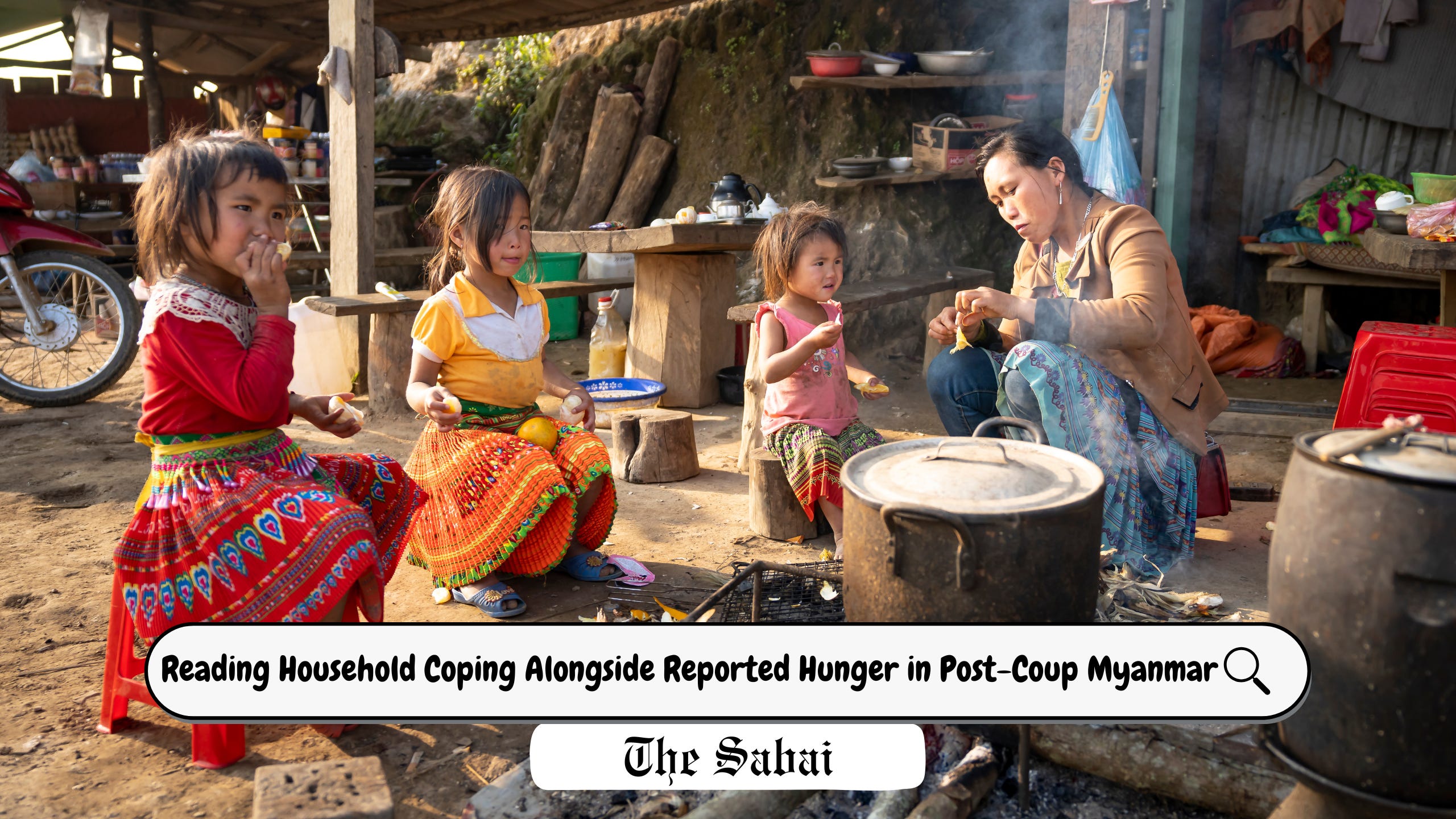
Hunger figures are an important measure of food insecurity, while household coping strategies can reveal the trade-offs families have to make to maintain consumption.
Key Takeaways
Food insecurity indicators and what they might miss. A household that is above the severe hunger threshold in a single food security indicator can still struggle to afford a varied diet, cover daily expenses, or maintain its standard of living.
Households cope under constraints in different ways, with different consequences. Some buy cheaper food or borrow from relatives. Others reduce meals, cut health spending or sell assets. These choices may help families get through a difficult period, but some can make life harder in the longer term.
Using hunger and coping figures together could give a fuller picture of household vulnerability. Myanmar’s household panel survey data record both experiences. Comparing them within the same households could help researchers and policymakers better understand the pressures families face.
1. Household Hunger measured in Myanmar
Since the February 2021 military coup, conflict, displacement, falling household incomes, and rising living costs have made it harder for many families to meet their basic needs. Research by the United Nations Development Programme (UNDP) documents the deterioration in household welfare, including deepening poverty and cuts in non-food spending. The International Food Policy Research Institute (IFPRI) has also recorded food security through the Myanmar Household Welfare Survey (MHWS).
One measure used in the survey is the Household Hunger Scale (HHS). The HHS was developed and validated for use in different cultures by the Food and Nutrition Technical Assistance (FANTA) project. It asks whether anyone in the household had no food to eat, went to bed hungry, or went a whole day and night without eating because there was not enough food. These questions record.
In MHWS, the share of surveyed households reporting moderate to severe hunger in HHS was about 4%, around 4% in late 2022, 3.5% in late 2023 and 3.0% in late 2024. It rose to nearly 3.5% between July and October 2025.
These figures help track reported hunger over time. But they don’t show if families choose cheaper food or borrowed money for meals or cut other necessary expenses to make ends meet. A household’s hunger score may stay low even as its finances become more precarious, because the HHS was not designed to capture every adjustment a household makes when money runs short.
IFPRI has noted that its phone survey struggles to reach households in the hardest-hit conflict areas and that displaced people are underrepresented. Consequently, the figures reported may not fully reflect the experiences of the most vulnerable households
2. Household coping strategies measured in Myanmar
The MHWS also asks households how they respond when resources are insufficient. In the first survey round, conducted between December 2021 and February 2022, around 90% reported moderate to severe hunger in the previous month, while about 4% reported moderate to severe hunger. More than half had reduced both food and non-food spending.
Later in the year, this pattern continued. In October-December 2022,84% and approximately 4% reported experiencing moderate to severe hunger. The survey also recorded households that had already exhausted particular coping options.
The gap between these figures raises a question: what were households doing to manage when they did not report moderate or severe hunger?
Later findings offer some insights. Between July and October 2025, 28.2% on cheaper or less preferred foods, while 10.7% borrowed food or depended on friends and relatives. Financial buffers were also limited. In late 2024, only 20% , and 64% of loans came from informal sources, such as friends and relatives.
These responses differ in their consequences. Buying cheaper food may help a family continue eating when prices rise, but it can also mean a less varied diet. Borrowing may cover immediate expenses, although the money must eventually be repaid. Cutting health spending can free up cash for food today but make treatment harder to afford later. Selling productive assets can bring in money quickly while reducing a household’s ability to earn an income in the future.
3. Why the two measures can work together
Research on food insecurity has long recognised that hunger is only one part of the experience. Comparing 22 food insecurity scales from 15 countries, Coates and colleagues found that people also experienced food insecurity through worrying about food, eating less varied diets and not having enough to eat. Hunger was one possible outcome, but not the whole experience. The authors also noted that food insecurity in developing countries was often measured mainly by the amount of food people had. This means hunger figures alone may miss the compromises families make, such as buying cheaper food, before they actually go hungry.
Coping data can reveal pressures that hunger figures may miss. A family might keep food on the table by putting off a doctor’s visit. It may not be counted as hunger, but it is still making difficult choices to get by. However, coping strategies need to be understood in context. Renzaho and Mellor explain that the same behaviour can mean different things in different social and cultural settings. Borrowing rice from relatives may be a normal way of helping each other, while repeatedly cutting meals or selling land or livestock to afford food can point to much greater hardship.
High rates of coping do not necessarily mean high rates of hunger, and some methods of coping are more costly than others. Hunger and coping measures tell us different things, so looking at them together can give us a clearer picture of what households are going through.
4. The combination of Hunger and Coping
Hunger indicators continue to be important but may not capture all the pressures that households are experiencing. The Myanmar Household Welfare Survey (MHWS) already collects information on both hunger and coping strategies, offering an opportunity to build a fuller picture of food-related hardship.
For example, researchers could examine whether households reporting little or no hunger are also buying cheaper food, reducing food consumption, borrowing to cover daily expenses, or cutting non-food spending. They could compare these patterns across HHS categories and survey rounds to see which coping strategies are more common among households reporting hunger.
Implication and Recommendations
Examine hunger and coping within the same households.
National percentages cannot show whether households reporting little or no hunger are still buying cheaper food, reducing meals, or borrowing to cover daily needs. Comparing these responses at the household level could reveal where the two measures overlap and where they tell different stories.
Distinguish between different coping strategies.
Not all ways to cope are created equal. A temporary response may be to eat less expensive food. However, repeated cutbacks in food, cuts in health spending or the sale of productive assets would have more serious consequences. Reporting these behaviours separately could help readers better understand the pressures households face.
Consider who the survey may miss.
Phone surveys may not equally well reach displaced persons and households in hard-to-reach areas. Acknowledging these limitations and drawing on other available evidence could provide a more balanced understanding.
These approaches do not require treating every coping behaviour as a sign of crisis. Rather, they recognise that households can experience financial strain and make difficult compromises before their circumstances show up as severe hunger. Bringing the measures together could help researchers, policymakers and humanitarian organisations better understand these pressures and identify questions that deserve closer attention.
Aye Aye Phyo is a Junior Research Fellow at the Shwetaungthagathu Reform Initiative Centre (SRIc) and a Master of Arts in Economics student at the Faculty of Economics, Thammasat University, Thailand.
“Advocating Sustainability, Shaping Our Future”
Help Sustain The Sabai - Myanmar’s Voice for Sustainability. Support The Sabai