


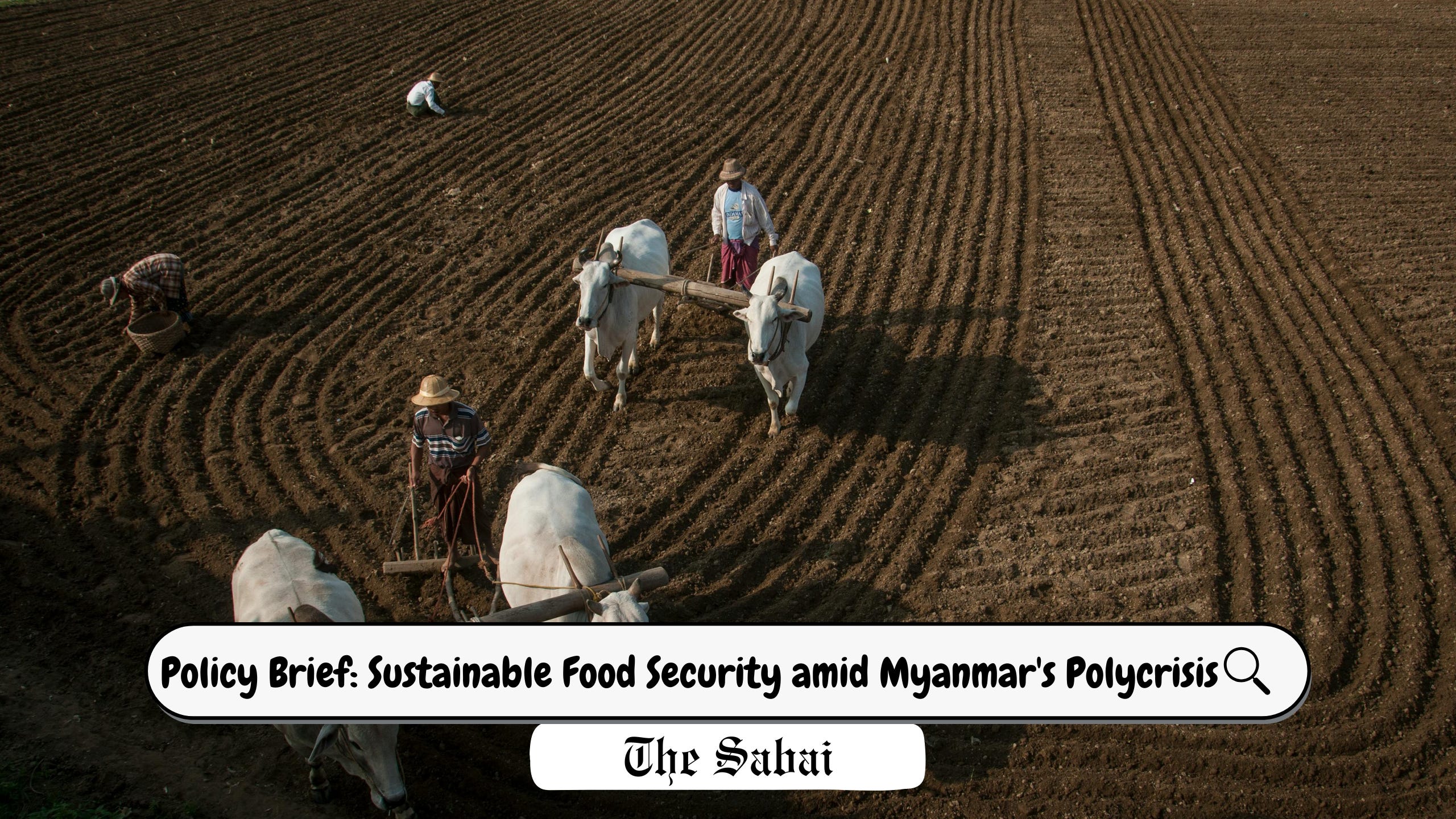
Myanmar’s food security crisis is deepening amid political instability, climate shocks, and rising food prices, but what can be done to build a more resilient and sustainable food system?
Key Takeaways:
•Food security is the cornerstone of sustainability, ensuring all people have consistent physical and economic access to safe, nutritious food without depleting the natural resources that future generations will need.
•Myanmar is experiencing one of the world’s most alarming hunger crises, driven by the combined effects of multiple crises.
•This briefing sheds light on the ongoing food security crisis in Myanmar.
•We provide 5 recommendations to improve food security during the ongoing Polycrisis in Myanmar.
Introduction
Since the 1st of February 2021, Myanmar has been experiencing multiple crises following the military (Tatmadaw) coup that ousted the democratically elected government. Myanmar’s population faces growing risks from this polycrisis characterised by overlapping political, economic, and environmental shocks, such as the devastating earthquake that struck in March 2025. These shocks are disrupting agri-food supply chains, reducing access to food, and deepening food insecurity across the country. Addressing this food security crises and strengthening the resilience of the nation’s food systems are urgent to improve livelihoods. This briefing is the outcome of desk-based research. It examines the food security situation in Myanmar in the middle of this multi-year polycrisis.
Key Findings/Argument
Based on desk research, our findings show that:
• According to Myanmar’s 2026 Humanitarian Needs and Response Plan, an estimated 16.2 million people require humanitarian assistance, with food assistance identified as one of the most urgent needs1.
• According to the United Nations Hunger Hotspots 2025 report, Myanmar was identified as a hotspot of very great concern, with millions of people at risk of acute food insecurity2.
• Most recent available data for 2026 showed that Myanmar was reclassified as a hotspot3. Although the country has been reclassified from a hotspot of “very high concern” to a “hotspot,” food insecurity remains a critical issue.
• An estimated 12.4 million people (equivalent to nearly 23% of Myanmar’s population) are experiencing moderate to severe food insecurity.
• Across all 14 states of Myanmar, households identify access to cash as their most pressing need, particularly in Chin, Kayah, Magway, and Sagaing. Food ranks as the second most important priority4, highlighting the close relationship between financial hardship constraints and food insecurity.
• Poverty in Myanmar has risen dramatically, increasing from 24.8% in 2017 to 49.7% in 2023. This has erased years of progress in poverty reduction and left nearly half of the population living in poverty5. This deterioration has weakened economic access to food, as declining household income and rising food prices make it increasingly difficult for households to secure adequate and nutritious diets.
• Climate change continues to intensify existing vulnerabilities and are expected to adversely affect agricultural production during the 2026 cropping season. Persistent rainfall variability and extreme weather events, including floods and droughts, remain significant threats to agricultural productivity and food security 3.
• Flood risks are increasing across several key agricultural areas, including the Ayeyarwady Delta, Bago Region, the Sittaung River Basin, and Yangon. The Department of Fisheries has urged fish farmers to take precautionary measures to protect ponds from flooding and minimise potential losses in fish stocks6.
• Driven in part by the Middle East crisis, staple food prices have increased by an average of 18%, reducing the purchasing power of families. Price increases have been particularly severe in Magway Region (38%), Kayin State (32%), and Rakhine State (31%), exacerbating food insecurity in these areas7.
• Myanmar’s economy is agriculture-based, with the farming sector providing income for around 70% of the rural population. Because most vulnerable households depend on crops, livestock, fisheries, and forest resources for their livelihoods8, strengthening the resilience of these sectors is essential for improving food security and reducing vulnerability to future shocks.
• Disruptions to trade through the Strait of Hormuz have contributed to sharp increases in fuel and agricultural fertiliser prices, with urea prices rising from 94,000 MMK per bag during the previous monsoon season to 140,000 MMK in June 2026 (an increase of almost 49%), after peaking at 157,000 MMK in May 2026, nearly 67% higher than the previous year’s price.
• Rising fuel prices have further increased production and transportation costs across the agri-food sector. As Myanmar’s agricultural system relies heavily on fuel for irrigation, mechanisation, transport, and processing, these increasing fuel prices are placing considerable strain on farmers.
• Reports indicate that some producers are already reducing cultivated areas and limiting land preparation activities to manage expenses. Fertiliser costs have risen rapidly, reducing the profitability of fertiliser use and likely leading to lower application rates3. If these trends persist, agricultural output may decline, causing significant consequences for food availability, rural livelihoods, and food security nationwide.
Policy implications and/or recommendations
• Strengthening social protection programmes, including cash-based assistance (e.g., maternal and child cash transfers), serves as a critical buffer against food insecurity by helping vulnerable households maintain purchasing power to meet immediate food needs, particularly in Chin, Kayah, Magway and Sagaing4. Integrating digital cash transfer mechanisms through mobile and online platforms could strengthen the reach and effectiveness of these interventions, provided there is reliable internet.
• Home gardens were positively associated with improved food security and dietary diversity in Magway, Ayeyarwady and Chin, as exemplified in home gardens used to produce fruit and vines. Expanding household food production can improve dietary diversity and nutrition among rural and peri-urban households while reducing reliance on volatile food markets4.
• Support for agricultural livelihoods is needed to help crisis-affected households avoid hunger. Priority interventions include the provision of emergency crop inputs, such as quality seeds, tools, and fertilisers, alongside livestock feed and veterinary services. By enabling households to resume food production quickly, these measures can strengthen self-reliance and reduce levels of acute food insecurity8.
• Investing in training, particularly for women, can create new income-generating opportunities beyond primary agricultural production. Training in food processing and value addition can help strengthen local food systems.
• Processing of locally produced crops such as groundnut and sesame could stimulate agricultural production4, create employment opportunities, increase household incomes, and enhance food security.
References:
European Commission. On the brink: the deepening hunger crisis in Myanmar - European Civil Protection and Humanitarian Aid Operations. https://civil-protection-humanitarian-aid.ec.europa.eu/news-stories/stories/brink-deepening-hunger-crisis-myanmar_en (2026).
Heiduk, F. Sham Elections amid the War in Myanmar: Prospects for National Stability and International Cooperation. https://www.econstor.eu/handle/10419/338245 (2026) doi:10.18449/2026C09.
Global Network Against Food Crises. Hunger Hotspots | Global Network Against Food Crises (GNAFC). https://www.fightfoodcrises.net/hunger-hotspots.
UNDP. Strengthening Food Security in Myanmar: A Roadmap for Localized Action. UNDP https://www.undp.org/asia-pacific/publications/strengthening-food-security-myanmar-roadmap-localized-action (2023).
Yeoh, B., Morais, F., Lam, T., Acedera, K. & Somaiah, B. No. 24: Food and Health Security among Burmese Migrant Domestic Workers in Singapore amid Myanmar’s ‘Triple Crisis’. Migr. Food Secur. MiFOOD Netw. https://scholars.wlu.ca/mifood/42 (2024).
Htar, M. T., Minten, B. & Masias, I. Myanmar monthly food price report – May 2026. https://hdl.handle.net/10568/183515 (2026).
WFP. Middle East crisis deepens hunger in Myanmar; EU responds with EUR 8 million for urgent relief | World Food Programme. WFP https://www.wfp.org/news/middle-east-crisis-deepens-hunger-myanmar-eu-responds-eur-8-million-urgent-relief (2026).
FAO. Myanmar: Emergency and Resilience Plan, 2026–2028. (FAO, Rome, Italy, 2026).
Rose Daphnee Tchonkouang is a Food Systems and Food Safety Researcher and a PhD Candidate in Biotechnological Sciences (Food Biotechnology) at the University of Algarve, Portugal.
“Advocating Sustainability, Shaping Our Future”
Help Sustain The Sabai - Myanmar’s Voice for Sustainability. Support The Sabai