

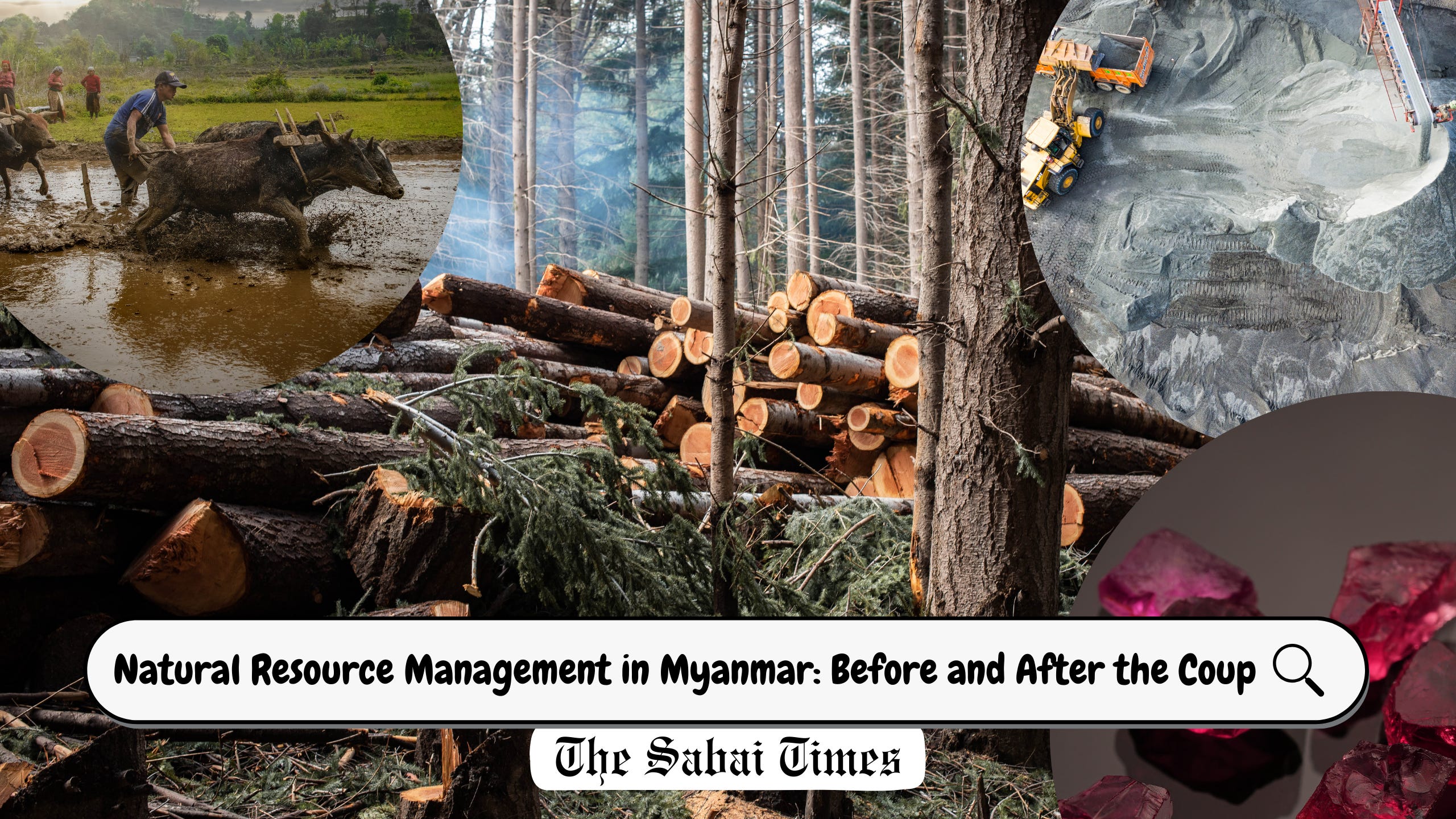
Myanmar is rich in natural resources, and a global biodiversity hotspot, but the sustainable aspects of natural resource management are not considered in current management.
Key Takeaways:
Effective and transparent resource management systems are urgently needed.
The military coup and ongoing conflict have further destabilized natural resource management.
Despite providing enormous economic potential, Myanmar's natural resources are a double-edged sword.
Myanmar’s natural resources, such as timber, oil and gas, jade, potential hydropower, and fisheries, have played a major economic role in Myanmar. From 2017 to 2018, the extractive industry accounted for 4.8% of GDP, 5.2% of state income, and 35% of total exports.
Land and Forest Management
In many areas, no land administration systems are in place to recognize, protect, and register land tenure rights. People are highly vulnerable to loss of land tenure rights, and land grabbing has occurred in all regions for many decades.
Under the pre-coup legal framework, management responsibilities were divided between at least 20 government agencies, including the Ministry of Agriculture, Livestock and Irrigation (MOALI), through its Department of Agricultural Land Management and Statistics (DOALMS), the Ministry of Natural Resources, Environmental and Conservation (MONREC), and the General Administration Department, in a complex variety of structures at the federal and state/regional levels. Regarding forest management, the Myanmar Timber Enterprise (MTE), a MONREC agency, is a state-owned economic enterprise (SEE) with extensive influence over the time trade. The MTE had a record of misappropriating funds, selling timber below market value, and laundering illegal timber, and the pre-coup government had addressed some of the underlying factors behind this corruption, which helped the general treasury get much-needed funding.
However, after the coup, to restrict the junta’s access to foreign exchange, the European Union and the United States added the MTE to their lists of sanctioned entities following the military coup.
Environment decision support tool (Environmental Impact Assessment-EIA)
Environmental impact assessment (EIA) provides information on the likely impacts of development projects for those deciding whether a project should be authorized. An EIA aims to determine the potential environmental, social, and health effects of a proposed development so that decision-makers are informed of the likely consequences of their decisions and also more accountable. Before the pre-coup period, the Government of Myanmar published an EIA procedure in 2015. It requires that project proponents undertake public consultation at the scoping stage and, depending on the project size, during the EIA report preparation. The procedure is in line with environmental legislation in the region and generally meets international good practice standards. According to the NUG MONREC organization, the Environmental Conservation Department is a large department with responsibilities in every state and region, possibly to collect detailed information on ongoing environmental damage. Insufficient human resources in the EIA department and delays in project responses meant that the EIA review and approval process took much longer than set out in the EIA procedure (2015).
Highlight on natural resource degradation: rare earth extraction in Kachin State.
In 2019, a license was issued to a local medical company under MONREC for 11 sites in Chipwi Township for rare earth mining, covering 281 acres. Harvard International Review’s article stated t“for every ton of rare earth produced, the mining process for e yields 13kg of dust, 9,600-12,000 cubic meters of waste gas, 75 cubic meters of wastewater, and one ton of radioactive residue.”
In September 2024, the Kachin Independence Organization (KIO) took control of Myanmar's primary rare earth mining region in northeastern Kachin State, which was previously dominated by a Border Guard Force (BGF) and militia linked to the military junta. However, the KIO's future management of this lucrative yet environmentally damaging industry remains uncertain, especially as they seek funds to support their ongoing conflict against the junta.
In conclusion, Myanmar's natural resources, although providing enormous economic potential, are a double-edged sword. Governance failures, corruption, and persistent violence hindered sustainable management, resulting in environmental degradation, social unrest, and economic instability.
The military takeover has weakened institutional capacity, encouraging illegal extraction and reducing regulatory monitoring. While foreign sanctions aim to limit the junta's access to foreign currency, they also create power vacuums in which non-state entities and armed groups can seize control.
Myanmar faces long-term instability, environmental degradation, and missed economic possibilities without a transparent and responsible resource management system. A long-term plan must integrate resource utilization with environmental and social responsibility.
Wint Thiri Marn, an environmental enthusiast specializing in greenhouse gas emissions and transport policy, is a researcher at the King Mongkut’s University of Technology Thonburi (KMUTT) in Thailand.
“Advocating Sustainability, Shaping Our Future”
The opinions expressed in these articles do not represent the official stance of SRIc - Shwetaungthagathu Reform Initiative Centre. The Sabai Times is committed to publishing a range of perspectives that may not align with editorial policy.
Help Sustain The Sabai Times - Myanmar’s Voice for Sustainable Development Support The Sabai Times