


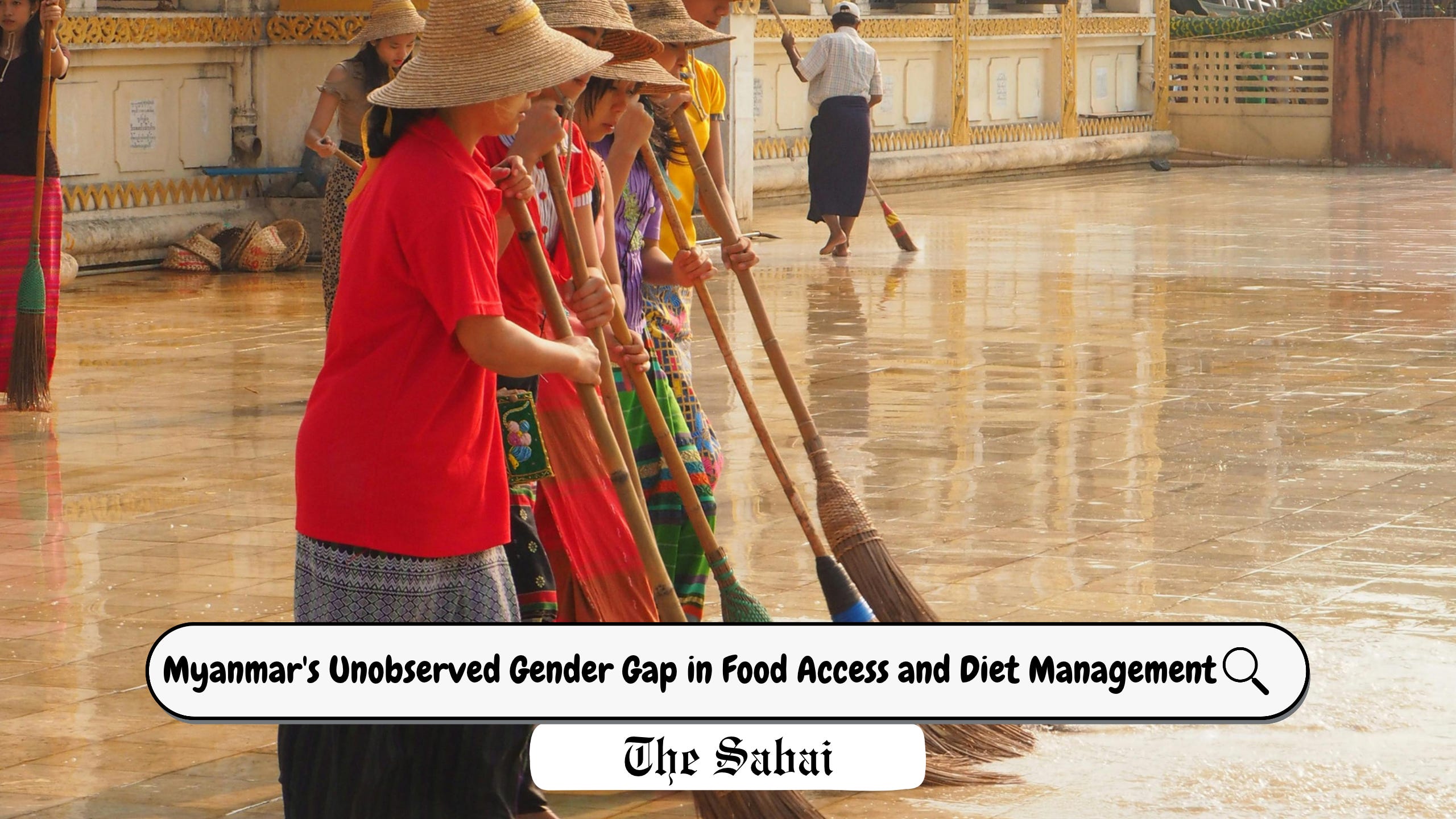
Amid Myanmar’s post-coup food crisis, monitoring often focuses on households, while recent surveys point to differences between women’s and men’s diets and access to food.
Key Takeaways
Data from the Myanmar Household Welfare Survey (MHWS) show that rural women and men had similar rates of inadequate dietary diversity in late 2022. By 2025, the rate was higher among women. The increase among women was statistically significant, while the change among men was not.
Surveys document gender differences in income, unpaid care work and food security. These findings raise issues of connections between household resources, responsibilities and access to food and dietary outcomes, but their contribution to the observed differences is unclear.
Household-level indicators cannot show how food is distributed or experienced by individual members. Individual-level dietary data, further research into gender differences, and assessments of how humanitarian assistance reaches different household members could help address these gaps.
Analysis and Literature Synthesis
1. Behind Household Figures
“In some families of five, only children are fed, and the mothers cannot eat.” That was how a local youth group member described displacement camps in Rakhine State to Radio Free Asia in January 2025. Since the military seized power in February 2021, Myanmar has faced worsening food security conditions. A UNDP report based on a 2025 survey mentioned that 32.6% of Myanmar’s population, about 17.9 million people, lived in multidimensional poverty, facing overlapping deprivations in health, education, and living standards. By 2025, United Nations human rights experts estimated that 15.2 million people, nearly a third of the population, faced acute food insecurity.
Driven by conflict, inflation, displacement, and the earthquake of 2025, food security remains a central focus of the national policy and humanitarian strategy. Yet household-level figures cannot show whether women and men within the same household have similar access to food or consume similarly varied diets. Few surveys in Myanmar measure women’s and men’s diets separately. This article examines the available evidence on gender differences in dietary diversity and food access during the post-coup crisis, and considers what remains unknown about the reasons behind these differences.
2. Cultural Norms and Household Food Allocation
A review of 60 studies found evidence of gender differences in household food allocation, particularly when food was scarce. Household-level data cannot show how food is distributed among individual members, so a household may appear food secure even when some of its members eat poorly.
This pattern of household food allocation was also found in Myanmar households. Under the custom of oo kya, the father or grandfather sits at the head of the table and is served first. This practice reflects the Burmese saying, “the husband is god, the son is master”. One participant explained that “the best is always offered to the head of the household who is always a man”, while the wife “is the one who usually has less, especially in low-income households”.
Women often set aside the best pieces of meat for their husbands and sons, followed by their daughters, leaving themselves with the remaining sauce. They also tend to eat last, “particularly when food is scarce”. As Myanmar’s 2024 Multi-Sectoral Needs Assessment notes, many gender inequalities occur within households, making them difficult to capture through household-level indicators alone.
This distinction matters when interpreting food security statistics. Household measures remain useful for identifying shortages and vulnerability, but they cannot establish whether all members have equal access to food or whether their diets meet their individual needs.
3. Pre-Coup Evidence on Diet Quality
Before 2021, relatively few published studies in Myanmar examined differences between women’s and men’s diets. Studies in the Central Dry Zone and Yangon Region did not find women to be worse off than men in the dietary measures they examined. However, the studies covered different regions and used different measures: one examined dietary diversity, while the other considered fruit and vegetable intake. Their findings therefore do not establish whether women and men had similar diets across Myanmar as a whole.
Women were already more likely than men to report food insecurity before the pandemic, and this gap widened during the pandemic. Food insecurity and dietary diversity capture different aspects of people’s food-related circumstances, so these findings cannot be directly compared. Collectively, the available pre-coup evidence provides a limited baseline for assessing changes in gender differences in diets and food access since 2021.
4. Post-Coup Data
The clearest evidence on gender differences in dietary diversity comes from the Myanmar Household Welfare Survey (MHWS), a phone survey conducted by the International Food Policy Research Institute (IFPRI). Among the national surveys reviewed here, it is the only one that tracks women’s and men’s diets separately. It counts how many of ten food groups a person ate the previous day. Eating from fewer than five groups is classified as an inadequate diet. Dietary diversity is a commonly used indicator of diet quality, although it does not measure the amount of food consumed.
The MHWS findings indicate a change in dietary diversity over the post-coup period. In rural Myanmar, the share of women and men with an inadequate diet was similar in late 2022, at around 26%. By July to October 2025, the figure was 30.0% among women and 25.2% among men. The MHWS data also showed that women were less likely to have eaten meat or fish than men. The increase in inadequate dietary diversity among rural women was statistically significant, while the change among men was not. These results describe different patterns over time, but they do not establish whether the difference between women and men increased significantly.
Other surveys provide additional evidence on gender differences in food access and food insecurity. The 2025 Myanmar Gender Survey, conducted by the United Nations Development Programme and UN Women, also reported somewhat worse food security outcomes for women nationally. Following the March 2025 earthquake, a gender analysis found that 54% of women and LGBTIQ+ people, compared with 39% of men, had eaten less because of a lack of resources. The study used a non-random sample, limiting the generalizability of the findings.
These sources measure different outcomes and cover different populations. They should not be treated as interchangeable measures of a single gender gap. However, they highlight several dimensions of food-related vulnerability that household-level indicators alone may not capture.
5. Figures That Call for Further Investigation
Research in Myanmar shows gender differences in dietary diversity and food access, but the reasons remain unclear. Several findings point to factors that need further investigation.
Income and access to resources. According to the Myanmar Gender Survey, 42% of women have no income of their own, compared with 23% of men. The survey also documents differences in earnings and land ownership. These findings raise questions about how control over income and other resources relates to individuals’ diets, particularly when food prices are high. The available figures do not, however, establish whether these differences account for the dietary patterns observed in the MHWS.
Traditional roles and food allocation. Women undertake almost twice as much unpaid care work as men and commonly manage household meals, reflecting gender norms around women’s roles in domestic care. These roles may shape how food is prepared and shared.
After the 2025 earthquake, women ate last in 14% of households surveyed, although the sample was not random. Women in other studies described eating less or last when food was scarce, and some secure food for other family members at a cost to their own well-being. Similar patterns have been found elsewhere.
Yet we found no study in Myanmar that has tested whether these practices are linked to women’s poorer diets. The evidence shows that unequal food sharing occurs, but not that it explains the MHWS findings. Research that measures eating practices and individual diets in the same households is needed to find out.
Conflict, disasters and loss of household earners. Conflict restricts access to farmland and markets and can reduce food production. It can also leave households without their breadwinner. Men killed, displaced or conscripted may no longer be able to support their families. Floods and the 2025 earthquake have brought similar problems, destroying homes and assets and disrupting livelihoods. Women left to support their families may have to live on little or no income of their own.
In crisis-affected populations, one in five households is headed by a woman, and four out of five of these women are widows. These households often depend on casual work, self-employment and their own production, leaving them with limited means to cope when income is disrupted. With so many women lacking an income of their own, losing a main household earner can make it harder to afford enough food, let alone a varied diet, while women are often left responsible for keeping their families “safe, together and fed”. Whether the loss of a household earner also affects the quality of women’s own diets remains an open question.
The differences across locations point to further inequalities. In Rakhine, fewer than one in five women were food secure, compared with three in ten men, and in Kayah, 12% of women compared with 18% of men. These figures do not measure dietary diversity, but they show that women already face greater difficulties accessing food in some conflict-affected areas. Collecting data in these communities is also difficult: nearly a third of surveys in a recent national assessment had to be conducted by phone where in-person access was not possible. As a result, we still know relatively little about how conflict, household income losses and unequal food allocation affect what women actually eat.
Implications and Recommendations
The available evidence raises questions about gender differences in dietary diversity and food access during Myanmar’s post-coup crisis. It does not yet explain the reasons for these differences or establish whether household assistance benefits women and men equally. Four areas deserve attention.
Investigate the reasons behind dietary differences. The MHWS provides evidence on dietary diversity, but it does not establish what accounts for the observed patterns. Further research could examine how individual income, control over resources, care responsibilities and household food allocation relate to women’s and men’s diets.
Assess how assistance reaches household members. Humanitarian organisations could examine not only whether assistance reaches a household, but also how it is accessed, controlled, and used by different members. Questions about who makes decisions over food and assistance, alongside individual dietary measures, could help identify needs that household-level monitoring may overlook.
Assessments could also look beyond the number of household members lost to conflict or disasters and consider the different impact of each loss on household income. Even if a household loses two men, it may recover if other members can take on earning roles, while a household that loses its only breadwinner may be left with no income at all. Recording whether a household has lost its main earner, and whether the remaining members can replace that income, would help identify the households, often those headed by women, most at risk of food insecurity.
Improve evidence from under-researched areas. Conflict-affected areas, including Rakhine and Kayah, and displacement sites remain difficult to assess. Supporting trusted local organisations to collect information on women’s and men’s dietary outcomes, where safe and feasible, could help address these gaps.
Gender-responsive nutrition support programmes. A programme by Save the Children in the Dry Zone provided monthly cash transfers to mothers from pregnancy until their child turned two. Follow-up findings showed that women who took part continued to have more diverse diets up to four years after the programme ended, despite the disruptions caused by COVID-19 and the coup. Women who also received nutrition education benefited most.
This type of support is especially needed in conflict-affected areas, where it is also harder to deliver. In 2026, an estimated 380,000 pregnant and breastfeeding women needed nutrition assistance, and acute malnutrition overall was most severe in Rakhine, Kachin, Kayin, Chin and Sagaing. Fighting and displacement are among the causes, and they also make it hard for aid workers to reach women and treat them early. Yet cash assistance specifically to improve their diets was planned for only 8,200 of these women.
NGOs, humanitarian organisations and donors could provide cash transfers directly to women, alongside nutrition advice. They could also offer flexible grants to women-led and local organisations so that support reaches women directly, including pregnant and breastfeeding women in conflict-affected areas and displacement sites. These actions can begin now, while researchers continue to investigate the reasons behind the differences in women’s and men’s diets.
Aye Aye Phyo is a Junior Research Fellow at the Shwetaungthagathu Reform Initiative Centre (SRIc) and a Master of Arts in Economics student at the Faculty of Economics, Thammasat University, Thailand.
“Advocating Sustainability, Shaping Our Future”
Help Sustain The Sabai - Myanmar’s Voice for Sustainability. Support The Sabai