


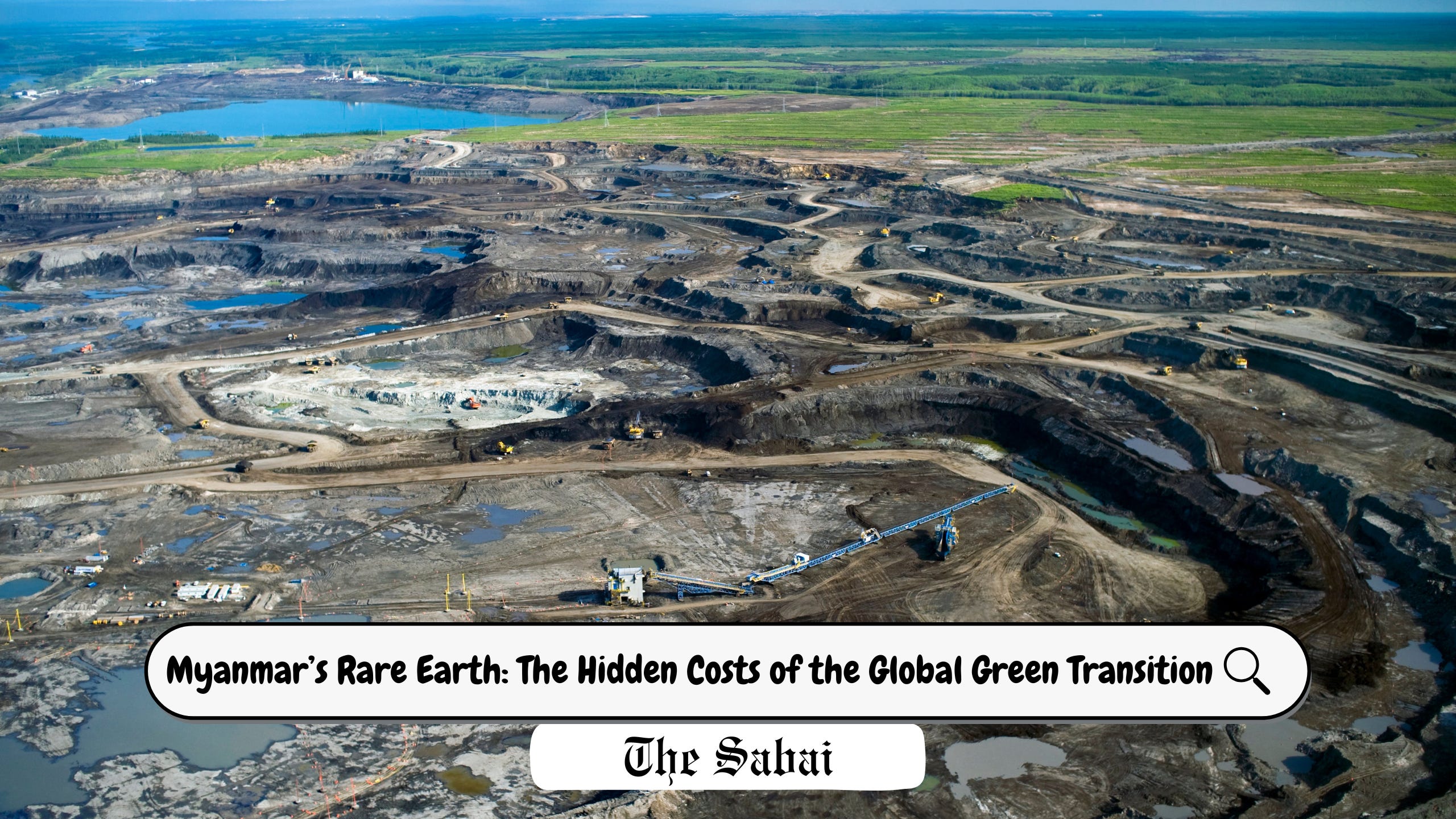
The global transition toward renewable energy and electric vehicles has accelerated demand for rare earth minerals, placing Myanmar’s conflict-affected borderlands at the center of emerging critical mineral supply chains. As rare earth extraction expands in Kachin State following the 2021 coup, environmental degradation, weak regulation, and fragmented governance structures have increasingly shaped the country’s role in the global green economy.
Key Takeaways:
Myanmar has become the world’s third-largest producer of rare earth elements, after the US and China, for advanced renewable energy technologies, as China increasingly shifts environmentally destructive extraction beyond its borders into Myanmar’s weakly regulated frontier regions.
The rapid expansion of rare earth mining in Kachin State after the 2021 coup reflects fragmented governance systems involving militias, armed actors, informal taxation networks, and opaque cross-border business arrangements operating with limited environmental oversight or accountability.
Myanmar’s rare earth frontier exposes a deeper contradiction within the global green transition: while wealthier societies pursue cleaner energy and “greener” cities, the environmental and human costs of extracting critical minerals are increasingly displaced onto conflict-affected and politically fragile regions, creating zones of ecological sacrifice that remain largely invisible within global climate narratives.
Introduction
Rapidly reducing dependence on fossil fuels and accelerating the transition toward renewable energy have become central to global climate strategies and the pursuit of a net-zero future. Electric vehicles, wind turbines, batteries, and other low-carbon technologies are increasingly viewed as essential tools for addressing climate change and advancing sustainable development goals. Yet the technologies driving this transition depend heavily on critical minerals, particularly rare earth elements essential for renewable energy systems and advanced manufacturing industries.
As global demand for critical minerals intensifies, governments and industries face growing challenges surrounding supply chain security, environmental sustainability, and geopolitical competition. While the expanding critical mineral economy presents economic opportunities for resource-rich developing countries, it also risks reproducing patterns of environmental degradation, corruption, conflict, and unequal resource governance commonly associated with the “resource curse.”
Myanmar has emerged as an increasingly important supplier within regional rare earth supply chains linked to China’s processing industries. According to Global Witness, Myanmar’s exports of rare earth minerals to China increased dramatically from approximately US$1.5 million in 2014 to nearly US$780 million by 2021. Much of this extraction has concentrated in Kachin State along Myanmar’s northern borderlands, where long-standing conflict dynamics and contested territorial authority continue to shape local governance systems.
As extraction rapidly expands, Myanmar’s rare earth frontier increasingly reveals a deeper contradiction at the heart of the global green transition: while renewable energy technologies are promoted as environmentally sustainable solutions, the environmental and governance costs associated with critical mineral extraction are increasingly displaced onto fragile border regions affected by conflict and weak regulation.
Myanmar’s Rare Earth Boom and China’s Supply Chain Shift
Rare earth minerals have become strategically important because of their essential role in renewable energy technologies and advanced manufacturing industries. Heavy rare earth elements such as dysprosium and neodymium are particularly valuable because they are used in permanent magnets essential for electric vehicles, wind turbines, batteries, smartphones, and high-performance electronics. As governments accelerate climate goals and low-carbon industrial strategies, global demand for these minerals has surged dramatically.
China has dominated the global rare earth industry since the 1980s and continues to control much of the world’s processing and refining capacity. However, the environmental consequences of rare earth extraction within China became increasingly severe over the past decade. Illegal mining, toxic waste, poisoned waterways, and long-term ecological degradation generated mounting environmental concerns, particularly in Jiangxi Province, often referred to as China’s “rare earth kingdom.”
In response, Chinese authorities intensified environmental enforcement measures after 2016 and shut down many domestic heavy rare earth mining operations. Yet while China reduced environmentally destructive extraction within its own territory, global demand for rare earth minerals continued to rise rapidly. Rather than reducing extraction overall, mining activities increasingly shifted across the border into Myanmar’s weakly regulated frontier regions. While China argues for a non-interference policy in the Myanmar crisis for Western powers, they are exploiting the Myanmar Civil War as a tool to increase China’s influence in Myanmar by dealing with both the military-led government and the ethnic military. China’s cooperation with KIA for rare earth minerals from Kachin state is evidence of China’s double standard in its own foreign policy towards Myanmar.
A six-month investigation by Global Witness documented how this highly polluting industry expanded rapidly into Myanmar’s Kachin Special Region 1, a semi-autonomous territory controlled by militia groups affiliated with Myanmar’s military establishment. Within just a few years, the region became one of the world’s largest suppliers of heavy rare earth minerals.
Reports indicate that thousands of Chinese workers and technicians crossed into Myanmar between 2016 and 2019 to establish and operate mining sites using the same in-situ leaching methods previously employed in Jiangxi. The mines continue to supply Chinese state-owned processing companies that dominate the global rare-earth refining industry. Commodity research firm Roskill noted in 2021 that nearly all major Chinese state-owned enterprises involved in heavy rare earth processing had become dependent on Myanmar as a source of raw materials.
The expansion of extraction into Myanmar demonstrates how stricter environmental governance in one country can displace ecological harm into weaker regulatory environments elsewhere. As one industry expert cited by Global Witness observed, “the environmental challenges that come with this type of mining in China have spread to a neighbouring nation.”
Fragmented Governance After the Coup
The rapid expansion of rare earth extraction in Myanmar cannot be understood solely through global market demand. It is also deeply connected to fragmented governance systems that intensified following the 2021 military coup.
Rather than producing a simple absence of governance, the post-coup crisis generated overlapping systems of competing authority involving military actors, militias, ethnic armed organizations (EAOs), border business networks, and informal economic actors. In many extraction zones across northern Myanmar, governance operates through negotiated control, informal taxation systems, and localized power arrangements rather than centralized state regulation.
In Kachin Special Region 1, mining operations reportedly function through opaque agreements involving militia-controlled authorities and cross-border commercial actors. Although foreign investment in small- and medium-scale mineral extraction is technically illegal under Myanmar law, enforcement remains limited in conflict-affected borderlands where competing systems of authority overlap.
The Institute for Strategy and Policy-Myanmar (ISP) reported that militia leaders and affiliated business networks have become central brokers in the rare-earth economy, facilitating mining operations, granting access to extraction sites, collecting informal taxes, and controlling cross-border trade routes into China. In many cases, Myanmar-registered companies reportedly function as fronts for Chinese investment operating through informal and opaque commercial arrangements.
The post-coup political environment has further weakened environmental oversight and institutional accountability. Under fragmented governance conditions, extraction activities continue with limited regulatory monitoring, while armed actors and border business networks benefit economically from the rapid expansion of rare earth mining.
Myanmar’s rare earth sector, therefore, illustrates how conflict-affected borderlands can become integrated into global supply chains through systems of shadow governance and informal extraction economies operating beyond effective environmental regulation.
Environmental Consequences in Kachin State and Beyond
The environmental consequences of rare earth extraction in Myanmar increasingly mirror the ecological devastation previously witnessed in China’s Jiangxi Province, where decades of poorly regulated mining contaminated waterways, destroyed forests, and generated massive long-term cleanup costs. China’s “Take profit without responsibility” policy in neighbouring countries for Rare-earth mining clearly downgrades China’s role as a global normative actor.
Mining operations in Kachin State commonly use in-situ leaching methods that inject chemical solutions such as ammonium sulfate directly into mountainsides to extract rare earth minerals. While highly profitable and relatively inexpensive, this process leaves behind toxic wastewater, contaminated soil, deforested landscapes, and unstable terrain vulnerable to erosion and landslides.
Global Witness documented how mining sites across Kachin State have expanded rapidly across mountainous terrain, with thousands of chemical collection pools identified near river systems and forest areas. Local communities have reported worsening access to clean water, dying fish populations, contaminated farmland, and the disappearance of wildlife from nearby forests. Residents also described growing fears about surrounding toxic exposure, respiratory illnesses, and long-term environmental destruction linked to chemical leaching processes.
The environmental consequences are no longer confined to isolated mining zones. Recent environmental monitoring in Thailand detected alarming levels of arsenic contamination in transboundary river systems linked to mining activities upstream in Myanmar, including areas associated with rare earth extraction. Investigations reported by Mongabay found growing concerns along the Salween River basin, where communities increasingly fear the impacts of toxic contamination on fisheries, agriculture, drinking water systems, and local livelihoods.
These developments highlight how environmental harm generated within Myanmar’s conflict-affected borderlands increasingly carries regional ecological and human security consequences. The contamination of shared river systems demonstrates that the environmental costs of weak extraction governance do not stop at national borders.
The long-term implications may prove severe. In China’s Jiangxi Province, authorities estimated that environmental cleanup costs linked to rare earth mining could exceed US$5.5 billion, with ecological recovery potentially taking up to a century. Myanmar currently lacks both the institutional capacity and regulatory mechanisms necessary to manage environmental remediation on a comparable scale.
The Hidden Contradiction of Global Green Transition
Myanmar’s rare earth frontier reveals a critical contradiction at the heart of the global green transition. Renewable energy technologies are frequently presented as environmentally sustainable solutions to climate change. Yet, the extraction systems that support these industries often impose severe environmental and social costs in politically fragile regions.
The environmental burdens associated with critical mineral extraction are not distributed equally. Instead, they are increasingly externalized onto vulnerable borderland communities where governance systems remain weak, fragmented, and conflict-affected. A green transition that ignores the social and environmental impacts on local communities is not truly green; it is simply greenwashing under the language of sustainability. While industries and consumers elsewhere benefit from electric vehicles, renewable energy infrastructure, and advanced technologies, the ecological and political consequences of extraction are concentrated in frontier regions such as northern Myanmar.
This dynamic raises broader questions about environmental governance, supply chain accountability, and the political economy of climate transition policies. Efforts to accelerate renewable energy adoption without addressing extraction governance risk reproduce new forms of environmental injustice and conflict-linked resource exploitation.
Myanmar’s rare earth frontier ultimately reveals a critical paradox at the heart of the global green transition: technologies designed to secure a sustainable future increasingly depend upon extraction systems rooted in environmental destruction, fragmented governance, and conflict-affected borderlands. Without stronger environmental accountability and conflict-sensitive supply chain governance, the pursuit of clean energy risks reproducing new forms of ecological injustice under the banner of sustainability.
Policy Recommendations
Addressing the environmental and governance challenges of rare earth extraction in Myanmar requires stronger international cooperation, conflict-sensitive environmental governance, and improved supply chain accountability.
Key priorities include:
Strengthening environmental monitoring in conflict-affected extraction areas and tightening regulations on rare earth trade linked to environmentally harmful practices, particularly within Chinese-linked supply chains.
Improving transparency and traceability in critical mineral supply chains, including the potential use of blockchain technologies to reduce illicit trade and improve accountability.
Expanding responsible sourcing standards for companies and governments reliant on rare earth minerals for renewable energy, electric vehicles, and advanced manufacturing.
Enhancing regional cooperation to address transboundary environmental impacts such as river pollution and ecological degradation. Local actors, including the NUG and EAOs, should also consider long-term environmental consequences in governance decisions.
Encouraging ASEAN to take a more active role in addressing regional environmental risks stemming from Myanmar’s extractive and ecological crises.
Htay Su Wai is a Junior Research Fellow at the Sustainability Lab of the Shwetaungthagathu Reform Initiative Centre (SRIc) and holds a Master of Public Policy (MPP) from the Hertie School of Governance in Berlin, Germany.
“Advocating Sustainability, Shaping Our Future”
Help Sustain The Sabai - Myanmar’s Voice for Sustainability Support The Sabai