


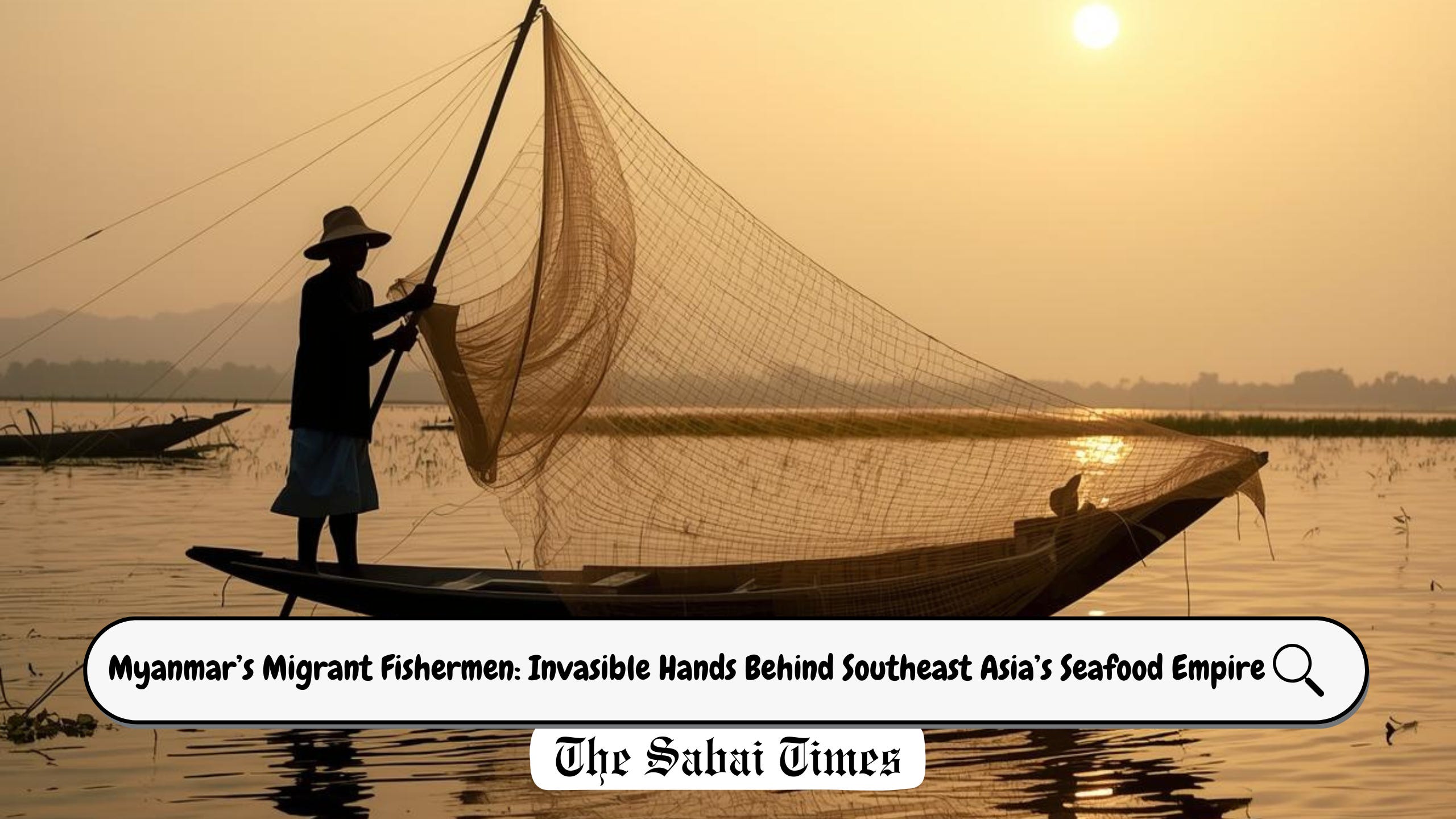
The article exposes the harsh realities faced by Myanmar’s migrant fishermen, whose exploited labor sustains Southeast Asia’s thriving seafood industry.
Key Takeaways:
Myanmar migrant fishermen play an important role in Southeast Asia’s seafood industry but face relentless exploitation through debt, abuse, and weak legal protection.
Policies and conventions exist, yet poor enforcement, costly documentation, and flawed grievance systems deny them fair pay and safety.
True reform demands shared accountability among governments, employers, and corporations to ensure ethical recruitment and humane conditions at sea.
Beneath the surface of Southeast Asia’s booming USD 50-billion fishing industry lies an ocean of exploitation and hardship. Thousands of Myanmar migrant fishermen sustain the region’s seafood supply chains under brutal conditions marked by debt bondage, withheld wages, and violence at sea. Drawn by desperation and trapped by systemic neglect, their labor fuels a global market that thrives on the very invisibility of those who make it possible.
1. The Fishing Industry Landscape in Southeast Asia
Southeast Asia’s fishing industry is responsible for supplying around 20% of the world’s fish, contributing nearly one-fifth of the region’s GDP, with Indonesia, Vietnam, and Myanmar leading production. Supporting over nine million workers, fisheries sustain coastal livelihoods and serve as a vital protein source for millions. Yet beneath this thriving economy lies a dependency on migrant labor, particularly from Myanmar, Cambodia, and Laos, who take on the industry’s most grueling “3D jobs”: difficult, dirty, and dangerous.
2. Myanmar’s Migrant Fishermen: A Workforce Across Borders
Within Myanmar, fisheries employ over 3.2 million people, accounting for roughly 6% of the population. Many are internal migrants from regions like the Central Dry Zone, Rakhine, and Ayeyarwady, who move to coastal areas in search of better wages. However, the lack of formal registration leaves many unprotected and vulnerable to exploitation. Across borders, Myanmar migrants form the backbone of Southeast Asia’s seafood supply chain, particularly in Thailand, where they comprise nearly 70% of the fishing workforce. In Ranong province alone, Burmese migrants make up more than 90% of the labor force. While official records listed 13,500 registered Myanmar fishers in 2022, the real figure is likely far higher.
3. Who Are These Fishermen, and Why Do They Work There?
Most migrant fishers are young men from rural villages, often with limited education and job prospects. Poverty, debt, and a lack of opportunity drive them abroad. Many are lured by brokers offering advance salaries to pay debts or support families, only to find themselves trapped in debt bondage once aboard. Others choose the work for the free food and accommodation it offers. However, the “choice” is stolen from some, as the recruiters promise factory jobs but deliver workers into forced labor on distant fishing vessels. The blurred line between migration and trafficking continues to define this hidden workforce.
4. The Challenges Beneath the Waves
a. Legal Recognition and Documentation
Legal status is both essential and burdensome for migrant fishers. To work legally, they must obtain pink cards, work permits, sea books, passports, and health insurance, costing between 10,000 and 30,000 baht (USD 300–800). The process is complex and expensive, pushing many into informal recruitment channels controlled by brokers who exploit loopholes. Even those who enter through formal MOU systems face long processing delays. Once at sea, employers often confiscated documents, creating “document bondage” that traps workers in jobs they cannot leave. Without papers, they risk arrest or deportation and are deterred from reporting abuse.
b. Wages and Debt Bondage
Despite legal wage protections, many fishers earn far below minimum standards, sometimes as little as USD 30 to 150 per month. Employers frequently manipulate payroll systems, controlling workers’ ATM cards to simulate compliance. Some migrants wait months or even years for payment, while others lose wages for sick days or port work. Debt bondage remains at the heart of this exploitation. Many migrants borrow heavily to pay recruitment fees or travel costs, up to USD 800, which are inflated with hidden charges. Employers then withhold documents until debts are “repaid,” trapping workers in a cycle of dependency and coercion.
c. Working Hours and Conditions
At sea, exhaustion is the norm. One in four fishers reports working 17–24 hours a day, with nearly half having no fixed schedule. Many endure days without rest or overtime pay. This relentless fatigue, combined with hazardous conditions and poor safety gear, not only violates labor laws but also signals forced labor.
Vessels often lack toilets, clean bedding, and adequate food or water. Some fishers survive on rice and dried fish, even boiled seawater. Long-haul voyages can confine crews for months or years, with little contact with the outside world.
d. Human Rights Violations
The 2021 Myanmar military coup triggered a surge of out-migration to Thailand, and it expanded the pool of Burmese migrants entering the fishing sector, where forced labor, trafficking, and physical abuse remain widespread. One in five migrant fishers reports being unable to leave their job without punishment. Violence is routine: some are beaten with iron rods or wooden blocks; others are threatened, “sold” to other vessels, or even thrown overboard for falling ill. Psychological coercion and racial discrimination deepen their fear and silence. Weak legal protection and retaliation risks make justice elusive, allowing impunity to persist across fleets.
e. Social Factors: Life Beyond the Boat
Migrant fishers live in overcrowded and unsafe quarters, often without proper sanitation, healthcare, or social protection. Injuries at sea frequently go untreated, and families left behind face economic instability. With limited access to education and welfare systems, migrants remain marginalised even onshore. This social neglect reinforces their dependence on exploitative employers and brokers.
5. The Role of Corporations and Industry Owners
Corporate and vessel owners sit at the centre of this crisis. Many withhold ID cards or wages, perpetuating debt and dependency, despite such acts being illegal. Some refuse to compensate for injuries or deaths at sea, denying accountability. Brokers exploit “travel first, pay later” schemes, often in collusion with employers, that deepen workers’ debts.
Corporate buyers and processors in global seafood markets wield significant power to change this system. Yet, many prioritise profit over ethics, failing to demand fair labor practices across their supply chains. Without market pressure, abuses at sea remain hidden behind layers of subcontracting.
6. Policies, Interventions, and Support Networks
Reforms have emerged at national and regional levels. The ILO’s Work in Fishing Convention (C188) sets global standards for safety, living conditions, and labor rights at sea, and Thailand is the first and only Southeast Asian country to ratify C188 in 2019. The move followed the EU’s “yellow card” warning against illegal, unreported, and unregulated fishing, prompting the Labour Protection in Fishing Work Act 2019.
At the ASEAN level, the 2023 Declaration and 2024 Guidelines on the Protection of Migrant Fishers introduced a rights-based framework emphasising ethical recruitment and access to justice. In Thailand, 32 Port-in-Port-out (PIPO) centres and the reorganisation of maritime enforcement (Thai-MECC) oversee compliance, while welfare committees provide grievance channels.
As a region deeply dependent on fisheries and aquaculture, ASEAN must move beyond declarations and guidelines to take decisive, region-wide action against labor exploitation and human trafficking. Protecting migrant fishermen’s rights cannot rest solely with labor ministries. It demands coordinated efforts across law enforcement, immigration, and workers’ associations.
Amplifying the voices of civil society organisations (CSOs) and migrant-led groups is crucial for meaningful progress in protecting migrant fishers’ rights. ASEAN must urge national governments to recognise and support workers’ freedom to organise. Only by empowering these associations can ASEAN expose the real challenges, strengthen advocacy, and drive sustainable, rights-based reforms within Southeast Asia’s fishing industry.
International agencies like the International Labour Organisation (ILO) and NGOs, such as Human Rights Watch, the Fishers’ Rights Network, and Migrant Workers Network, continue to build capacity, offer legal aid, and advocate for reform, forming a web of support amid fragmented enforcement.
7. The UNHCR Forum: Voices from the Deep
On September 16, 2025, the UNHCR convened a forum in Bangkok spotlighting migrant fishers’ human rights. The discussions exposed ongoing abuses, long hours, withheld pay, debt bondage, and discrimination, despite policy advances. Speakers underscored that progress has been driven more by unions and NGOs than by governments. Nearly half of the surveyed fishers still do not know where to seek help. Participants called for stronger corporate accountability, democratic grievance systems, and regional cooperation to make ASEAN’s declarations truly actionable.
8. Gaps, Challenges, and the Road Ahead
Despite multiple initiatives, major gaps remain. Inspections often focus on paperwork rather than worker welfare, with little confidentiality, leaving migrants afraid to report violations. Barriers such as high documentation fees, restrictions on union formation, and loopholes in labor agreements perpetuate exploitation.
Justice remains out of reach for most fishers since the legal processes are slow, evidence is scarce, and trust in institutions is low. To bridge these gaps, stakeholders recommend eliminating recruitment fees, simplifying documentation, ensuring confidential reporting, and sanctioning violators. Vessel certification and stronger oversight by Thai-MECC could enhance transparency.
Cross-border cooperation between Thailand and Myanmar, including digital data sharing and harmonised welfare systems, could help ensure compensation and social protection for migrant fishers.
Conclusion
Consequently, the plight of Myanmar’s migrant fishermen reveals the dark underside of Southeast Asia’s ocean wealth, highlighting prosperity built on invisible suffering. Though regional frameworks and international conventions promise reform, genuine progress demands accountability from governments, vessel owners, and corporate buyers. ASEAN must go beyond policy rhetoric by empowering and collaborating with civil society organisations (CSOs) that represent migrant fishers’ voices and drive real on-the-ground change. Until fair wages, safe work, and dignity are ensured, the region’s fishing triumph will remain shadowed by injustice and silent endurance.
Dr. Htet Khaing Min, a medical doctor, is a Research Fellow at the Sustainability Lab of the Shwetaungthagathu Reform Initiative Centre (SRIc). He recently led Remote Health Projects, focusing on Community Health Worker programs in the border regions of Naga and Karen States.
“Advocating Sustainability, Shaping Our Future”
Help Sustain The Sabai Times - Myanmar’s Voice for Sustainable Development Support The Sabai Times