


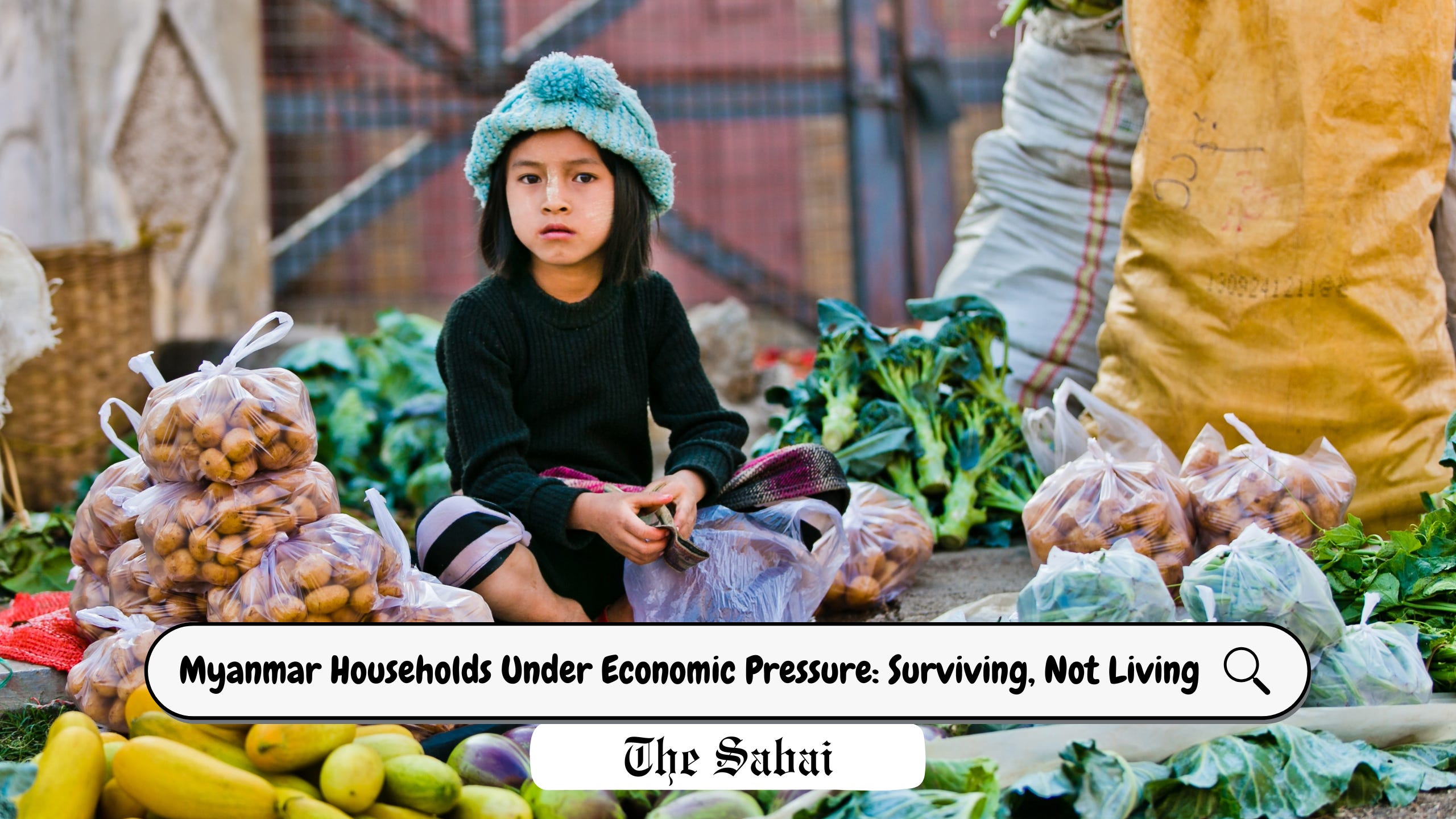
As livelihoods in Myanmar become increasingly unstable, many households are struggling to meet basic needs and rely on survival-based coping strategies. This article examines the economic pressures facing Myanmar households, the coping mechanisms they adopt, and possible pathways for recovery and resilience.
Key Takeaways:
Political instability, conflict, inflation, and environmental crises have pushed many Myanmar households into survival-based living conditions.
Households increasingly rely on informal work, multiple jobs, migration, borrowing, and high-risk activities to cope with economic hardship.
Long-term recovery requires stronger social protection, economic stability, and improved peace and governance.
Economic Pressures on Myanmar Households
Myanmar’s economy has sharply declined since the 2021 military takeover, with rising inflation, increasing poverty, and weakened investment, employment, and human capital development. While military elites and connected cronies remain financially insulated, ordinary workers, farmers, and low-income households bear a much heavier burden.
Many businesses struggle with rising costs and weak purchasing power, leading to factory layoffs and hardship for street vendors under the “100-Day Project”. Ongoing conflict, civilian deaths, and forced conscription have pushed more households into poverty, particularly female-headed households, which are more vulnerable due to limited gender-sensitive support.
Conflict, rising agricultural costs, disrupted trade, and currency depreciation continue to reduce farmers’ and exporters’ incomes. At the same time, overlapping crises including COVID-19, cyclones, earthquakes, inflation, and environmental degradation continue to damage livelihoods and housing. Despite rising living costs, salaries remain largely unchanged.
Weak law enforcement has also allowed cyber scam syndicates to target vulnerable Myanmar citizens increasingly. Overall, Myanmar people continue to endure a polycrisis driven by governance failures and compounding environmental shocks.
Households’ Coping Mechanisms and their Costs
Working Multiple Jobs
Worsening economic conditions have forced many Myanmar households to rely on multiple jobs to survive. Even before 2018, one in three Myanmar people reportedly held more than one job, with many combining full-time work and informal side jobs such as farming, casual labour, and small businesses. Although this may provide temporary income and financial security, it often results in stress, exhaustion, health problems, and reduced time for family and personal development. As household welfare remains fragile and the middle class continues to shrink, holding multiple jobs has become a survival strategy rather than a sustainable long-term solution.
Reliance on Informal Work
In the absence of stable formal employment, many households rely on informal work, which made up 80.7% of the workforce by 2020 and accounts for 50.1% of Myanmar’s GDP. Informal work includes activities such as street vending, farming, domestic work, and transport services, offering accessible income opportunities with low entry barriers, alongside flexible hours and home-based arrangements. However, workers often lack contracts, paid leave, health benefits, legal protection, and stable income. Women are particularly vulnerable to low pay, discrimination, poor working conditions, and mental health risks. Although informal work can continue during crises, unstable income and limited upward mobility continue to contribute to rising inequality.
Risky and Illegal Livelihoods
As a Myanmar proverb goes, “an empty sack cannot stand upright“ — when economic hardship deepens, some people turn to risky and illegal activities that reportedly pay several times more than ordinary jobs. Since the 2021 coup, job shortages, travel restrictions, and conscription have pushed many toward cyber scam work, including in border-area scam compounds where many face coercion, forced labour, and human rights abuses.
Illegal gambling has also expanded significantly, including two-digit and three-digit lotteries, football betting, and online gambling, driven by hopes of quick income despite risks of addiction, debt, and financial instability. Cyber scammers have exploited this desperation by promoting illegal gambling as a path to overnight wealth. Economic pressures have similarly pushed some women into sex work to support household expenses, exposing them to abuse, violence, HIV/AIDS, and social stigma due to limited legal protection.
At the same time, robberies, thefts, and other petty crimes have increased across post-coup Myanmar amid worsening economic hardship and weak law enforcement, which has prioritised cracking down on political activists and releasing criminal perpetrators. Although these activities may provide temporary income, they remain unsafe and unsustainable, exposing individuals to exploitation, violence, health risks, and even death.
Migration
A well-known Myanmar proverb states that “those who do not move to a new village will not rise to greatness,” reflecting the long-standing belief that migration can improve livelihoods. Since the 2021 coup, migration has become a major coping strategy, mainly for employment and conflict-related reasons. Many migrate to neighbouring countries seeking better wages and stable income. However, around 25% of migrants’ earnings are reportedly seized by the regime through unfair exchange rates, while undocumented workers often face exploitation, abuse, arrest, discrimination, wage theft, and limited access to healthcare, education, and social security. Stricter migration controls and military restrictions have further increased uncertainty, with some workers reportedly arrested even while waiting for brokers to transport them to jobs or falling victim to human traffickers. Although migration can improve income, it is increasingly driven by desperation rather than opportunity.
Asset Depletion, Borrowing, and Under-Consumption
Many Myanmar households survive by selling assets, depleting savings, borrowing money, reducing spending, and consuming less food. However, selling productive assets and relying on debt can weaken long-term financial stability and trap households in debt cycles. Borrowing from relatives may also strain personal relationships, while informal lenders often charge excessive interest rates and sometimes resort to threats and abuse.
Reducing food consumption has become a common coping mechanism, with many households eating less or switching to cheaper food options, increasing risks of malnutrition and starvation, particularly among children, pregnant women, and older people. Many households also reduce spending on healthcare and education, which weakens health, productivity, and long-term human capital development. Although these strategies may provide temporary relief, they significantly reduce long-term recovery capacity.
Recommendations
Skills Training and Livelihood Programmes
Expanding access to flexible and market-oriented skills training programmes, such as digital work, repair services, food processing, and sewing, can strengthen livelihoods. Improving women’s access to skills development and employment opportunities can also support household incomes and local socio-economic recovery.
Support for Small Businesses and Informal Workers
Support for small businesses and informal workers should include micro-grants, low-interest loans, and licensing systems that recognize their role in the economy. At the same time, government spending priorities should be rebalanced to better support economic recovery and household welfare, rather than being concentrated on military operations. Expanding legal protection and investing in infrastructure such as solar energy, clean water, sanitation, drainage, and storage facilities can improve working conditions and reduce dependence on unstable electricity and fuel supplies. These efforts should also be supported by stronger monetary management to control inflation and ensure that financial support remains effective and sustainable.
Strengthen Local Supply Chains
Investment in processing, transport, and storage systems can strengthen local supply chains. For example, reopening key trade corridors such as the Myawaddy–Hpa-an road for cargo movement is essential to improve market access and trade flow. Agricultural support should include input subsidies, fair pricing systems, climate-resilient farming methods, and improved access to affordable fertilizer, farm equipment, and irrigation systems. Promoting local production, reforestation, mangrove restoration, and sustainable resource management can also strengthen livelihoods and resilience while reducing climate-related risks.
Support Safe Migration and Remittance Systems
Safer migrant labour pathways require stronger legal protection, safer recruitment systems, and enforcement against abusive practices. Migrant workers should also receive greater awareness of labour rights and foreign labour laws. In addition, remittance systems should be safer, faster, and more accessible for migrant workers and their families, supported by a sound remittance policy and the abolition of multiple exchange rate policies.
Strengthen Household Social Protection
Strengthening social protection initiatives can improve societal well-being. Expanding cash-for-work programmes, direct cash assistance, and flexible loan repayment arrangements can help reduce financial pressure and prevent debt traps.
Improve Access to Basic Needs
Improving access to basic needs requires stabilizing fuel prices and essential commodity costs. Healthcare and education services should also continue through community-based approaches such as mobile clinics and temporary learning centres, particularly in conflict-affected and displaced communities.
Strengthen Community and Local Support Systems
Strengthening cooperation with NGOs and humanitarian organizations that already support vulnerable communities can support more localized and community-driven solutions. Community mutual support networks should also be strengthened to help households cope during crises and improve social and economic resilience.
Promote Long-Term Economic Recovery
Long-term recovery requires rebuilding stable labour markets, promoting positive international engagement, improving the investment environment, and implementing policy reforms that reflect on-the-ground economic realities. Since ongoing instability, conflict, inflation, and sanctions continue to weaken livelihoods, long-term household stability depends on peace, governance stability, and national economic recovery. Humanitarian-Development-Peace (HDP) approaches remain essential for supporting both immediate needs and sustainable long-term recovery.
Conclusion
Myanmar’s economy has increasingly shifted toward survival-based livelihoods, with many households relying on unstable and informal income sources to cope with daily hardship. However, these coping mechanisms are often temporary and unsustainable. Therefore, sustainable recovery requires stronger social protection, livelihood opportunities, economic stability, and improvements in peace and governance.
Dr. Jeslyn is a Junior Research Fellow at the Sustainability Lab of the Shwetaungthagathu Reform Initiative Centre (SRIc). She holds a Master of Public Health and has experience in research analysis, remote healthcare services, and community outreach programs.
“Advocating Sustainability, Shaping Our Future”
Help Sustain The Sabai - Myanmar’s Voice for Sustainability Support The Sabai