


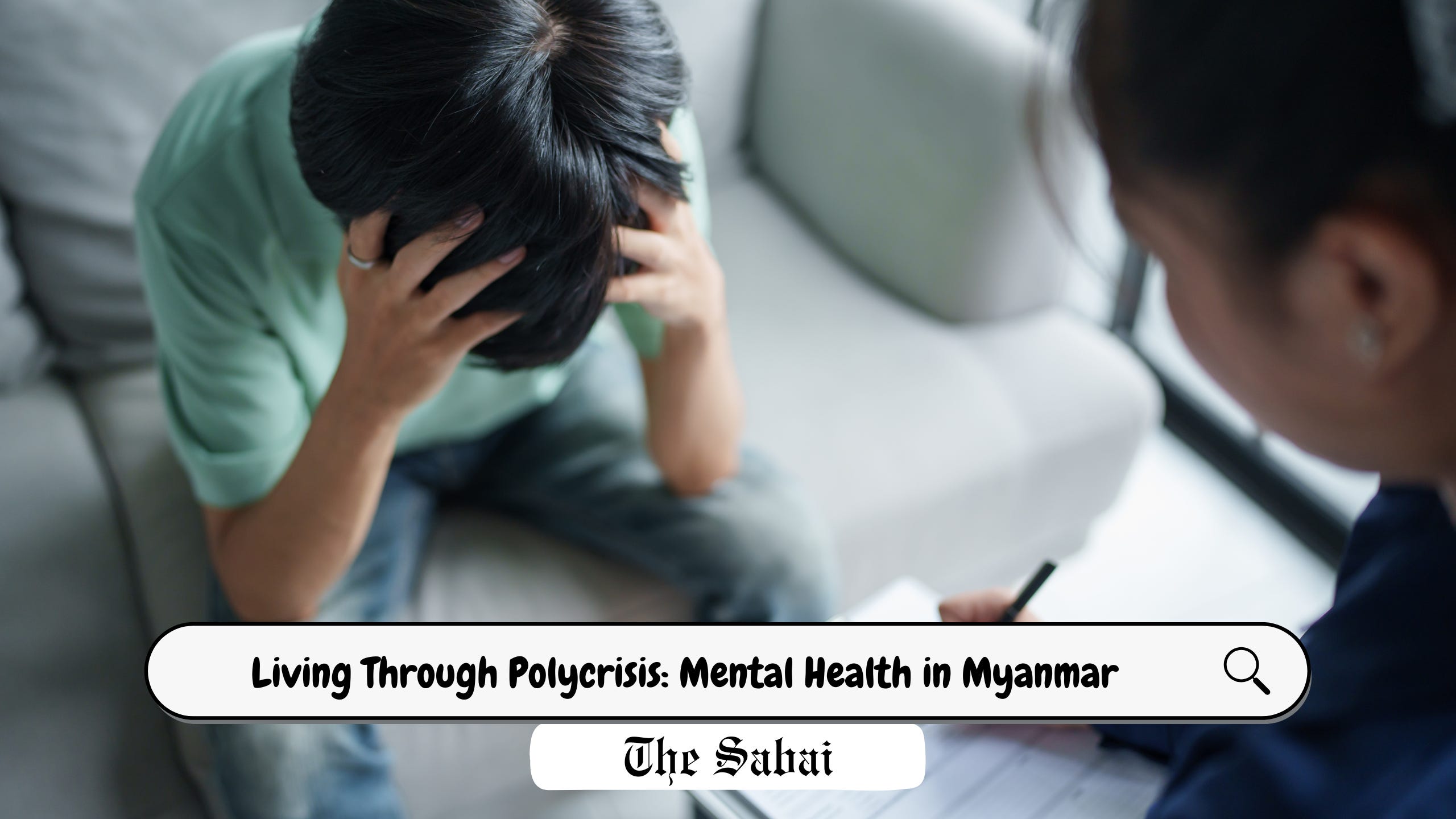
Myanmar is facing a severe and often hidden mental health crisis, shaped by ongoing conflict and systemic disruption. This article examines the key drivers, impacts, and current responses to mental health challenges within the country’s polycrisis context.
Key Takeawys:
Myanmar’s mental health crisis is driven by conflict and systemic limitations, creating both visible and invisible burdens.
Community-based and digital approaches are the most feasible short-term solutions.
Long-term progress depends on political stability and sustained system strengthening.
Political unrest has severe effects on population health, particularly increasing the mental health burden. People living in conflict settings commonly experience anxiety, depression, post-traumatic stress disorder (PTSD), substance abuse, and suicidal thoughts. Evidence from Afghanistan and Ukraine also shows high levels of PTSD and depression in conflict settings.
In Myanmar, the ongoing conflict has led to a sharp rise in mental health problems. Depression and anxiety increased from 14.3% and 22.2% in mid-2021 to 61.39% and 58.02% by October, and by late 2022, one in four people experienced moderately severe to severe depression. Therefore, mental health remains a severe and often hidden public health crisis.
Mental Health in Myanmar’s Polycrisis Context
Mental health is not regarded as a priority due to competing needs, as families struggle to survive in a context of multiple overlapping crises. In 2021, a military coup overthrew the elected government, triggering widespread anti-coup protests across Myanmar. These peaceful demonstrations were met with violence, human rights violations, and attacks on civilians. Many people were killed, arrested, or displaced, and repression later expanded beyond protesters, with journalists being killed or detained. Women have also faced sexual violence, causing lasting psychological trauma. Forced conscription of adults aged 18 and above into frontline conflict pushed many young people to flee abroad or move to urban areas. At the same time, three in four Myanmar youths are no longer engaged in education or training due to unsafe learning environments, unaffordable educational costs, and limited scholarship opportunities, particularly among low- and middle-income families. As a result, many youths, who are essential to the country’s future resilience and recovery, face growing distress and anxiety over an uncertain future.
Ongoing conflict has displaced thousands of families, leaving them without adequate shelter or basic services, while also causing family separation. At the same time, the targeting of social service providers and the withdrawal of government workers under the Civil Disobedience Movement (CDM) have significantly weakened essential public services, including healthcare. Many CDM workers face arrests, torture, and threats against their families. Some are forced to move between safe houses for safety. In addition, the military regime has restricted passport issuance for CDM workers and increased questioning and detention at airports to prevent them from leaving the country. Without documentation and under constant risk of arrest or imprisonment, many CDM members continue to live in fear, insecurity, and anxiety.
Since the coup, inflation has risen to 28.58%, while the poverty rate reached 32.10%, leaving nearly one-third of the population in poverty. Agricultural productivity has declined by 16%, and around 15 million people are at risk of food insecurity. Meanwhile, the cost of essential goods and unemployment have both increased significantly. Salaries, however, have remained largely unchanged, making even daily commuting a financial burden. Many can no longer afford basic leisure or personal items. Some are forced to skip meals or reduce spending. Under such conditions, survival takes priority over mental health care, which costs between $7 and $12 per session.
Stigma is another major barrier. Mental health problems are often viewed as a source of shame, linked to evil spirits or karma, reflecting a limited understanding. Seeking professional care remains highly stigmatized, making people reluctant to access services. Many fear burdening others, hospitalization, or discussing their condition. As a result, individuals often endure problems silently and hide their condition, leading to underestimation of mental health needs.
The lack of adequate mental health care further worsens the situation. There is a major imbalance between professionals, facilities, and patients, especially between urban and rural areas. Only 1.4% of government health spending is allocated to mental health, and although the National Mental Health Policy (2021–2025) was approved, its implementation has stalled due to political unrest and limited resources. Consequently, stigma, low awareness, and limited access to care continue to deteriorate mental health outcomes.
At the same time, Myanmar citizens face additional crises such as COVID-19, cyclones, and earthquakes, causing loss of loved ones, livelihoods, and housing, creating compounded trauma. When these crises overlap, their impacts intensify, making recovery extremely difficult. Weak disaster governance and poor preparedness further worsen these impacts.
As a result, many Myanmar people are carrying invisible wounds. Rising prices have made simple activities unaffordable for many. Rising crime and worsening public transport have increased insecurity. Safety concerns also extend online, as user data has been handed over to the military. Daily life is further disrupted by power cuts, fuel shortages, and strict refuelling limits, while travel restrictions and detentions limit mobility. Anxiety has become a daily reality, driven by insecurity, forced conscription, limited opportunities, and uncertainty about the future.
The Hidden Costs of Mental Health Crisis
The psychological impact of the Myanmar polycrisis does not end with ceasefire agreements. It may contribute to trans-generational trauma, shaping families and communities. For example, people born in Rwanda after the 1994 genocide have experienced trauma passed down over time. Children are especially vulnerable, as violence and displacement impair development and learning. In some cases, trauma may alter gene expression, increasing the risk of future mental health problems and creating cycles of inherited distress.
Mental health issues not only affect a person’s mind but also their physical health. They can lead to alcohol and substance abuse, as well as other coping behaviors, and in severe cases, suicide. Anxiety and chronic stress can significantly reduce work productivity and income, while also placing emotional and economic burdens on families. High out-of-pocket healthcare costs further strain households. Over time, it contributes to reduced human capacity and increased pressure on the country’s overall economic and social systems.
Current Responses and Limitations
The institutional infrastructure, regulation, and oversight of mental health services in Myanmar remain limited, with a significant imbalance between care providers and patients. Individuals with severe mental distress require professional support at higher levels of the Mental Health and Psychosocial Support (MHPSS) care pyramid. Due to system neglect, cultural beliefs, and stigma, many rely on traditional approaches such as support from Buddhist monks, religious practices, or meditation. Online community groups also provide peer support. While useful for daily coping, these methods are not sufficient for severe conditions.
Mobile psychiatric clinics offer free services through periodic community visits, but this may increase workload and burnout among providers. Earlier efforts to integrate mental health into primary healthcare were also not fully implemented. The parallel government, NUG, prioritizes mental health by offering free telemental health services and awareness campaigns. However, the lack of in-person care limits support for frontline and on-ground individuals, especially those who have lost family members or suffered severe injuries, requiring intensive emotional support. For instance, some civilians have survived junta airstrike while losing family members. Such experiences leave survivors with severe trauma while caring for remaining family members with little or no access to mental health support.
NGOs and international organisations, such as UNFPA, also contribute through online platforms and training programs. At the same time, there has been a rise in short-term training courses, many lacking regulation and proper standards. Some individuals with minimal training offer services, raising safety and quality concerns. While approaches like Psychological First Aid are useful, they should be part of a broader system with proper training and supervision. More structured, evidence-based counselling programmes are needed.
Comments and Way Forward
Given the current polycrisis, community-based and digital approaches are the most feasible in the short term. However, long-term improvement requires a coordinated approach that includes policy reform, workforce strengthening, awareness, and integration into primary healthcare. Political stability is also critical due to its direct and indirect impacts on mental health systems and overall well-being. At the primary care level, clear guidelines and better training are required. Community volunteers can provide basic psychosocial support locally. Reducing stigma is critical. Community-based outreach, culturally appropriate education, and engagement with local and religious leaders are essential. Digital campaigns can reach wider populations. Mental health information should also be provided in multiple ethnic languages to reflect Myanmar’s diversity.
Conclusion
Myanmar’s mental health crisis is deeply shaped by the current polycrisis, making it widespread and complex. While existing responses provide some relief, they remain insufficient for long-term needs. Addressing this crisis requires coordinated efforts, along with improved political stability, to strengthen systems, reduce stigma, and expand access to care.
Dr. Jeslyn is a Junior Research Fellow at the Sustainability Lab of the Shwetaungthagathu Reform Initiative Centre (SRIc). She holds a Master of Public Health and has experience in research analysis, remote healthcare services, and community outreach programs.
“Advocating Sustainability, Shaping Our Future”
Help Sustain The Sabai - Myanmar’s Voice for Sustainability Support The Sabai