


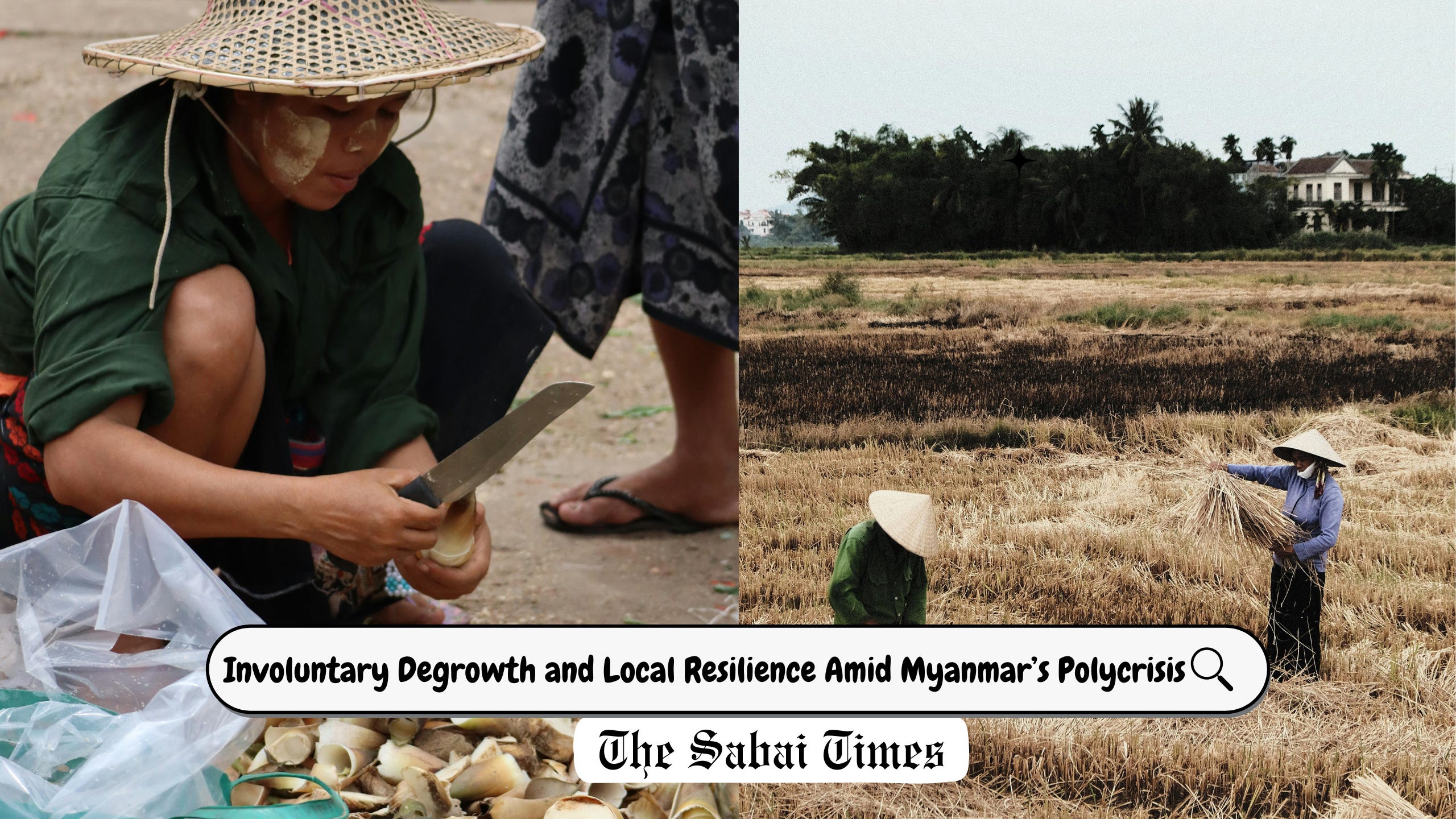
Since the 2021 military coup, Myanmar has been facing constant political instability, exacerbating a polycrisis in its environment, economy, and society. Wars, mass displacement, and livelihood hardship led to an involuntary reality, which is referred to as “degrowth.” The term “degrowth” is typically associated with purposeful initiatives towards economic downscaling for ecological and social reasons.
Key Takeaways
Involuntary Degrowth: In Myanmar, degrowth occurs not by choice but due to ongoing polycrisis..
Local Resilience: Communities use self-resilience, informal social safety nets, and small-scale projects with limited resources to cope and ensure survival.
Systemic Support: A long-term recovery strategy is essential to rebuild the structural frameworks and create economic opportunities.
What is Degrowth?
Degrowth is a socio-economic movement and theoretical framework that means intentional downscaling of production and consumption to emphasize ecological sustainability and human well-being. It criticises the goal of infinite growth as unsustainable and intimately related to environmental deterioration and social inequity.
Economic growth brings benefits like poverty reduction and improved living standards; however, without integrating sustainability, it leads to serious consequences such as resource depletion, pollution, climate change, and biodiversity loss—threatening both ecosystems and human health. It also leads to social injustice by disproportionately affecting vulnerable groups. Thus, the degrowth movement criticises growth without limits as unsustainable and demands prioritising ecological balance and well-being. The value of degrowth encompasses sufficiency, care, and community, independent of an emphasis on GDP (Gross Domestic Product) and material consumption.
Additionally, the degrowth is rooted in ecological economics. It promotes a societal shift where social justice, quality of life, and environmental health are valued more highly than material wealth. Nonetheless, degrowth is typically presented as a voluntary, policy-focused strategy that wealthy and stable societies adopt.
Degrowth Theory vs Polycrisis in Myanmar
Myanmar has faced a series of interconnected polycrises since 2021. Myanmar’s economy is declining from its previous status as an emerging market with growing industries and a youthful population. According to the theoretical approach, degrowth is associated with the intentional economic downscaling for environmental and social safety. However, the current economic reduction in Myanmar is mainly involuntary due to its political instability and structural collapse.
The crisis-induced degrowth in Myanmar has resulted in adverse economic outcomes. The continuous political instability has impacted trade and logistics, resulting in a sharp drop, with exports falling by 13% and imports falling by 20% during the six months from October 2023 to March 2024. Also, Myanmar’s GDP dropped by 9% from 2020 to 2024, showing an economic downturn.
The currency also fell from 1,330 kyat per USD in 2021 to 4,520 kyat in 2025, increasing import costs and domestic prices, while inflation increased sharply to 25.4% in 2024. The Financial Action Task Force (FATF) also blacklisted Myanmar for anti-money laundering efforts, advancing the crisis and shutting the country off from international financial systems.
Half of the population now lives below the poverty line, and the need for basic necessities and financial security is widespread in many areas. As a result of continuous political instability, economic backwardness, high inflation, and the current conscription law, many people and families have been displaced and forced to relocate both locally and abroad. When skilled workers are lost due to migration, the local human resource is weakened, productivity suffers, and the potential for economic growth is limited. Therefore, communities left behind may face difficulties escaping poverty and building sustainable households.
As the legal economy of Myanmar continues falling apart, the illegal economy has grown a lot. Trafficking, drug production, and unregulated markets are spreading across the country, and now it is the world's biggest producer of heroin and opium. The crimes, such as illegal gambling, human trafficking, and scams, have increased due to the lack of proficient policies and easy border crossings. The rise in illegal activities made the country’s socioeconomic crisis worse, which has made things more complicated for local communities.
Local Resilience: Community Strategies and Innovation
Even though the economic and social systems break down in this polycrisis, local communities are trying to be resilient as a means of adaptation. Some forms of resilience strategies include community-driven coping mechanisms and organized resilience initiatives.
Community-Driven Coping Mechanisms
Community-driven coping strategies, including self-resilience, livelihood diversification, and social safety nets, are now crucial for rural communities, which are dealing with social and economic challenges in Myanmar.
1.1 Self-Resilience
Many households have adopted self-reliant ways to survive, as it is hard to receive reliable government help. Their ways of surviving include relocating for employment, selling household properties for money, engaging in traditional farming to meet basic food needs, and implementing food coping methods such as skipping meals or eating less nutritious food. These strategies show how communities in Myanmar are vulnerable and resilient to long-term stressful situations.
1.2 Livelihood Diversification
Livelihood diversification became essential for local resilience as the rural population increasingly relies on small-scale businesses, agriculture, and informal labor markets to replace income lost from industrial and urban jobs. These tactics not only help households meet their everyday needs but also create a safety net against uncertain future situations.
1.3 Social Safety Nets
Informal social safety nets have emerged or grown in response to institutional gaps. Religious communities, diaspora networks, and community-based organizations provide material and emotional support to families that must maintain social cohesiveness and a basic living level. These grassroots initiatives show the importance of local collaboration in developing community resilience during crises.
Organized Resilience Initiatives
Organized resilience is crucial in helping vulnerable communities recover from current crises and build long-term sustainability. Community recovery projects and women empowerment programs are examples of organized resilience initiatives.
2.1 Community Recovery Projects
Community recovery projects such as UNDP's ENCORE program have been initiated to restore local livelihoods, improve essential infrastructure, promote social cohesion, and prepare for future shocks in highly affected cities. These strategies address actual needs and pave the way for long-term resilience.
2.2 Women Empowerment
Women's empowerment is one of the key initiatives to help and recover from crises by supporting women-led businesses. These projects help women sustain their livelihoods, contribute to household income, and build community resilience by providing financial, training, and technical assistance. By investing in women, these efforts promote the social fabric, boost local economies, and improve food security. Indeed, all these initiatives contribute to short-term resilience and inclusive and sustainable development during and after crises.
Challenges to Sustainable Resilience
While local efforts show strong determination and adaptability, they often face serious challenges such as a lack of funding, ongoing conflict, displacement, and climate disasters. In many areas, these community initiatives can only partly ease the broader economic decline and are still at risk from external pressures. Poor governance, limited support from authorities, and unforeseen challenges continue to threaten their progress. Even though these efforts help communities survive and thrive, they are still weak without a long-term recovery plan and better coordination. Therefore, stronger international humanitarian support is needed to run these local efforts more effectively and lastingly.
Conclusion: Survival is not a strategy
Degrowth has not been a choice in Myanmar’s crisis economy. However, it was shaped by a complex reality during a polycrisis, such as conflict, rising poverty, and the disintegration of daily life. Many communities in Myanmar have adopted their own ways to address these challenges as they are dealing with the shift in social and economic systems. Many households remain stuck in cycles of debt, food insecurity, and uncertainty. Without proper support, both from within the country and internationally, these coping strategies may not be enough to sustain people in the long term. More efforts are needed to improve essential services and create economic opportunities. Local resilience can serve as a foundation, but must be accompanied by a long-term commitment to rebuilding the systems and structures upon which people rely.
Pyae Phyoe Mon is a Junior Research Fellow at the Sustainability Lab of the Shwetaungthagathu Reform Initiative Centre (SRIc) and an M.A. Candidate in Social Sciences at the Faculty of Social Sciences, Chiang Mai University, Thailand.
“Advocating Sustainability, Shaping Our Future”
Help Sustain The Sabai Times - Myanmar’s Voice for Sustainable Development Support The Sabai Times