


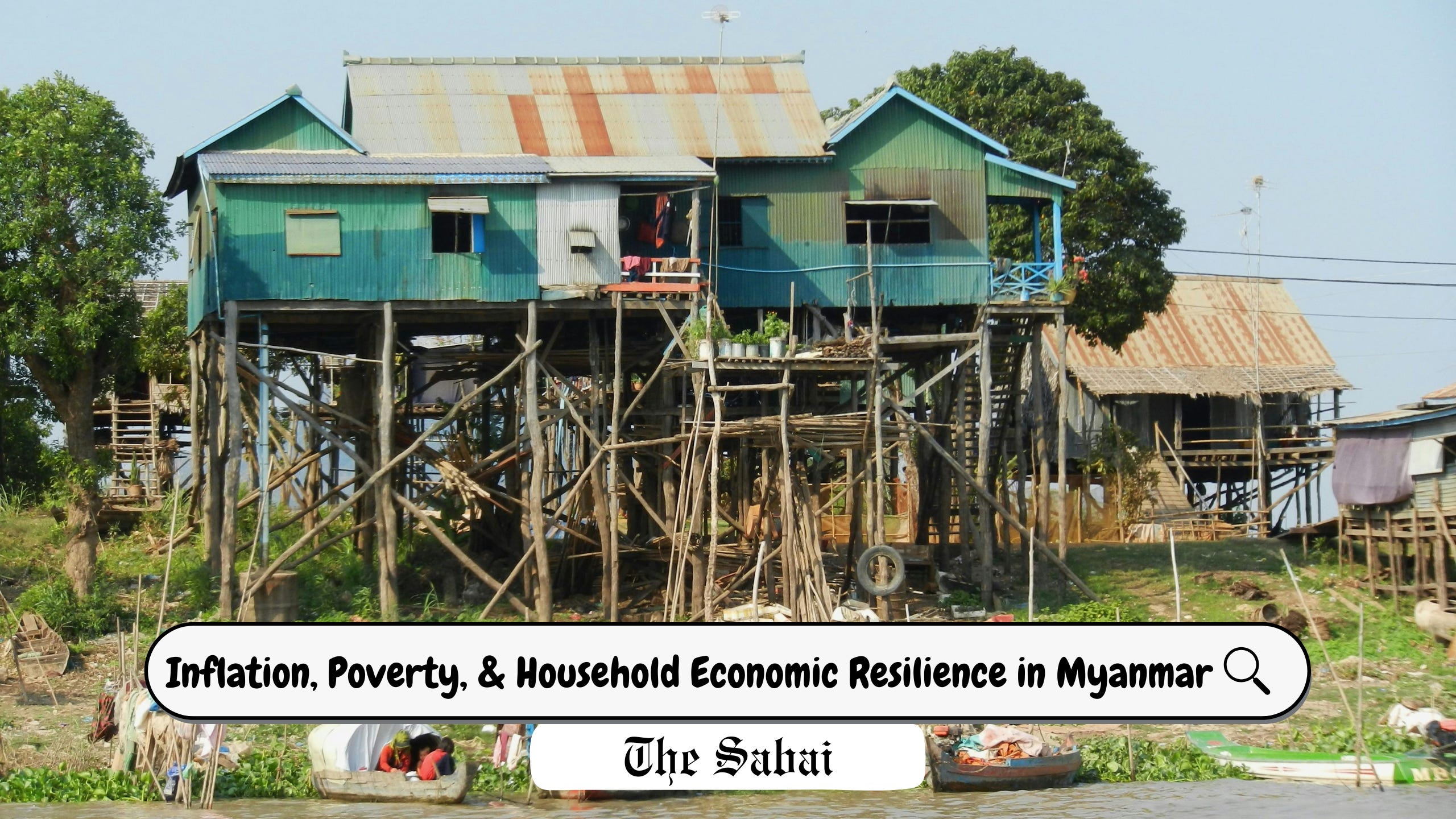
Myanmar’s ongoing polycrisis has accelerated inflation and poverty, placing growing pressure on households and increasing the urgent need for inclusive recovery and social protection measures.
Key Takeaways
Myanmar’s post-2021 polycrisis has driven persistently high inflation, weakening household incomes and purchasing power.
Inflation reflects structural problems in fiscal management, currency policy, trade systems, and political instability. At the same time, rising living costs have forced households to rely on harmful coping strategies that weaken their long-term economic resilience.
Without coordinated reforms and stronger social investment, Myanmar risks long-term poverty and inequality.
Nature of the Polycrisis (Post-2021 Context)
Since 2021, Myanmar has been experiencing a complex “polycrisis” driven by overlapping political, economic, social, and environmental shocks. Political instability and armed conflict have weakened public institutions and disrupted markets. The COVID-19 pandemic further strained already fragile health and education systems. At the same time, forced conscription, insecurity, and limited job opportunities have encouraged young and skilled workers to migrate, leading to serious human capital loss.
By 2024–2025, around half of the population was living below the poverty line, with another one-third close to it. Electricity access fell below 50 percent, while agricultural productivity declined due to rising input costs and restricted market access. Environmental degradation also increased climate risks. As incomes fell, households increasingly relied on selling assets and reducing consumption. These coping strategies have become long-term survival mechanisms rather than temporary responses, indicating deep fragility as a system.
Inflation in Myanmar
Inflation has been one of the defining features of Myanmar’s economic crisis. In 2023 and 2024, inflation remained extremely high, reaching nearly 30 percent year-on-year. By October 2024, end-period inflation stood at 29.7 percent. From April 2025, inflation began to ease as the kyat strengthened and food supply conditions improved. By October 2025, year-on-year inflation had declined to 19.8 percent, while average inflation fell from 27.9 percent in 2024 to 23.1 percent in 2025. This decline was driven mainly by slower food inflation, supported by humanitarian assistance and tighter price controls. At the same time, continued economic cooperation with China, including project financing and alternative financial arrangements after the 2021 coup, has provided the military government with an additional source of external funding despite Western sanctions. However, non-food inflation remained high, especially in energy, health, and transport, reflecting ongoing import restrictions and conflict-related disruptions. Overall, inflation has moderated from its peak but remains structurally elevated.
Several structural factors explain this pattern. First, monetary financing has fueled inflation. In 2023, two-thirds of the budget deficit was financed by the Central Bank of Myanmar, with the deficit reaching 5.6 percent of GDP. This expanded the money supply without corresponding growth in production. Second, supply constraints reduced the availability of goods. Import restrictions, conflict-related transport disruptions, and energy shortages limited both domestic and external supplies. Third, policy responses were largely ineffective. Price controls failed to manage inflation and instead created shortages, while the issuance of high-denomination notes in 2023 weakened public confidence in monetary management. Finally, depreciation of the kyat increased import costs, transmitting currency instability into higher domestic prices.
Together, these factors show that inflation in Myanmar reflects a combination of fiscal weakness, supply disruptions, and policy distortions rather than short-term market fluctuations.
Effects on Households
Inflation has severely affected household welfare, mainly because incomes have not kept pace with rising prices. In 2023, 57 percent of households reported no income growth, and 30 percent reported declines. Real household income fell by 15 percent between 2022 and 2023, while median incomes remained close to survival levels. Job losses, business decline, and farm disruptions were key causes. Informal employment increased, and job quality deteriorated, reversing earlier economic progress. The minimum wage has remained unchanged since 2018.
At the same time, prices of basic goods rose sharply. Food inflation reached 39 percent in late 2024. Non-food inflation was also high, especially in health, transport, and energy. Conflict-affected regions faced higher inflation due to transport disruptions and market fragmentation.
Urban households faced heavy cost burdens. Rent rose by 24.6 percent, petrol prices increased by 44 percent between Q4 of 2023 and 2024, and city inflation ranged between 21 and 26 percent. In cities, prices increased more rapidly than in rural areas because businesses faced higher transport and operating costs, while the arrival of displaced people also raised demand for housing, food, and services. Urban consumption fell by nearly 20 percent between 2017 and 2023. In March 2026, the military government introduced an even-odd” licensing scheme driving rule for private vehicles to conserve fuel amid global supply disruptions linked to conflict in the Middle East. This policy suggests limited fuel reserves and could further increase transport costs and inflationary pressure in Myanmar.
Rural households were affected by declining agricultural viability. Agricultural employment fell from 43 percent to 34 percent, while rising input costs reduced farm incomes. Rural consumption declined by 6 percent.
Marginalised communities experienced frequent shortages, displacement, and restricted market access. Low-income households across all areas lacked savings and secondary incomes. Overall, inflation has deepened inequality and weakened household resilience.
Coping Strategies
As economic pressure increased, households relied more on negative coping strategies. Many reduced their food intake and cut spending on health and education. Among the poorest households, 42 percent reported eating less. These practices weakened nutrition and human capital development.
Savings were rapidly depleted. By late 2024, only 20 percent of households had any savings or bank deposits. Informal borrowing became widespread. About 64 percent of loans came from relatives and friends, while 22 percent came from moneylenders who usually charge high rates. Most loans were used for food and health expenses, indicating distress borrowing. Many households sold productive assets such as land, bicycles, and tools, reducing their future earning capacity.
As financial pressure increased, some households turned to risky income-generating activities, with about 5 percent reporting engagement in such strategies nationwide. Economic stress has also been linked to rising drug and alcohol use, domestic and gender-based violence, and increased vulnerability among adolescents and young people, who face greater risks of harmful behaviours due to disrupted education and limited job opportunities.
Migration became one of the most important coping mechanisms. Around 10 percent of households sent migrants in 2024, and about 3.7 million Myanmar migrants lived in Thailand. Migrants to Thailand and Malaysia earned two to three times domestic wages, while those in Japan and Korea earned much more. The introduction of compulsory military service in 2024 has also accelerated outward migration, as many young people left the country to avoid conscription. Remittances supported about 7.5 percent of households and improved nutrition. However, forced currency conversion and taxation reduced net benefits and encouraged informal transfers.
Overall, while these coping strategies help households survive immediate shocks, they are largely unsustainable and weaken long-term resilience.
Consequences
The combined effects of inflation and conflict have severely damaged health, nutrition, and education. Many households reduced meals, relied on cheaper food, or borrowed food. Around 25 percent of households experienced acute food insecurity in early 2024. Adult diet quality deteriorated, and more than 20 percent of children had inadequate diets. Unmet healthcare needs reached 8.1 percent nationally and over 14 percent in conflict-affected regions. Limited access to medicines and medical services further increased health risks.
Education has also been deeply affected. In 2023/24, 21 percent of children were out of school. Low-income households spent only 2 percent of their budgets on education, compared with 4 percent among wealthier households. Financial pressure forced many families to withdraw children from school.
As household incomes declined, some families relied on child labour and early marriage to cope with financial stress. The introduction of the conscription law has further intensified these pressures, as some families arrange early or forced marriages for young women to avoid military service obligations. Informal and community-based education systems struggled with limited resources and security risks. These trends have reduced learning outcomes and skill development.
Together, deteriorating health and education outcomes threaten Myanmar’s future productivity and social mobility. Loss of human capital increases long-term vulnerability and limits the country’s capacity to recover from a crisis.
Poverty Trap
Myanmar’s poverty levels have risen sharply over the past decade due to overlapping political and economic crises. By the end of 2023, 49.7 percent of the population lived below the national poverty line, while another 25 percent remained just above it, meaning around 42 million people were living at or near subsistence levels. This marks a dramatic increase from 24.8 percent in 2017. Child poverty has also worsened, with 53 percent of children, about 8.9 million, living in poverty by 2022.
At the same time, the poverty gap has widened, showing that poor households are becoming more vulnerable. Reduced spending on health, education, and nutrition is reinforcing long-term disadvantage, while the middle class continues to shrink. Without the post-2021 crisis, poverty would likely have been close to 11 percent in 2023, with around eight million fewer poor people (WB04). These trends indicate that Myanmar is entering a self-reinforcing poverty trap.
Conclusion
Between 2021 and 2026, Myanmar’s economy has been shaped by structural inflation, currency instability, and prolonged trade disruptions. These pressures have weakened household resilience and accelerated the erosion of human capital. As incomes stagnated and prices surged, families increasingly relied on negative coping strategies that undermine long-term well-being. The combined effects of poor governance, policy distortions, and conflict have reinforced poverty and inequality, pushing many households into a cycle of vulnerability.
These trends not only deepen domestic hardship but also highlight major challenges in achieving SDG2 (Zero Hunger), SDG3 (Health), SDG4 (Education), and SDG8 (Decent Work). Without political stabilisation and institutional reforms, as well as improvements in monetary governance, exchange rate management, trade facilitation, social protection, and sustained investment in health and education, Myanmar will face prolonged stagnation and intergenerational poverty.
Hsu Latt Phyu is a Junior Research Fellow at the Sustainability Lab of the Shwetaungthagathu Reform Initiative Centre (SRIc). She holds a Master’s degree in Social Innovation and Sustainability from Thammasat University, Thailand.
“Advocating Sustainability, Shaping Our Future”
Help Sustain The Sabai - Myanmar’s Voice for Sustainability Support The Sabai