

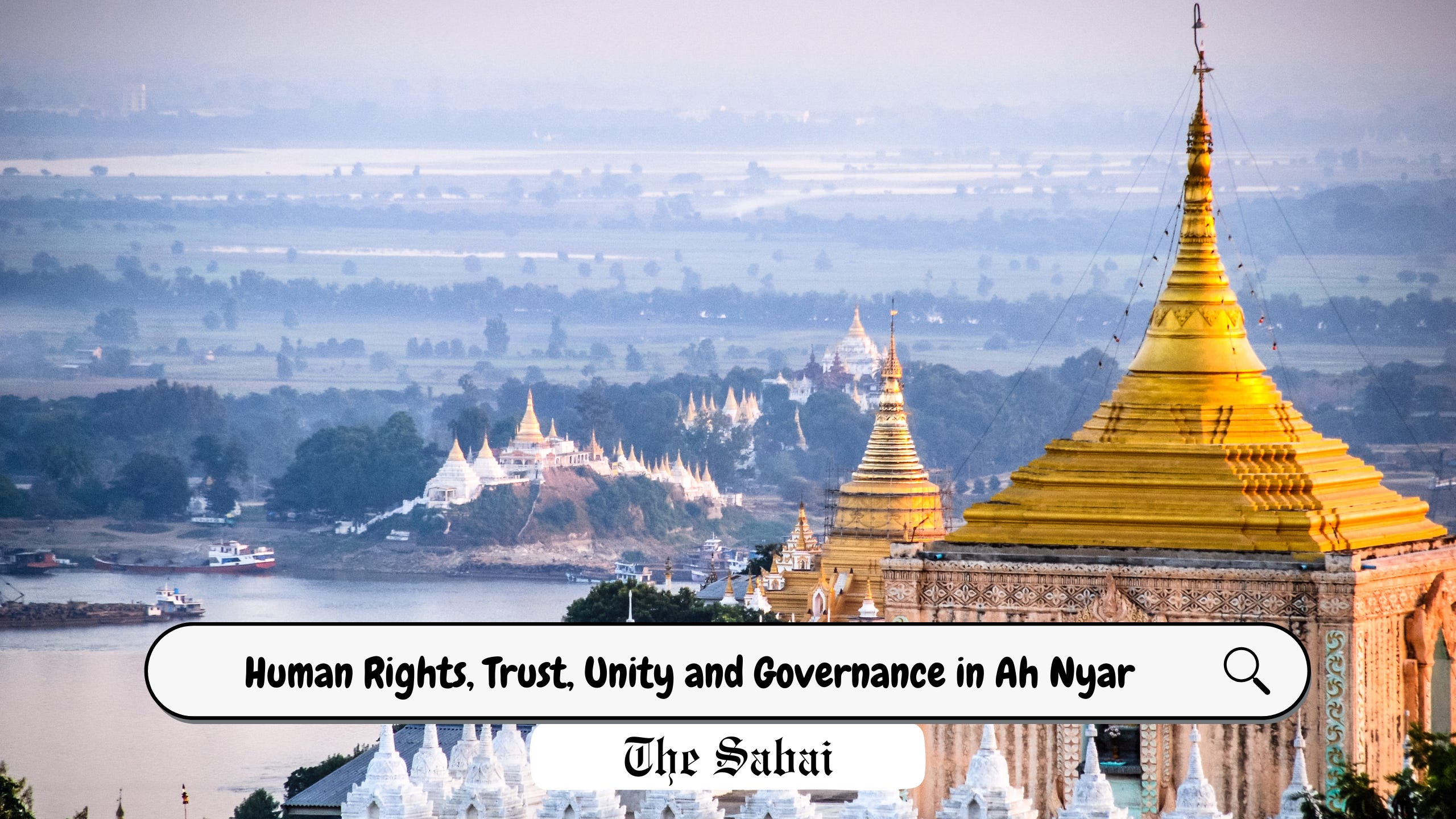
In Myanmar’s conflict-affected Ah Nyar region, growing awareness of human rights is creating new expectations of local authorities while security pressures complicate how those rights can be protected.
Key Takeaways:
Human-rights awareness is growing, but awareness alone is not enough. Communities need practical ways to understand and advocate for their rights within conflict and security constraints.
Security restrictions can affect public trust and governance. When restrictions on rights such as freedom of expression or movement lack clear limits, accountability can weaken, and distrust between communities and local authorities can deepen.
Trust requires shared responsibility. Local authorities, communities, and NGOs/CSOs can work together to balance security, rights, and accountability through practical rights education, dialogue, monitoring, and mechanisms for restoring restricted rights.
Myanmar’s post-2021 crisis has led to not only a political and humanitarian crisis but also a governance and sustainability challenge, especially under the control of resistance forces. In particular, the period of the conflict has lasted longer; simultaneously, the trust and social cohesion between relevant actors- communities and local authorities- have declined gradually (Ko, 2024). In this article, the good governance and sustainability challenge will be approached through a human rights dimension. It did not even exist in the history of Myanmar; online-based human rights universities and broader human rights training have appeared physically and virtually, raising human rights awareness among the public (Our Diplomas, n.d.; School, 2025; Studies, 2023). Similarly, Ah Nyar’s public has also obtained access to study human rights during the conflict despite the serious oppressions and violations committed by the military (Centre for Ah Nyar Studies, 2025; Karen Human Rights Group, 2024). Therefore, the public's awareness level of human rights has risen. Simply, delivering human rights awareness is a good sign.
Yet, during conflict-tension settings, there are multiple factors to be considered to practise human rights. Importantly, human rights language must not be a distractor between the public and local authorities, who are altogether fighting for democracy against the military regime. In the conflict zones, between the public who demand their rights from the authorities and the local authorities who hold safety and security concerns, some invisible and critical issues have been found, challenging good governance, sustainable unity, and trust. Especially when interviewing ordinary citizens, CDM teachers, and human rights activists in the conflict zones, a trust decline in the local authorities was discovered. Despite several reasons, the human rights corner has played a critical role in this discourse. As the momentum of human rights has penetrated into the rural public, people who had not heard about human rights before the coup have now spoken about human rights. Yet, human rights language in the war zones is not as simple as literature written. It is essential not to hinder governance, the unity and trust between both actors, revolutionizing the dictatorship. However, although the public gained fundamental human rights awareness, the essential sector- how to advocate human rights in the conflict setting and how to manage the distracting factors affecting the revolution- might not be trained. Consequently, the public likely sees their rights and advocates for them, but less so considering conflict zone-based external factors - safety and security, resource availability, and realistic status- which leaves local authorities in a quandary. It does not mean that basic rights are not vital; they are essential, as rights are interrelated and interdependent. Yet, such consideration can help the local authorities to fulfill the rights in the conflict zones, strengthening good governance, unity, and trust between both revolutionary actors.
In contrast, local authorities should consider the specific timeframe and make deep attempts to provide basic rights, such as freedom of expression and movement, although a limitation on basic rights referring to safety and security concerns is acceptable and understandable. Besides, to avoid violating other rights as a domino effect, alternative ways should be discovered. For example, a limitation on freedom of expression, for the reason of safety and security concerns, can shut up the voice of the public about the violations of armed groups, affecting sustainable unity and trust (Mizzima, 2026). Thus, a limitation on basic rights, without a specific timeframe or recovery ways to control the domino effects of this right, can challenge other rights, testing the cohesive resistance between the local authorities and the public (Ko, 2024). Shortly, local authorities should deeply consider that even basic rights are limited; attempts to provide these rights back and recovery ways not to violate or affecting other rights should be guaranteed, ensuring good governance, unity, trust, and sustainable support of the public.
In this context, only gaining mutual understanding between the service receivers (the public) and service providers (the authorities) is not enough; the role of NGOs/CSOs is critical, working as a bridge between these two bodies. Especially from the human rights perspective, when training human rights to the public and local authorities, not only raising human rights awareness but also guide the ways- how to consider conflict tensions, a practical ground-based approach beyond the theoretical approach, and the strategies to strengthen good governance- the unity and trust between both revolutionary actors should be included. Importantly, the possibility of head-to-head conditions between the public and the authorities should be avoided because this is a conflict-context-based training. Instead, human rights should be a tool, strengthening good governance, unity, and trust between the public and authorities.
To sum up, a three-dimensional approach- the public, the local authorities, and the NGOs/CSOs- can help to raise the human rights sector in the conflict zones, while strengthening good governance and the unity and trust between revolutionary actors.
References
Centre for Ah Nyar Studies. (2025, March 20). Human Rights ToT Training. https://ah-nyarstudies.org/human-rights-training-of-trainers-programme-successfully-held-in-ah-nyar/
Karen Human Rights Group. (2024, October 4). Resilience and Resistance: Challenges and threats faced by Human Rights Defenders (HRDs) in Southeast Burma since the 2021 coup. Karen Human Rights Group. https://khrg.org/2024/09/24-3-bp1/resilience-and-resistance-challenges-and-threats-faced-human-rights-defenders-hrds
Ko, A. T. K. (2024). GOVERNANCE CHALLENGES IN RESISTANCE-CONTROLLED AREAS AMID MYANMAR’S REVOLUTION.
Mizzima. (2026, January 5). လိင်အကြမ်းဖက်၈၈ခုတွင် စစ်အုပ်စုက ၃၁ မှု တော်လှန်သူများက ၂၈ မှု ကျူးလွန်ကြောင်း BMW ဖော်ပြ. https://www.facebook.com/share/p/1JMXGHT5Tq/
Our Diplomas. (n.d.). SUM. Retrieved October 19, 2025, from https://www.springuniversitymm.com/diploma-in-hr
School, I. (2025). Irrawaddy Law School. https://ils.ac/
Studies, H. R. and P. (2023, June 12). PNMD Official Launch: Enhancing Human Rights and Peace Education through International Partnership in Southeast Asia. สถาบันสิทธิมนุษยชนและสันติศึกษา. https://ihrp.mahidol.ac.th/news-in-2023-en/pnmd-official-launch/
Maw Byar Myar is currently pursuing a Master of Arts in Human Rights, Peace, and Democratization at Mahidol University, Thailand, through the Pyin Nyar Mann Daing (PNMD) Programme, jointly implemented with Yangon Cosmopolitan University.
“Advocating Sustainability, Shaping Our Future”
Help Sustain The Sabai - Myanmar’s Voice for Sustainability. Support The Sabai