


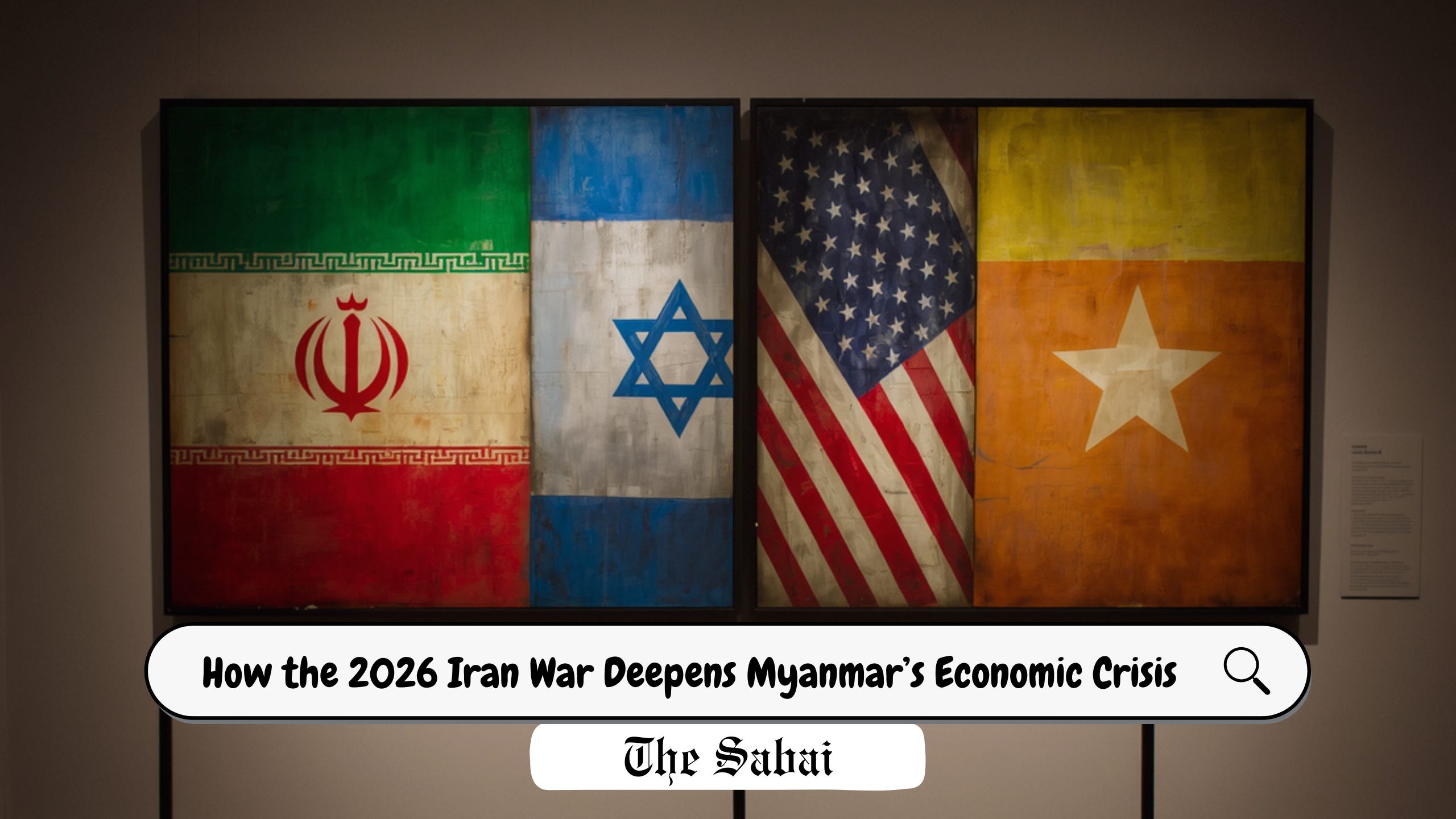
The 2026 Israel-Iran war is shaking up energy markets around the world. In Myanmar, this has led to fuel shortages, rising costs, and greater pressure on agriculture and people’s livelihoods.
Key Takeaways
Myanmar’s heavy reliance on imported fuel (over 90%) leaves it highly exposed to global disruptions, with instability in the Strait of Hormuz triggering shortages, price spikes, and long fuel queues domestically.
Rising fuel and fertiliser costs are disrupting agriculture, reducing productivity, and increasing food prices, putting pressure on farmers and worsening food insecurity across the country.
Fragmented government policies, combined with crony control of sectors like the EV market, allow elites to benefit during the crisis while ordinary citizens face shortages, higher living costs, and limited access to resources.
Introduction
The U.S.-Israel-Iran war, often known as the 2026 Iran war, started on February 28, 2026. Coordinated Israeli and U.S. attacks on Iran started the conflict, which rapidly intensified once the Iranian supreme leader and civilians were killed. As the Middle East is a key hub for energy production and international shipping routes, instability in the region can have widespread economic consequences. One of the most critical factors is the Strait of Hormuz, a narrow shipping route between Iran and Oman. It is one of the world’s most important maritime chokepoints, with around a quarter of global crude oil shipments passing through it daily. On April 22, WTI crude futures stayed above $89 per barrel after peace talks between the US and Iran failed, and shipping through the Strait of Hormuz is mostly blocked.
These problems have had significant effects on global supply chains, especially because fuel prices are going up and energy flows are being limited. Myanmar is especially vulnerable because it is an underdeveloped country that has been affected by internal conflict and relies heavily on imported fuel, which makes up more than 90% of its domestic consumption. Myanmar relies heavily on suppliers in the region, like Singapore, Malaysia, Indonesia, and Thailand. They are also imposing export controls as a precaution because of global uncertainty, while domestic production in Myanmar accounts for only about 3% of consumption. This article argues that the Israel-Iran War has intensified Myanmar’s economic fragility by disrupting fuel imports, increasing agricultural costs, and worsening economic inequality, while exposing governance limitations and policy gaps.
Why is Myanmar highly vulnerable?
1 Dependence on Structure and Energy Insecurity
Dependency theory explains why Myanmar is so vulnerable to the global fuel crisis. It shows how economies on the edge rely on resources from outside the nation’s borders. Approximately 90–95% of the petroleum products that the country uses come from other countries, which shows that it is dependent heavily on foreign sources. At the same time, there isn’t sufficient refining capacity in the country, and local production only meets a small part of national demand. In the largest city, Yangon, long queues at gas stations usually take around 5 hours to buy the limited amount of petrol in the heat, which causes fainting. Myanmar’s ability to import fuel is limited by insufficient foreign exchange reserves, resulting in this structural imbalance being significantly worse. Because of this, outside shocks, like problems with the global oil supply, lead to shortages and higher prices at the national level.
2 Insufficient Oil Production despite oilfields
Experts and former oil industry workers say that Myanmar does make crude oil, although it can’t refine it adequately for use in the country, so it has to rely heavily on imported fuel. One big reason is that the country’s refinery factories are old and do not have the latest technology, so they can’t turn crude oil into high-quality petroleum that meets industrial standards. Also, crude oil made in the area is often of low quality and needs chemical refining, which makes things more expensive and complicated. The situation is even worse because there isn’t enough electricity, and there are security problems in some oil-producing areas that have been controlled by local revolutionary forces. Limited government budgets also make it hard to invest in refinery and energy infrastructure improvements. In consequence of this, Myanmar is still structurally dependent on foreign refined fuel, even though it holds its own oil resources.
3 Agricultural Sector in Myanmar
The Iran conflict is also impacting the availability of critical raw materials. The region is a major exporter of fertilisers, petrochemicals, and energy-based products used in agriculture and manufacturing. Any disruption would strike the imports of Myanmar fertilisers worth over USD 500 million a year. People are queuing to purchase fuel to irrigate their fields and harvest their summer rice fields during this summer rice planting season, and it is difficult to get plenty to plant in their farms. A severe shortage of diesel, necessary for agricultural machinery, threatens food security. The increase in diesel price and oil shortage is leading to unable to operate their tractors and irrigation pumps for rice farming, as well as transportation to the market. Farmers are struggling with fuel prices, which are nearing 4,000 kyats per litre. Planting could be delayed, and yields could drop. On 21 March, Myanmar Rice Federation (MRF) made a statement, urging the stakeholders in the industry to avoid panic buying of fuel and fertilizers. However, MRF cannot control fuel prices or global shortages directly. The price of agricultural products, especially in the rice market, will dramatically increase along with the other food markets if the situation continues in the next three months.
4 Vulnerability of Myanmar Civilians
The crisis is not limited to farmers, but it is also severely affecting day-to-day workers who depend on transportation to earn a living. Low-income workers, particularly trishaw drivers (scooters with sidecars used for local passenger transport), taxi drivers, and those commuting daily from suburban or rural areas, are facing escalating fuel costs. As a result, their income is shrinking while the cost of essential goods continues to rise. At the same moment, the government’s increased airstrikes on civilian areas are compounding these hardships by disrupting local economies, displacing communities, and increasing insecurity. Recent reports say that airstrikes have killed hundreds of civilians in many areas and caused a lot of damage to schools, clinics, and religious buildings. This doubled pressure, economic strain from the fuel crisis, and continuous airstrikes make it even more challenging for civilians.
Government and NUG Responses
1 Government’s Actions
The head of Myanmar’s junta, Min Aung Hlaing, has swapped his uniform for the top civilian office and become the president on 3 April. In response to the worsening fuel crisis triggered by the Israel-Iran conflict, the new regime led by President Min Aung Hlaing has implemented a series of short-term measures to reduce domestic fuel consumption. Between March 7 and April 3, authorities introduced multiple fuel control systems, including the odd–even license plate policy, which disrupted transportation-dependent businesses, reducing operating capacity and income for logistics providers, small traders, and service workers. The old and revised Barcode/QR distribution systems a mechanism that allocate fuel based on vehicle engine type. This QR system has revealed systemic misconduct that goes beyond inefficiency. Because of the system’s reliance on static data, legal owners are unable to access their own fuel quotas, allowing actors with fake license plates to take control of them. In addition to making illegal trade easier, this crack puts car owners who are harmed by a flawed regulatory system under a great deal of financial and psychological strain. Also, authorities are conducting office work from home on Wednesdays of each week. These rapidly changing policies suggest a lack of preparedness for an urgent crisis of this scale. At the same time, Energy Minister U Ko Ko Lwin travelled to China and Russia, where discussions focused on long-term fuel imports at lower prices, including electricity cooperation and fertiliser imports, but the implementation will not solve the current economic recession.
On the other hand, ASEAN countries have taken steps to lessen the economic shock. For instance, Malaysia has fiscal space in its budget to deal with outside pressures because its currency is stable, inflation is under control, and its bond markets are strong. Indonesia has set aside about 381.3 trillion rupiah (about USD 22.5 billion) for energy subsidies. This includes paying state-owned businesses to keep fuel and electricity prices low. The Philippines has also introduced targeted subsidies to help with rising oil prices and the costs of basic goods. Vietnam, on the other hand, has taken proactive steps to make sure that fuel supplies stay stable during global disruptions.
However, Myanmar lacks comparable fiscal power or policy flexibility. The current regime already relies on printing money to make up for its budget shortfall, so it is unlikely to give out a lot of subsidies. Instead, it is focusing on getting fuel for the military instead of for civilians. In consequence of this, farmers, workers, and low-income families bear an unfair share of the burden of rising food and fuel prices, making the situation harder for those who are already struggling financially and starving.
2 Cronies & Myanmar EV market
Myanmar’s electric vehicle (EV) market is largely controlled by businesses linked to Min Aung Hlaing’s family, particularly his children, who dominate EV imports and distribution. This reflects their close ties, through crony capitalism, to the current president, who emerged from the widely criticised 2025 “sham election.” The existing regulatory framework is biased in favour of military-related organizations, and competition is restricted, which contributes to economic inequality. During the current Israel-Iran conflict, the public was restricted to fuel, including the “odd-even” policy, which exempted EVs, which boosted the demand artificially in a market dominated by military-related companies. As a result, EV prices surged dramatically, with some models rising from around 195 million (about US$44,318) to 285 million kyats ($64,777). This lack of regulation permits price fixing and monopoly, which explains how patronage networks can help elites to make money under crisis circumstances, as normal citizens remain trapped in fuel shortages and rising living costs.
2 Role of NUG in the Oil Shortage
The National Unity Government (NUG) has responded to Myanmar’s fuel crisis, mainly in areas under its control. It has introduced a fuel transit permit system to regulate and monitor petroleum flows, requiring official approval for transportation into regions such as Kachin, Chin, and Rakhine, primarily to prevent supplies from reaching the military junta. However, this policy has created friction with Chin and Rakhine allies, as this letter can create potential dissent among the public. The NUG also uses fuel control as a wartime strategy to weaken the regime’s logistics capacity. However, these restrictions have contributed to local shortages, higher prices, and logistical delays in some areas. Overall, its role is indirect and politically driven rather than solving structural fuel supply problems.
Recommendation & Implementation
Myanmar should monitor and adjust fuel allocation policies, learning from successful practices in neighbouring countries to reduce the risk of severe fuel shortages.
The country needs to strategically diversify fuel import channels, expand national energy reserves, and reduce dependence on limited external suppliers.
The NUG, EAOs, and other local defence forces should reach a mutual consensus on fuel management strategies and oil control policies to prevent misuse by military actors.
In the long term, the agricultural sector must transition from fuel-dependent mechanised farming to a hybrid resilience model, combining limited diesel use with renewable energy and cooperative farming systems.
Above all, Myanmar needs political stability since no technological or economic programme can be successfully implemented or maintained in the absence of transparent institutions and decent administration.
Conclusion
Myanmar’s crisis illustrates how geopolitical conflicts can deepen economic instability in vulnerable states, highlighting the urgent need for resilience-building policies. Energy prices are a key factor in supply chain operations because industries such as the agricultural sector, the manufacturing sector, and logistics depend heavily on fuel. When oil and gas prices increase, transportation and production costs rise, profit margins shrink, and consumers face higher prices. This creates ongoing pressure for supply chain professionals to improve efficiency and manage cost fluctuations effectively.
Khant Eaint Hmoo is a Research Assistant at the Sustainability Lab of the Shwetaungthagathu Reform Initiative Centre (SRIc) and a Bachelor of Economics (Hons) student from Albukhary International University, Malaysia.