


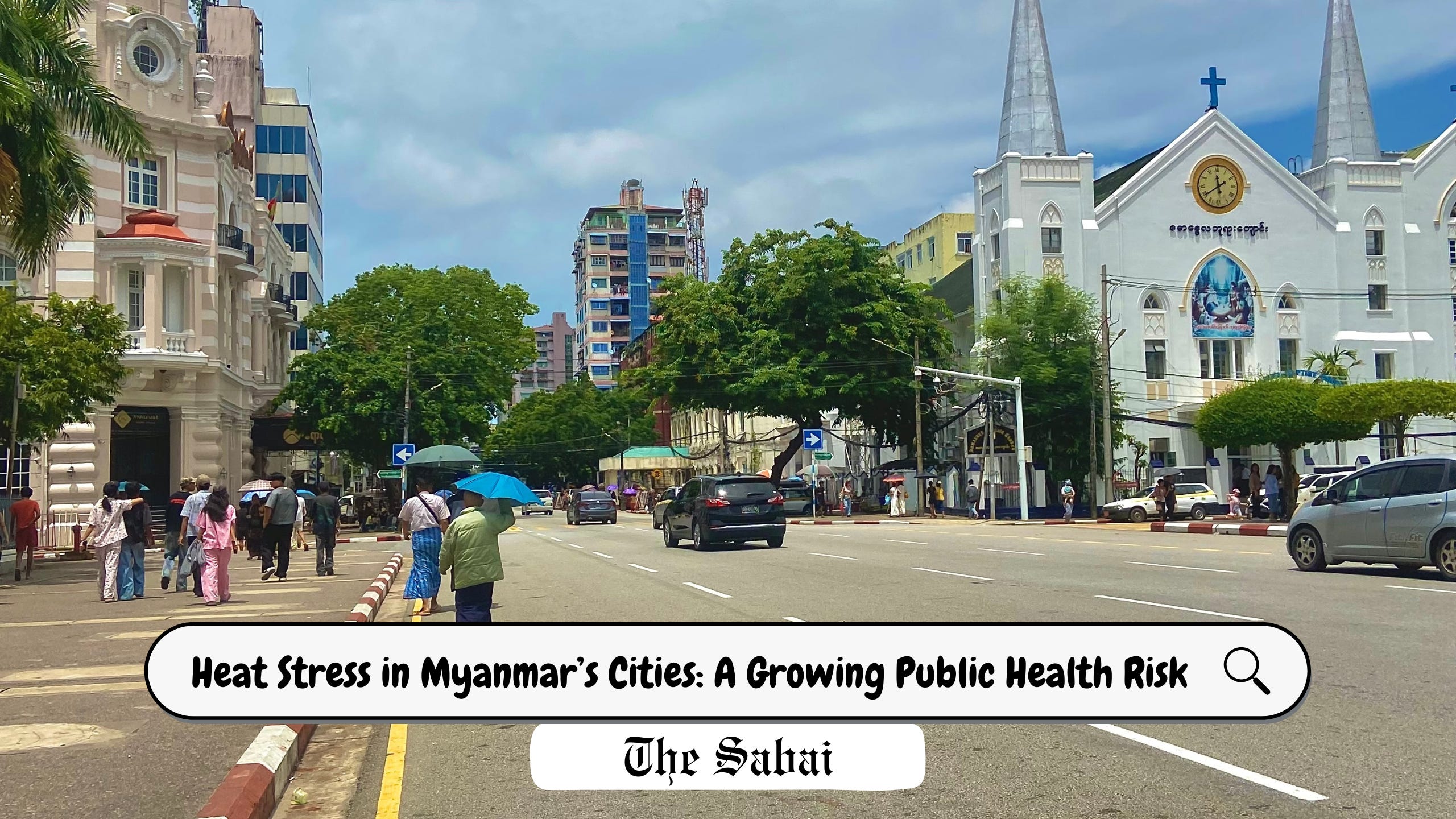
Extreme heat is becoming a serious and growing risk to public health in Myanmar’s cities.
Key Takeaways
Extreme heat in Myanmar is increasing rapidly, with record-breaking temperatures and rising heat-related deaths showing it is already a serious public health risk.
Urban conditions, such as dense infrastructure, limited green space, unreliable electricity, and ongoing conflict, are intensifying heat exposure, especially for vulnerable groups.
Despite growing impacts, heat stress remains under-recognised and under-addressed, requiring urgent, coordinated action at both national and urban levels.
1. Importance of addressing the problem
Across Southeast Asia, heatwaves are becoming more frequent, longer, and more intense due to global warming. Recent years have seen record-breaking heat causing deaths, hospitalisations, school closures, and economic losses. Scientists warn that this trend will continue, with each year becoming hotter than the last.
Myanmar is part of this regional pattern and is highly vulnerable to climate change. Temperatures have already increased over recent decades, and extreme weather events, including heatwaves, are becoming more frequent and intense. Limited capacity to respond further increases the country’s risk.
Heat stress is driven mainly by climate change, which increases temperatures and leads to more frequent and intense heatwaves. Natural factors like El Niño can worsen extreme heat, while human activities, such as deforestation, land-use change, and rapid urbanisation, reduce natural cooling and make cities hotter.
Despite these risks, extreme heat is still not widely recognised as a major public health issue, with gaps in data, research, and policy attention. As a so-called “silent killer,” heatwaves are likely causing more deaths than reported, especially in urban areas where exposure is highest.
2. Evidence of Extreme Heat Stress in Myanmar
Evidence shows that extreme heat in Myanmar is increasing in both frequency and intensity. Temperature data indicate a clear warming trend. Myanmar’s mean annual temperature has risen by about 0.82°C over the past 50 years and is projected to increase by up to 2.07°C by 2060. Long-term projections also suggest that both minimum and maximum temperatures could rise by up to 2.7°C by the end of the century. In recent years, temperatures during the hot season have regularly exceeded 40°C, with some areas experiencing temperatures above 44°C. This reflects a broader global pattern, as the past decade has been the warmest on record.
Historical records show that extreme heat events have occurred before, but are becoming more severe. For example, a heatwave in 2010 recorded temperatures as high as 47°C in Mandalay.
More recently, new records have been set. In April 2024, Myanmar recorded its highest-ever April temperature of 48.2°C in Chauk, while Yangon exceeded 40°C and Mandalay reached 44°C. According to Eldorado Weather, four cities from Myanmar have been listed among the world’s 15 hottest cities in March 2026. At the same time, projections indicate that sea levels could rise by 20–41 cm by the 2050s (up to 83 cm by the 2080s), potentially submerging 30% of the Ayeyarwady Delta and leading to 43% land loss .
These data confirm that climate risks in Myanmar are increasing rapidly year by year.
3. Urban Heat Stress & its Contributing Factors
Urban areas in Myanmar face higher heat stress due to a combination of environmental and socio-economic factors.
Changes in land use, including the loss of vegetation, reduce the ability of the environment to regulate heat. One key driver is the urban heat island effect. Dense buildings, concrete, and asphalt surfaces absorb and retain heat, making cities significantly hotter than surrounding areas. Rapid urbanisation, combined with limited green spaces, reduces natural cooling and prevents temperatures from dropping, especially at night. Rapid urbanisation is worsened by corruption and weak land-use regulation in Myanmar, leading to the conversion of green spaces into built-up areas. In cities like Yangon, high humidity combined with trapped heat in crowded living environments makes it even harder for residents to cope with extreme temperatures. As urban populations grow, these challenges are expected to worsen.
Beyond environmental factors, broader sustainability challenges also increase vulnerability. Ongoing conflict has displaced many people into temporary or poorly ventilated shelters, where protection from extreme heat is limited. At the same time, the conflict has forced people to move from rural areas to cities like Yangon, placing additional pressure on already overstretched urban centers like Yangon.
Limited access to electricity further worsens the situation. Many households experience unstable and insufficient power supply, making it difficult to use fans or air conditioning during extreme heat. Electricity has increasingly become a luxury rather than a basic service for the public, due to structural challenges, resource shortages, and political instability. In many areas, power is available for only around eight hours per day, often at unpredictable times due to supply shortages. Although there are other alternative energy sources, such as solar power, access to them remains limited, as high installation costs make them affordable only for wealthier households.
These factors together make urban populations in Myanmar particularly exposed to heat stress.
4. Heat Stress Impacts in Myanmar: Evidence and Trends
The rise in extreme heat is already having serious impacts on human health in Myanmar.
Heatwaves are prolonged periods of unusually high temperatures that can harm both human health and ecosystems. Health risks are especially high in urban areas, where dense infrastructure and limited cooling increase exposure.
Recent events show the scale of these impacts. During the 2024 heatwave, at least 1,473 people reportedly died from heat-related causes in a single month. This represents a significant increase compared to 2010, when 260 heat-related deaths were recorded during the summer. Such figures suggest that heat-related mortality is rising rapidly alongside increasing temperatures.
While people in Myanmar are accustomed to high temperatures, increasingly deadly heat extremes are being recorded. This can create a false sense of safety, as some may believe they are prepared for the heat. However, those who do not seek information on heat-related risks may face higher exposure during heatwaves. As a result, heat stress is emerging as a significant but often overlooked public health risk in Myanmar.
5. Public Health Risks
Extreme heat poses serious and wide-ranging public health risks in Myanmar, particularly for vulnerable populations.
Exposure to high temperatures can lead to a range of health problems, including heat exhaustion, heatstroke, dehydration, and worsening of cardiovascular and respiratory conditions. Evidence from Myanmar also shows that people experience symptoms such as fatigue, headaches, skin problems, and difficulty concentrating during heatwaves. In many cases, these effects can last beyond the heatwave period and increase the risk of mortality.
The impacts are not evenly distributed. Older people are particularly vulnerable, as their bodies are less able to cope with extreme heat, and most excess deaths during heatwaves occur among the elderly. Children are also at higher risk, as heat can affect their physical and cognitive development. Outdoor workers, such as construction workers and street vendors, face prolonged exposure and a higher risk of heat-related illness.
Social and economic inequalities further increase vulnerability. Low-income communities and those living in informal settlements often lack proper housing, ventilation, and access to cooling, increasing their exposure to heat. Women, especially those who are pregnant or postpartum, also face additional health risks, as exposure to extreme heat has been linked to higher risks of preterm birth, low birth weight, stillbirth, congenital abnormalities, and neonatal mortality, yet gender-sensitive responses remain limited.
Current conditions in Myanmar can further worsen these risks. Fuel shortages have led to long queues at petrol stations, with people waiting for hours under extreme heat. Some reports on social media and certain sources suggest that individuals have fainted or even died while queuing in these conditions.
These patterns show that heat stress is not only a health issue, but also a question of social inequality in Myanmar’s context.
6. Recommendations to mitigate and adapt to the risks
Addressing heat stress in Myanmar requires both immediate responses and long-term planning.
In Myanmar, some initiatives are already being implemented, although they remain limited. The Myanmar Red Cross Society (MRCS) has been supporting communities through early warning messages, awareness campaigns, first aid services, and the creation of shaded spaces during heatwaves. However, these efforts face constraints due to limited resources and ongoing political challenges, which restrict wider implementation. Since the 2021 military coup, reductions in international funding, the withdrawal of aid programmes, and increasing restrictions on NGO operations have significantly weakened the capacity of civil society organisations to deliver services and support vulnerable communities. In addition, Myanmar still lacks advanced heat monitoring systems, such as standardised heat stress measurement tools, which limits effective early warning and response.
At the regional level, neighbouring countries are adopting more structured approaches. For example, Bangkok has introduced cooling centres and public cooling spaces, along with a heat warning system to guide public behaviour during extreme heat. Other Countries in Southeast Asia are also using data and technology to improve responses. Singapore applies climate modelling and urban monitoring systems to inform heat-resilient urban planning, while cities like Malacca use low-cost sensors and nature-based solutions to reduce urban heat.
In the short term, expanding green spaces, improving access to water, strengthening public education and awareness on the risks of extreme heat, and ensuring access to electricity for cooling are critical to reduce immediate risks. In the long term, improving urban design, strengthening early warning systems, and addressing energy supply issues are essential to build resilience against rising temperatures.
Heat stress in Myanmar is a silent and growing crisis, caused by both climate change and ongoing structural challenges. Without greater recognition and integration into policy and response systems, it will continue to increase risks, especially for the most vulnerable.
Hsu Latt Phyu is a Junior Research Fellow at the Sustainability Lab of the Shwetaungthagathu Reform Initiative Centre (SRIc). She holds a Master’s degree in Social Innovation and Sustainability from Thammasat University, Thailand.
“Advocating Sustainability, Shaping Our Future”
Help Sustain The Sabai - Myanmar’s Voice for Sustainability Support The Sabai