

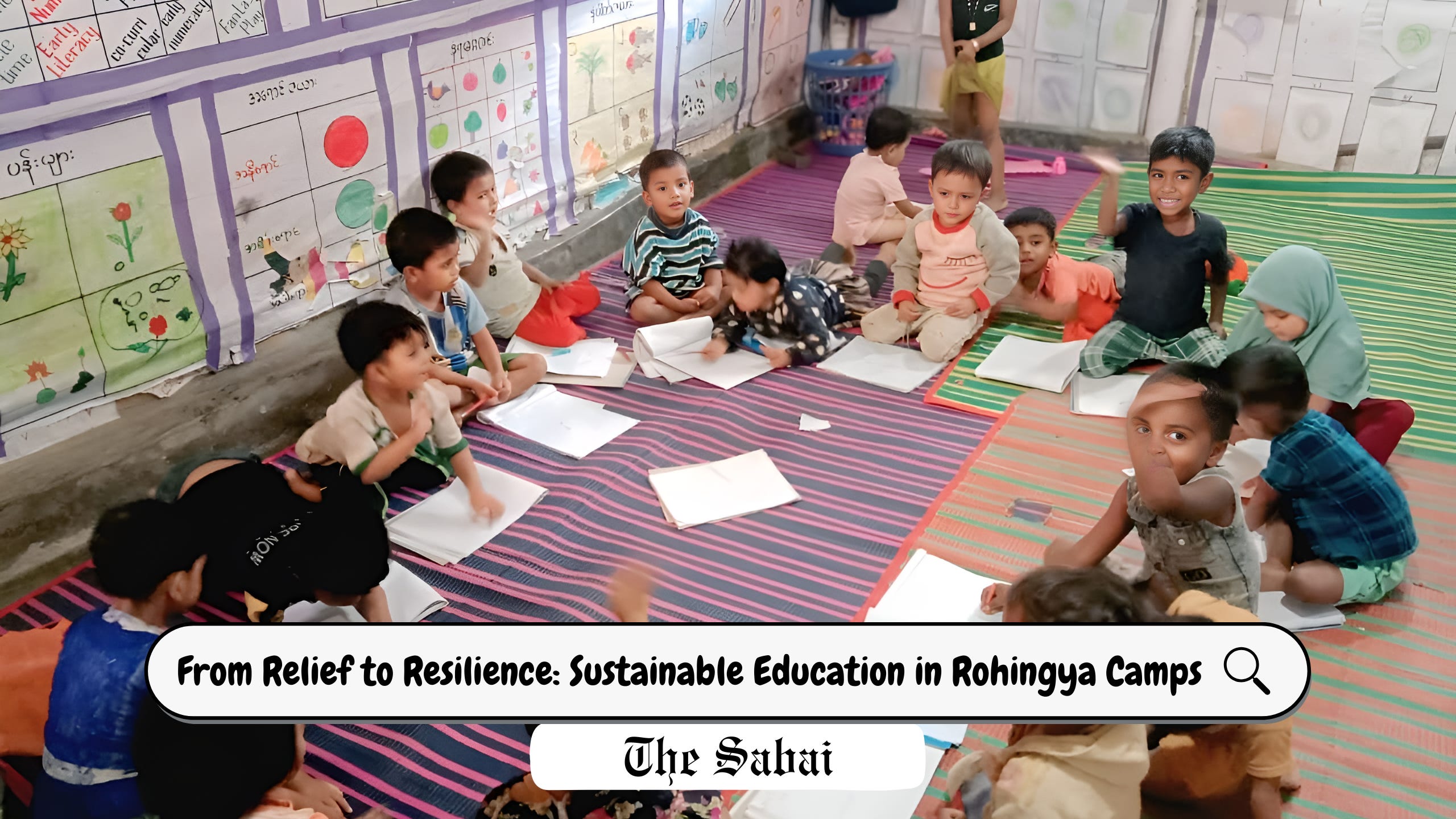
In the Rohingya refugee camps of Cox’s Bazar, Bangladesh, education remains trapped between emergency relief and long-term sustainability, leaving an entire generation uncertain about its future.
Only a limited amount of education is available in the Rohingya refugee camps in Cox’s Bazar, Bangladesh. For more than a million displaced people, learning has become fragile, erratic, and uncertain. Although education in refugee settings is often discussed as a humanitarian issue, it is fundamentally a sustainability concern. Without access to high-quality, continuous education, entire generations risk being excluded from sustainable development, deepening inequality and instability far beyond the camps.
Education directly supports the Sustainable Development Goals (SDGs), particularly United Nations Sustainable Development Goal 4 (Quality Education) and Sustainable Development Goal 10 (Reduced Inequalities). However, budget cuts, structural disparities in learning levels, and policy restrictions continue to limit Rohingya children’s access to education. These barriers not only deprive children of their rights but also weaken the long-term resilience of displaced communities.
Two primary education systems are operating in the camps. The first consists of community-based schools run informally by Rohingya teachers during early morning and evening hours. These classes are often led by instructors who either developed their skills within the camps or previously taught in Myanmar. Families typically pay nominal fees. Although these schools are unlicensed, underfunded, and lack official certification, they sometimes offer instruction using the Myanmar curriculum up to Grades 10 or even 12.
Alongside them are learning centres supported by non-governmental organisations (NGOs) and funded by local partners and international donors such as UNICEF. Some centres follow in-house programs focused on foundational literacy and life skills, while others use the Myanmar curriculum. These facilities are more structured, yet they generally provide education only up to lower secondary levels. Notably, there are no government-run schools, colleges, or universities operating within the camps. For most students who reach Grade 10, the educational pathway effectively ends.
This educational dead end significantly affects children’s motivation. Many begin school with aspirations of becoming doctors, engineers, teachers, or computer scientists. Over time, however, they realise that the system cannot support their ambitions. When education is not linked to viable opportunities, attendance declines, child labour increases, and early marriage, particularly among girls, becomes more common. Education shifts from being a pathway out of poverty to merely a temporary refuge from hardship.
Teacher recruitment and training further complicate the situation. In NGO-supported centres, teachers are hired by implementing organisations and paid through donor funding. Training is provided after recruitment, but it is often brief and inconsistent. Experienced educators are sometimes overlooked in favour of less qualified candidates due to administrative or regulatory constraints. As a result, teaching quality varies widely, and effective pedagogical methods, especially in science, mathematics, and digital skills, are not consistently applied.
From a sustainability perspective, this model is short-sighted. An education system that ends at basic literacy does not prepare young people for climate adaptation, sustainable livelihoods, or civic participation. Many young refugees express a strong interest in digital literacy, computer skills, vocational training, and emerging technologies such as artificial intelligence. These ambitions are not abstract; they reflect a genuine desire to contribute meaningfully to society if given the opportunity.
Investing in refugee education, therefore, is not charity; it is prevention. Education reduces dependency, mitigates social risks, and equips displaced populations to contribute to host communities and future reconstruction efforts. Reports from international organisations, including the United Nations and the World Bank, consistently demonstrate that education strengthens social cohesion and economic resilience, particularly in crisis-affected contexts.
To advance sustainability, education in refugee camps must evolve from an emergency response model to a long-term development strategy. This includes expanding secondary and post-secondary pathways, standardising teacher recruitment and training, integrating digital and vocational education, and recognising refugee-led initiatives as partners rather than temporary stopgaps. Donors and policymakers must align educational support with sustainability goals to ensure continuity rather than repeated cycles of disruption.
If sustainability means meeting present needs without compromising future generations, then denying refugee children access to quality education is inherently unsustainable. At its core, the Rohingya crisis is not only about displacement, but it is also about whether the global community is willing to invest in human potential where it has been most disrupted. Education is not a luxury reserved for stable societies; it is the foundation of stability itself.
Ata Ullah is a Rohingya refugee researcher, writer, and education advocate based in Cox’s Bazar, Bangladesh. He is the founder of the NextGen Rohingya Network, focusing on refugee education, sustainability, and youth advocacy.
“Advocating Sustainability, Shaping Our Future”
Help Sustain The Sabai - Myanmar’s Voice for Sustainability Support The Sabai