


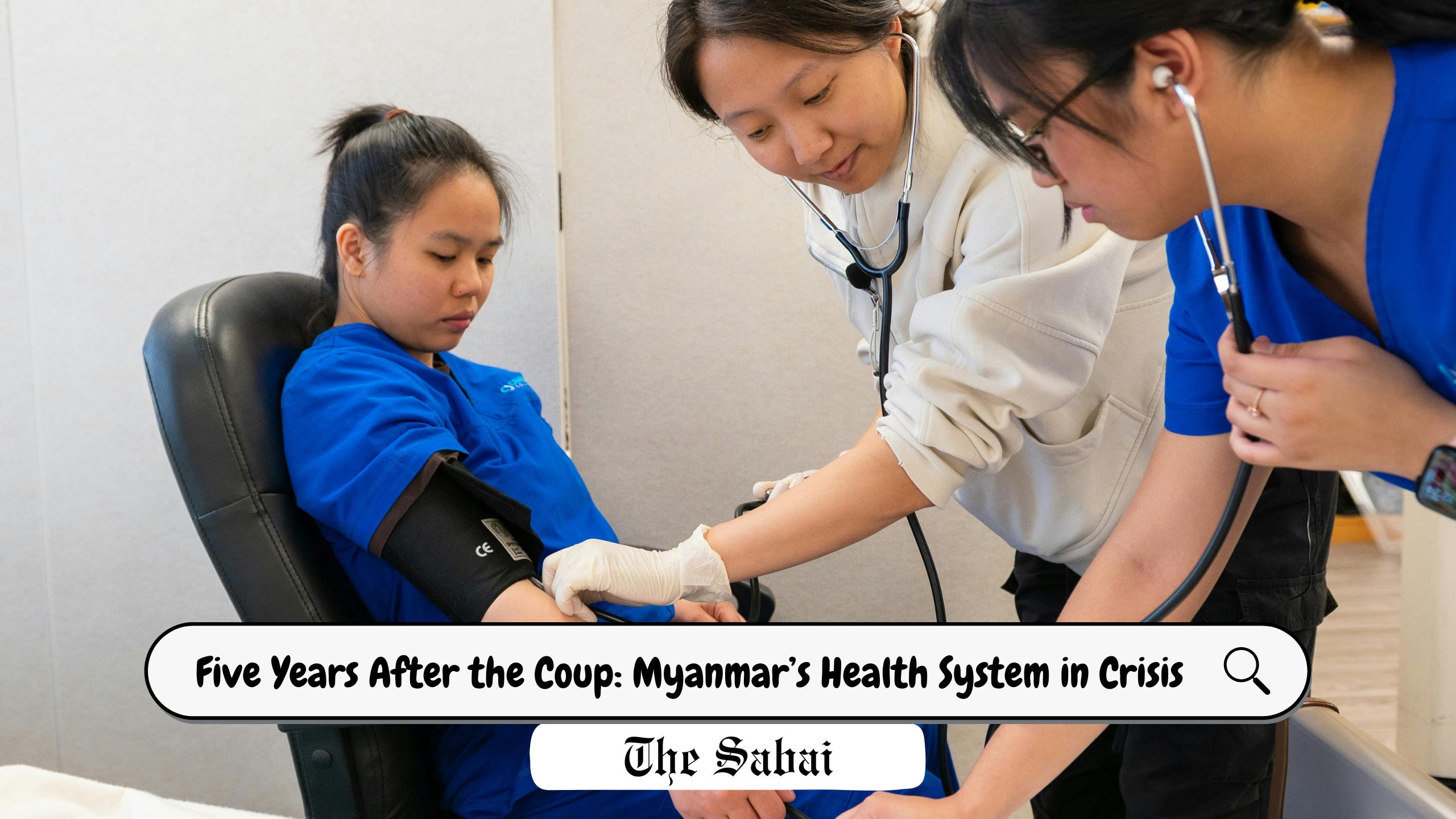
When Myanmar’s military seized power on 1 February 2021, the immediate consequences were political: mass protests, violent repression, and the collapse of a fragile democratic transition. Five years later, the deeper consequences are institutional. Myanmar is now experiencing a prolonged polycrisis, armed conflict, economic contraction, displacement, and humanitarian emergency, but at its core lies a crisis of governance.
Key Takeaways
After five years of the military coup, Myanmar’s healthcare system has shifted from a fragile public service to a fragmented and increasingly privatised survival mechanism.
Service disruption, funding instability, and institutional fragmentation have weakened Myanmar’s healthcare system.
Workforce depletion, declining immunisation coverage, and rising out-of-pocket spending demonstrate a reversal in progress toward Sustainable Development Goal 3 (SDG 3).
Healthcare provides one of the clearest indicators of governance failure. Before the coup, Myanmar’s health system was fragile but was gradually improving. Public spending remained limited, yet vaccination coverage was rising, HIV and tuberculosis (TB) programs were expanding, and international partnerships were strengthening service delivery. The trajectory was uneven, but it was forward. Since 2021, that trajectory has reversed.
Sustainable Development Goal 3 (SDG 3) commits states to universal health coverage, financial risk protection, and epidemic preparedness. These are governance obligations requiring institutional capacity, fiscal prioritisation, territorial coordination, and professional autonomy. Myanmar’s post-coup experience demonstrates how quickly these foundations can erode.
This regression can be understood through three interrelated governance failures:
(1) collapse of access to healthcare;
(2) disruption of financing and financial risk protection; and
(3) institutional and territorial fragmentation driven by Civil Disobedience Movement (CDM) participation and mass displacement.
1. Collapse of Access: Institutional Erosion and Service Breakdown
The most visible consequence of post-coup governance failure is declining access to healthcare. According to the World Health Organisation (WHO), escalating conflict, displacement, and economic collapse have created a severe humanitarian crisis in Myanmar, with 19.9 million people requiring humanitarian assistance, including 12.9 million in need of humanitarian health services (WHO, 2025). Conflict-affected areas, including Sagaing, Rakhine, Kachin, Kayah, and northern Shan, face repeated disruptions to clinics, referral systems, and outreach services. Since 2021, approximately 433 attacks on healthcare facilities have been reported, according to WHO surveillance data (WHO, 2024).
Workforce depletion has critically weakened service capacity. Before the coup, Myanmar’s health workforce density stood at 17.8 doctors, nurses, and midwives per 10,000 population (WHO, 2024), already below the WHO benchmark of 22.8 required for SDG-compatible service coverage. By 2022-2023, reported figures fell to roughly 1.01 doctors and 1.96 nurses per 10,000 population (WHO, 2024). Nursing availability declined by an estimated 73 percent between 2019 and 2022 (WHO, 2024). These figures indicate systemic incapacity rather than temporary disruption.
Preventive services have similarly regressed. WHO and UNICEF WUENIC estimates show DTP3 coverage declining to around 48 percent in 2021 before partially recovering to 76 percent in 2023 (WHO, 2024). WHO estimates that around 1.2 million children in Myanmar are zero-dose or under-immunised, reflecting major disruptions to routine immunisation services following the political crisis (WHO, 2023). The WHO Global TB Reports (2024) document declines in TB case detection following the coup compared to pre-2021 notification levels. HIV testing and treatment continuity were also disrupted in conflict-affected regions (WHO, 2024f). Treatment interruptions increase risks of transmission and drug resistance, undermining previous gains.
Analyses in global health journals similarly highlight how conflict, health worker participation in the Civil Disobedience Movement, and infrastructure disruptions have collectively weakened routine healthcare delivery (BMJ Global Health, 2026; The Lancet, 2024).
2. Funding Disruption and the Re-Privatisation of Health Risk
Healthcare sustainability depends on financial protection as much as service availability. The 2023 Myanmar National Health Accounts show that 71 percent of total health expenditure was out-of-pocket (WHO, 2024g), among the highest in Southeast Asia. While public spending remained limited, international funding played a stabilising role in HIV, TB, malaria, and immunisation programs.
Several international humanitarian programmes have also been disrupted or suspended since the coup. Before 2021, international NGOs played a central role in supporting Myanmar’s health sector, particularly in HIV/AIDS, tuberculosis, malaria control, and maternal and child health services. However, political instability, operational restrictions, and new registration requirements have forced many organisations to scale back or suspend activities. Médecins Sans Frontières reported that Myanmar’s national HIV/AIDS and tuberculosis programmes effectively “shut down” after the coup as the public health system collapsed and partnerships with the Ministry of Health were disrupted (The New Humanitarian, 2021). Although other funding did not disappear entirely, coordination weakened, and long-term system strengthening stalled.
Simultaneously, domestic fiscal priorities shifted toward security expenditures amid economic contraction and declining tax revenues (WHO, 2024).Investigative reporting by Athan News has highlighted how public hospitals increasingly require patients to purchase medicines and supplies externally. The economic crisis has sharply increased household vulnerability. A United Nations Development Programme (UNDP) study warned that the combined effects of the COVID-19 pandemic and the 2021 military coup could push up to 25 million people, nearly half of Myanmar’s population, below the national poverty line, reversing over a decade of poverty reduction (UNDP, 2021). When 76 percent of health expenditure was already out-of-pocket prior to the coup, further fiscal retrenchment deepens financial vulnerability and shifts health risk directly onto households (WHO, 2024g). Financial risk protection, central to SDG 3, has eroded, widening inequality.
3. CDM Participation, Displacement, and Territorial Fragmentation
Institutional fragmentation represents the third structural driver of health system unsustainability. Following the coup, an estimated half of the public-sector health workforce participated in the Civil Disobedience Movement (CDM), withdrawing from state institutions in protest against military rule (Amnesty International, 2021). The mass walkout of doctors, nurses, teachers, and other civil servants significantly disrupted public service delivery, including healthcare, education, and social welfare systems.
While the CDM has been a central component of resistance to military rule, the withdrawal of large numbers of public-sector professionals created additional pressures on already fragile service systems. These disruptions occurred during the COVID-19 pandemic and amid escalating conflict, further constraining the health sector’s ability to maintain routine services and emergency response capacity. At the same time, conflict-related displacement has fragmented service delivery across regions, weakening referral systems and continuity of care.
Moreover, procurement systems and medical supply chains have deteriorated due to import licensing delays, transport insecurity, and currency instability. Restrictions on transporting medicines and medical equipment to conflict-affected and opposition-controlled areas have further complicated humanitarian delivery, particularly in territories outside military control. These constraints have contributed to shortages of essential medicines, including tuberculosis drugs and other life-saving treatments.
Conflict escalation has displaced millions. According to the United Nations Office for the Coordination of Humanitarian Affairs, 19.9 million people were estimated to require humanitarian assistance in 2025, including approximately 4 million internally displaced persons and 1.5 million refugees (OCHA, 2024). Displacement disrupts vaccination records, HIV and TB treatment adherence, maternal health services, and chronic disease management. Health systems depend on territorial coherence, stable populations, referral networks, and administrative coordination. In Myanmar, territorial control is increasingly fragmented, and service provision varies significantly by region.
Long-established ethnic health systems in areas administered by organisations such as the Kachin Independence Organization and the Karen National Union have historically maintained parallel healthcare governance structures and community-based service networks. These systems have helped sustain basic services in some conflict-affected regions. However, newly contested territories under resistance forces such as the Sagaing Region aligned with the National Unity Government often lack comparable institutional infrastructure (BMJ Global Health, 2026). In such areas, healthcare provision frequently relies on mobile clinics, community volunteers, or humanitarian actors, resulting in uneven coverage and limited continuity of care (BMJ Global Health, 2026; WHO, 2024). Prolonged fragmentation risks institutionalising geographic inequalities in access to healthcare.
Implications and Recommendations
Myanmar’s health crisis demonstrates that humanitarian assistance cannot substitute for governance recovery. Sustainable progress toward SDG 3 requires restoring institutional functionality alongside emergency support.
Protection of health workers and facilities must be prioritised to safeguard service continuity and professional autonomy. Financial risk protection mechanisms require stabilisation through accountable pooled financing that supports essential medicines and primary care, particularly for displaced and low-income populations. Strengthening transparency and oversight in health financing and procurement is also critical. Even before the coup, Myanmar’s health system faced governance challenges, including weak regulatory oversight and risks of corruption in procurement and pharmaceutical supply chains. Since 2021, institutional collapse and severe staff shortages have further weakened accountability, with reports indicating that patients in some public hospitals have been forced to pay informal fees or bribes to access treatment and basic services (Frontier Myanmar, 2023). Finally, adaptive coordination among state, ethnic, and community-based providers is necessary to mitigate fragmentation and expand equitable coverage.
Health outcomes will remain the clearest indicator of whether governance recovery is taking place. Without institutional resilience, fiscal prioritisation of social sectors, and territorial coordination, healthcare will continue shifting from a public good to a private burden borne disproportionately by the poor and displaced.
References
Amnesty International Thailand. (2021). After coup, Myanmar military puts chokehold on people’s basic needs.
BMJ Global Health. (2026). Health system disruption and humanitarian crisis in Myanmar.
Frontier Myanmar. (2024). Myanmar’s public hospitals are failing their patients.
Human Rights Watch. (2025). Myanmar: Junta assault on health care hinders quake response.
Insecurity Insight. (2022). Myanmar: Attacks on health care in 2021 – Factsheet.
The Lancet. (2024). Health and humanitarian crisis in Myanmar following the 2021 military coup.
The New Humanitarian. (2025). Myanmar healthcare and disease prevention are neglected casualties of war.
United Nations Development Programme (UNDP). (2021). COVID-19, coup d’état and poverty: Compounding negative shocks and their impact on human development in Myanmar.
United Nations Office for the Coordination of Humanitarian Affairs (OCHA). (2024). Myanmar Humanitarian Needs and Response Plan.
World Health Organization (WHO). (2023). Decreasing zero-dose children threefold amidst pandemic and political unrest in Myanmar.
World Health Organization (WHO). (2024a). Myanmar External Public Health Situation Analysis.
World Health Organization (WHO). (2024b). Global tuberculosis report 2024. Geneva: WHO.
Frontier Myanmar. (2023). “No remedy”: A broken public health system fosters neglect and corruption.
World Health Organization (WHO). (2024c). Global Health Expenditure Database: National Health Accounts country profile.
Htay Su Wai is a Junior Research Fellow at the Sustainability Lab of the Shwetaungthagathu Reform Initiative Centre (SRIc) and holds a Master of Public Policy (MPP) from the Hertie School of Governance in Berlin, Germany.
“Advocating Sustainability, Shaping Our Future”
Help Sustain The Sabai - Myanmar’s Voice for Sustainability Support The Sabai