

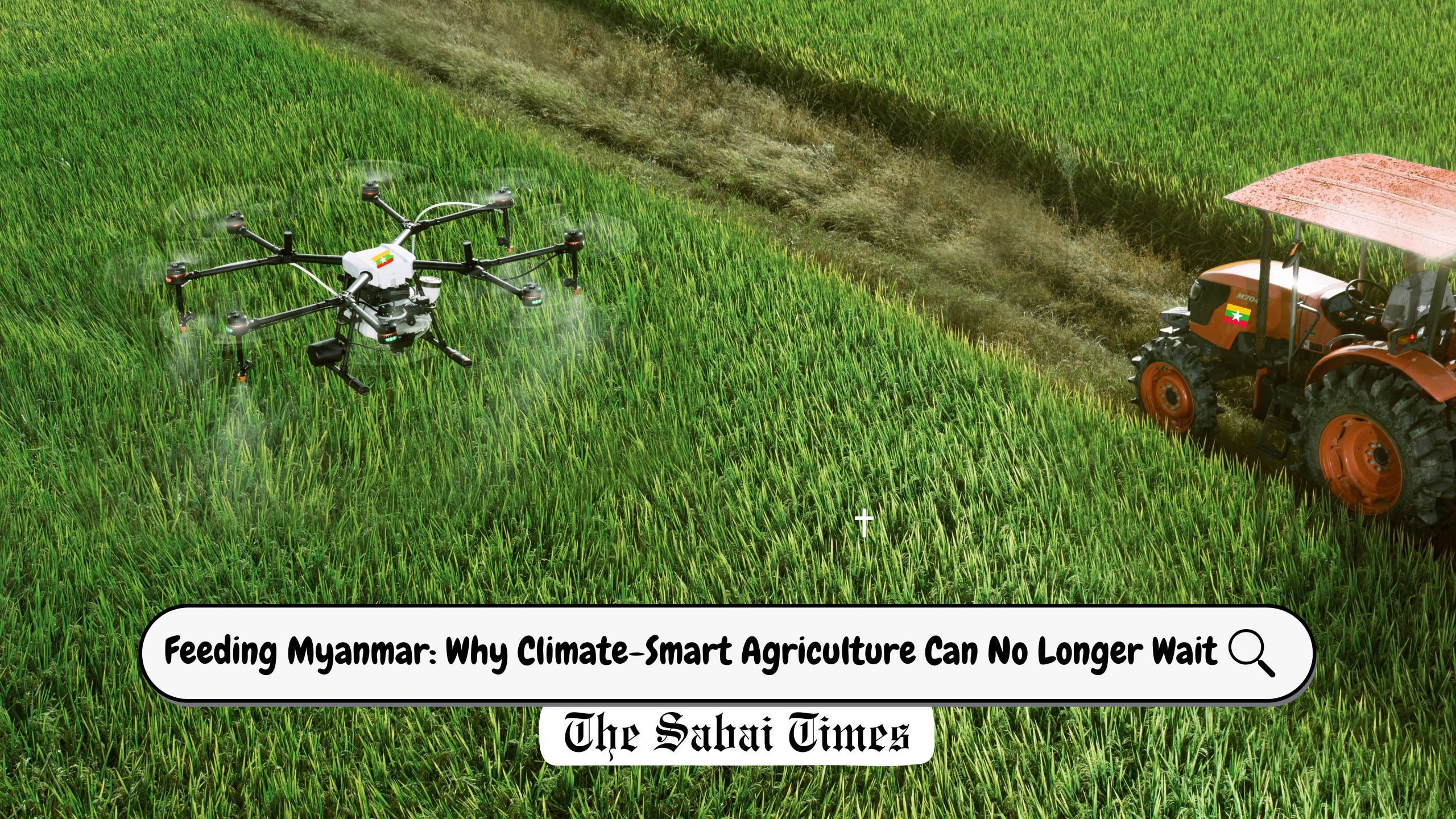
Myanmar must urgently prioritize climate-smart agriculture to safeguard its food security and national resilience amid escalating climate disasters and systemic agricultural vulnerabilities.
Key Takeaways:
Climate change-driven disasters severely disrupt agriculture and threaten food security in key regions like Ayerawaddy and Bago.
Myanmar’s agriculture sector, relied on by over 70% of the population, lacks resilience and infrastructure to withstand climate shocks.
To ensure long-term food security and meet SDG targets, Myanmar must prioritize environmentally sustainable practices and integrate climate adaptation into its agricultural policies and development plans.
Environmental sustainability is no longer an abstract concept and a distant problem—it has become a critical issue for the survival of all humans worldwide. No other area is this more evident than in the struggle for food security. As the climate crisis intensifies, the sustainability of food systems is being tested like never before. Around 2.33 billion people globally faced moderate or severe food insecurity in 2023. Among those, over 864 million people experienced severe food insecurity, going without food for an entire day or more at times. A toxic mix of factors is causing this, although one particular reason, climate change, leaves no country on earth safe. Up to 40 percent of the world’s land is now degraded, leading to increasingly frequent and severe climate shocks, such as droughts, floods, extreme temperatures, and severe storms, causing a profound impact on agriculture and food production.
It is uncontested that agriculture, the backbone of livelihoods in many developing countries, is highly vulnerable to extreme weather events, water scarcity, and land degradation. About 80% of the global population is at risk from crop failures and hunger due to climate change, including the Southeast Asia region, home to many coastal and agricultural communities. Within the area, Myanmar stands as the most climate-vulnerable country and is ranked the second most-impacted country by extreme weather events in the past two decades; the country often faces extreme temperatures, drought, cyclones, flooding, storm surge, and heavy rainfall. Exacerbating the situation, over 70% of the population relies on agriculture, accounting for 32% of the country’s GDP.
All successive governments have thus pronounced that enhancing agricultural production, productivity, and rural livelihoods has been the main objective. However, the result is far from successful. For a country that uses a total of 53 million out of its 167 million acres of land for crop cultivation, the fundamental necessity, i.e., food security, remains a significant challenge for Myanmar. Recently, food security has reached unprecedented levels, affecting 15.2 million people and over 1 in 4 of the population. This condition is caused not only by the political crisis, economic downturn, and pre-existing poverty, but also by the increasing climate-related disasters. The disasters caused 40 to 60% of the crops produced seasonally to be lost, together with the lack of post-harvest technology and machinery.
One of the most devastating recent examples of how climate change affects agriculture and food security in Myanmar is the 2023 and 2024 floods in the Bago Region. In 2023, the region experienced its heaviest rainfall in almost 60 years—a record of 200 mm over just 24 hours. The Bago River, which flows through the city, rose to around 1.2 meters above its critical level, severely overflowing into urban, suburban, and agricultural zones. The flooding even reached up to about eight feet deep in low-lying areas. Reportedly, 27,300 people were displaced, 2,800 houses were destroyed, transportation was disrupted, and around 100,000 acres of monsoon paddy were damaged. Consequently, in 2024, Bago experienced a greater flood, exacerbated by Typhoon Gaemi and Typhoon Yagi. Taungoo, Kyaukkyi, and Shwegyin Townships were considerably impacted by the beginning of October. Three hundred sixty-four villages were flooded, at least four bridges collapsed, and farmland, railway routes, and infrastructure were extensively damaged, affecting over 316,000 people.
Bago is not just another region—it is Myanmar's second most productive rice region. Producing hundreds of thousands of tons of rice for the country, any threat to this region’s agriculture threatens the country’s food supply chain. Such vulnerability of the crucial region to the disasters two years in a row exposes the fragility of its climate resilience and agricultural-food system, as well as Myanmar’s. The events also warn of a worsening climate reality, highlighting that achieving food security is no longer possible without agricultural-climate adaptation strategies. Myanmar must make climate-smart agriculture a national priority and stop being blind to the increasing importance of environmental sustainability.
Tangible efforts towards SDG 2: Zero Hunger and SDG 13: Climate Action - climate-smart and sustainable agriculture to ensure food security, must be emphasised, so that the country can sustain its 54 million people. The time to act is now - because without environmental sustainability, there is no resilience, food security, or future.
Yamone Aye is currently studying for a Bachelor of Arts in International Relations and Development at Rangsit University, Thailand.
“Advocating Sustainability, Shaping Our Future”
The opinions expressed in this article do not represent the official stance of SRIc - Shwetaungthagathu Reform Initiative Centre. The Sabai Times is committed to publishing a range of perspectives that may not align with editorial policy.
Help Sustain The Sabai Times - Myanmar’s Voice for Sustainable Development Support The Sabai Times