

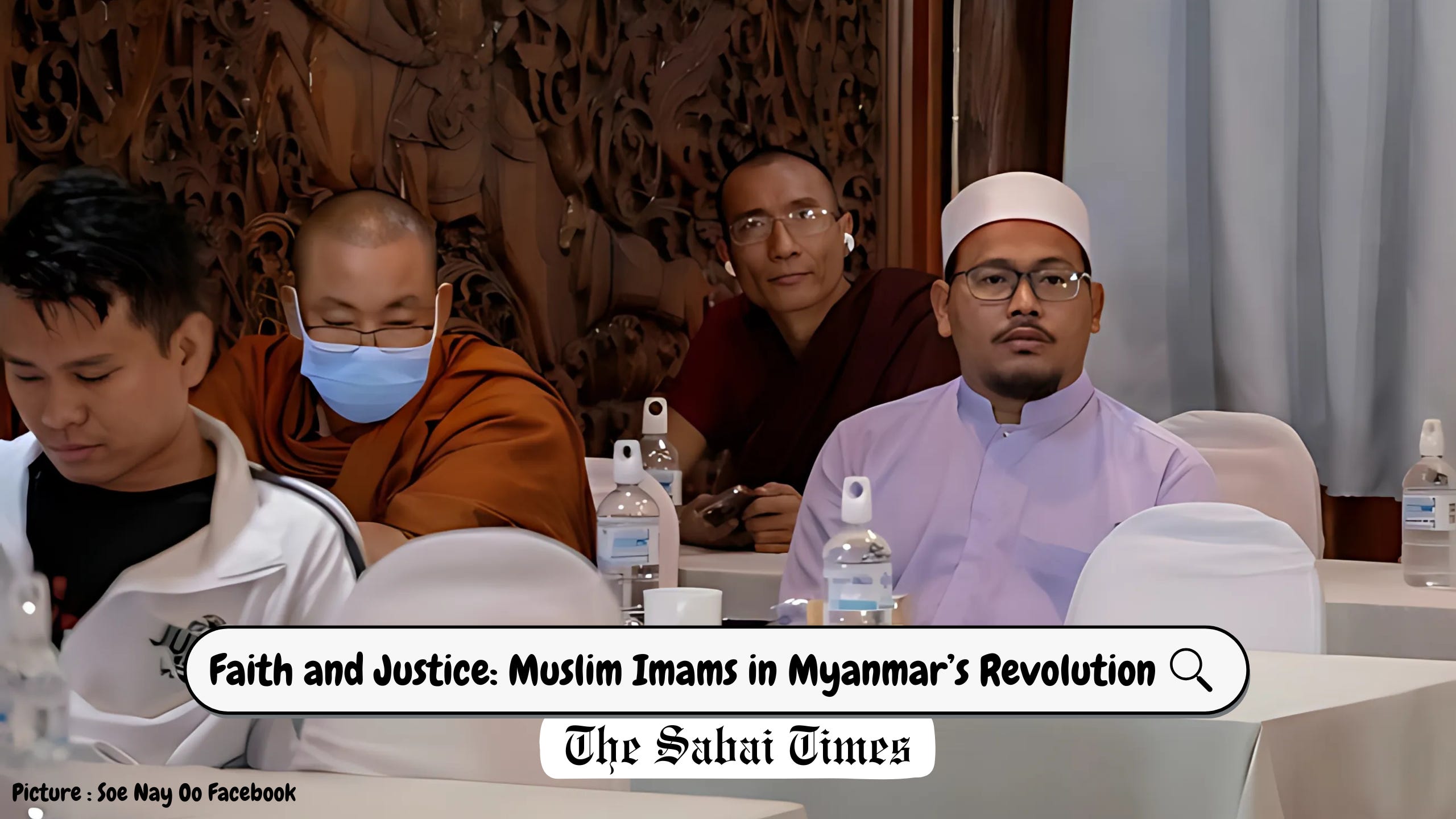
Amid the ongoing struggles in Myanmar’s Spring Revolution, Muslim Imams, often overlooked, are playing a pivotal role.
Guided by their deep faith and the teachings of Islam, they advocate for justice, equality, and resistance against tyranny, drawing on the principles found in the Quran and the life of Prophet Muhammad. Despite their low profile, these religious leaders remain committed to upholding fundamental human rights, even as Myanmar's military regime deepens its reign of terror.
Since the February 2021 coup d'état, Myanmar’s military has unleashed widespread atrocities, leading to an escalating humanitarian crisis. The United Nations estimates that over 17.6 million people now require humanitarian aid, with 1.6 million displaced and more than 55,000 civilian structures destroyed. Military tactics, including systematic aerial and artillery bombardments, have targeted both armed resistance groups and civilian populations, especially in contested regions like northern Shan and Rakhine states.
Entire villages have been leveled, leaving communities in despair. One group that has borne the brunt of the military's brutal campaign is Myanmar's Muslim population. Already marginalized and subjected to systemic discrimination, they have faced not only the general brutality experienced by all dissenters but also religiously motivated persecution. This is particularly true for the Rohingya Muslim minority in Rakhine State, who have endured decades of state-sponsored violence, ethnic cleansing, and apartheid-like conditions.
Even beyond Rakhine, Muslim communities across the country are stigmatized and targeted, with the military often using religious tensions to justify their oppressive actions. Reports from international organizations, such as Amnesty International, confirm that Muslims face frequent violence, arbitrary arrests, and systematic deprivation of their rights.
In the face of such adversity, the role of Muslim Imams in the Spring Revolution has been transformative, though underreported. Their engagement is not merely a political stance but is deeply rooted in Islamic teachings that call for justice, community welfare, and standing up against oppression. Central to their faith is the Quranic command to "be persistently standing firm in justice, witnesses for Allah, even if it be against yourselves or parents and relatives..." (Quran 4:135).
This verse compels them to support efforts restoring rights and correcting wrongs, providing religious justification for their involvement in the revolution.
The life of Prophet Muhammad further strengthens their resolve: "The greatest struggle is to speak the truth in front of a tyrannical ruler." In Myanmar’s current turmoil, this teaching emboldens Imams, reinforcing their moral obligation to confront the military regime and voice the plights of the marginalized.
The concept of Ummah, or the global Muslim community, extends their responsibility beyond just religious or ethnic boundaries. It fosters a sense of solidarity with all those suffering under oppression, regardless of their background. This has inspired prominent Imams such as Sheikh Soe Nay Oo, Faisal Khattab, and Hassan Al-Qadri to take active roles in the revolution. Sheikh Soe Nay Oo, for example, highlights the religious obligation of Muslim leaders to "stand up against the tyranny inflicted upon the innocent."
At the same time, Imam Faisal Khattab emphasizes Islam’s call to defend human dignity, reflecting the life of Prophet Muhammad as an advocate for the marginalized. Their participation is not just symbolic; it is a practical expression of their faith. Imam Hassan Al-Qadri's involvement sends a powerful message that the universal Islamic values of peace, justice, and protection of the oppressed transcend mere religious identity and have a critical role in social and political movements.
However, this involvement of Muslim leaders has not insulated them from targeted repression. The military’s deeply entrenched Islamophobia, compounded by societal discrimination, continues to make Muslims in Myanmar vulnerable to violence and exclusion. Several International human rights groups have documented the state’s systematic efforts to marginalize Muslim political leaders and prevent their communities from fully participating in the national discourse.
Despite these challenges, the involvement of Imams in the Spring Revolution underscores the importance of recognizing the role of all religious and ethnic communities in Myanmar's struggle for freedom. For Myanmar to achieve sustainable peace, the contributions of Muslims and other marginalized communities must be acknowledged. The National Unity Government (NUG) and the National Unity Consultative Council (NUCC) have been instrumental in creating a new, inclusive Myanmar framework.
However, they must ensure that the Muslim community, whose contributions to the Spring Revolution have been significant, are fully integrated into the political process. Their involvement is essential to fostering a pluralistic, just, and peaceful vision of Myanmar.
It is crucial that the broader Myanmar society, as well as international stakeholders, understand that true peace cannot be achieved without addressing the deep-rooted religious and ethnic divisions that have long plagued the country. The recognition of Muslim’s roles in the Spring Revolution—and their inclusion in the nation's future political roadmap—is not just a matter of justice but a prerequisite for a sustainable coexistence in a democratic Myanmar.
Harry Myo Lin is a Myanmar expert with extensive experience across Myanmar and Asia, specializing in peacebuilding, interreligious dialogue, and promoting freedom of religion and belief.
“Advocating Sustainability, Shaping Our Future”
The opinions expressed in these articles do not represent the official stance of SRIc - Shwetaungthagathu Reform Initiative Centre. The Sabai Times is committed to publishing a range of perspectives that may not align with editorial policy.
Help Sustain The Sabai Times - Myanmar’s Voice for Sustainable Development Support The Sabai Times