


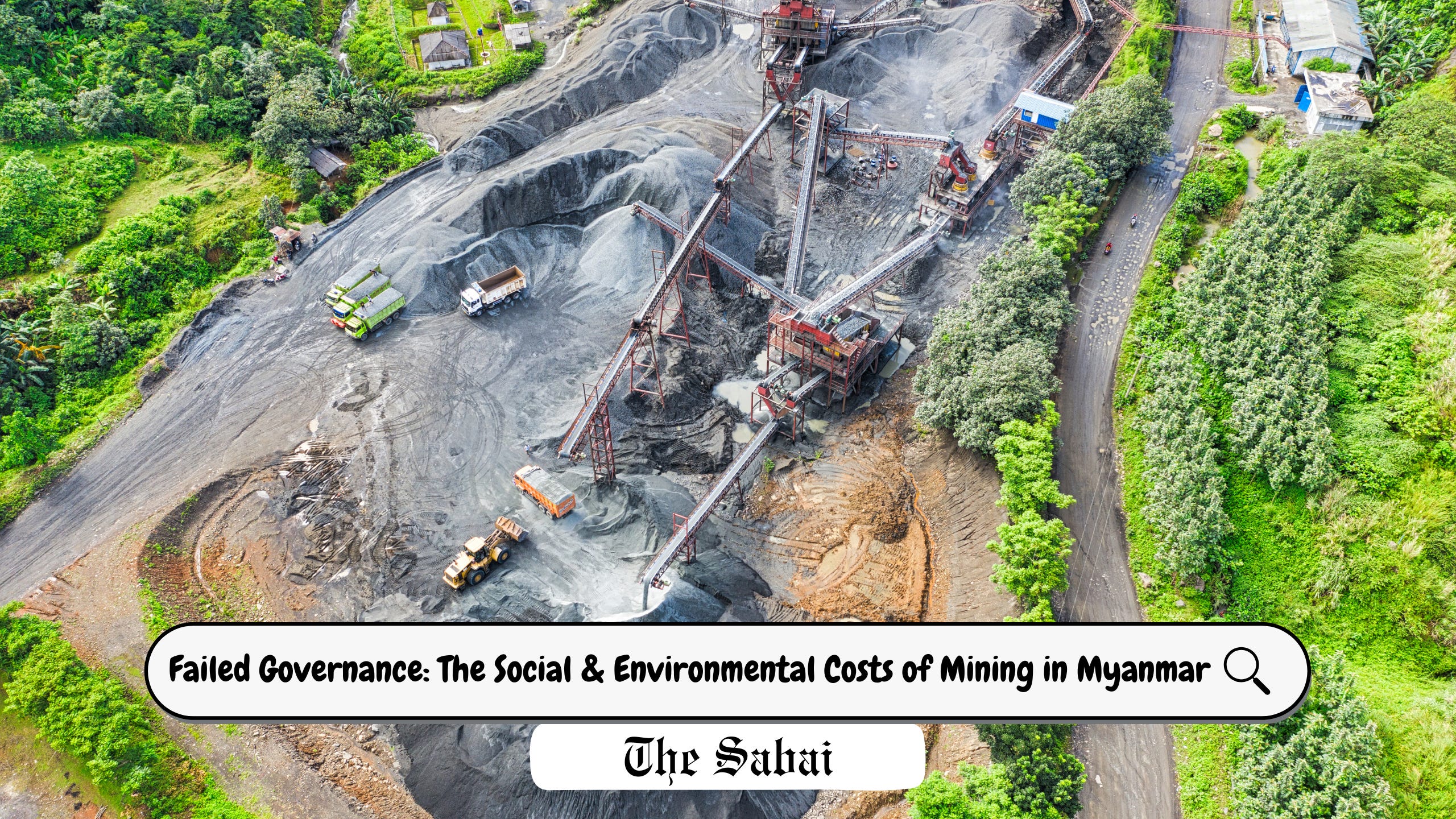
Myanmar is a resource-rich country with abundant deposits of jade, gold, and rare earth minerals, yet it faces increasing environmental degradation and social harm.
Key Takeaways:
Weak governance, not resource scarcity, is the main driver of environmental degradation and social harm in Myanmar’s mining sector.
The benefits of mining are concentrated among powerful actors, while local communities bear the environmental, health, and livelihood costs.
Unregulated extraction is linked to conflict economies and cross-border impacts, making mining a regional governance and sustainability issue.
Introduction
Mining activities often fail to comply with laws and Environmental Impact Assessment procedures, leading to land loss, water scarcity, and severe pollution that directly affect local communities. This pattern reflects a long history of extractive waves driven by global demand. Since the 2021 military coup, governance breakdown has accelerated unregulated mining, intensifying these impacts. Mining in Myanmar is therefore not only an environmental issue, but also a broader social and governance crisis.
Background: Mining and Governance Context
Myanmar’s mining sector has long been central to its economy, supported by abundant deposits of minerals such as tin, tungsten, copper, jade, and gemstones, and shaped by successive political regimes from independence to military rule and partial democratisation. Across these periods, mining has expanded under different governance systems, but weak enforcement of environmental laws and fragmented control among the government, military, ethnic armed groups, and foreign actors have limited effective oversight.
During the post-independence period (1948–1962), the government sought to develop the mining sector through national planning and partnerships with foreign companies, but progress was constrained by internal conflict and limited institutional capacity. Under military rule (1962–2010), mining governance became increasingly centralised yet opaque, with the expansion of state control and military-linked enterprises alongside widespread illegal and artisanal mining, leading to growing environmental degradation and social impacts. Many laws and governance structures during this period were still based on outdated colonial-era legal frameworks. The democratic transition period (2011–2021) introduced legal reforms and opened the sector to foreign investment, but governance remained weak, as the Permanent Secretaries of every ministry were appointed by the previous administration, which created a barrier for the NLD-appointed ministers to plan for the reform.
Since the 2021 military coup, these challenges have intensified as the rule of law deteriorated and illegal mining activities surged, contributing to widespread deforestation and environmental damage. International sanctions reduced foreign investment, pushing the military regime to rely more heavily on natural resources to finance its operations. This has accelerated the expansion of rare earth mining, particularly in border regions controlled by armed groups and foreign-linked actors. On the other hand, after the 2021 coup, environmental and climate-related initiatives were disrupted as international funding withdrew, and many civil society organisations reduced or redirected their activities due to political instability and security concerns. As a result, Myanmar’s mining sector increasingly reflects an “open-access” system, where overlapping authorities and weak governance enable uncontrolled extraction and concentration of benefits among powerful actors.
Governance Framework and Its Gaps
Myanmar has established a formal governance framework to regulate its mining sector, including the Myanmar Mines Law (2015), Mining Rules (2018), and Environmental Impact Assessment (EIA) procedures, which require companies to minimize environmental damage and comply with environmental standards. These frameworks are supported by institutional oversight from the Environmental Conservation Department (ECD), and in principle align with international practices by incorporating environmental management plans and compliance requirements. However, while regulatory systems exist, their implementation remains weak. Even before 2021, only a small proportion of EIA-related reports were approved due to limited institutional capacity and poor-quality submissions, highlighting long-standing weaknesses in enforcement that have likely worsened under current governance conditions. Monitoring is also inadequate, as compliance inspections are often conducted only in response to complaints rather than through regular enforcement mechanisms.
Significant governance gaps persist across the sector. Transparency and accountability are limited, with local communities often lacking access to information about mining projects and decision-making processes. The post-coup crisis also weakened local civil society participation, as many organisations reduced environmental activities and some community leaders were arrested or unable to engage due to security risks. Overlapping authorities and unclear jurisdiction further complicate governance, while enforcement of regulations remains weak during project implementation. In many cases, consultation processes are superficial and can be influenced by economic incentives or pressure, undermining genuine community participation. As a result, governance in Myanmar’s mining sector exists formally through laws and regulations, but fails functionally in practice.
Governance Breakdown in Practice
In practice, governance of Myanmar’s mining sector is highly fragmented, with control divided among military-linked actors, ethnic armed organisations (EAOs), and foreign stakeholders, particularly in border regions. These actors operate with limited coordination, and local communities are largely excluded from decision-making processes despite being directly affected by mining activities. Rather than approaching natural resources from a sustainable development perspective, many military actors and armed groups increasingly treat mining as a source of revenue to strengthen their financial and political position during the ongoing conflict. In many areas, extractive projects are closely tied to political and economic interests, where access to resources provides both financial benefits and strategic power for armed groups and elites.
Mining is deeply embedded in Myanmar’s conflict economy. Revenues generated from resource extraction often fund armed actors, reinforcing cycles of conflict and instability. In regions such as Kachin State, ethnic armed organisations have taken on governance-like roles, controlling mining activities and taxation systems linked to cross-border trade. At the same time, China acts as a double-edged sword by engaging with both the military and ethnic armed groups, while exploiting Myanmar’s weak rule of law to sustain continued extraction and secure access to rare earth minerals for global markets.
Since the 2021 military coup, these dynamics have intensified. The breakdown of law and order has led to a surge in illegal and informal mining, especially in remote areas. The number of rare earth mining sites has increased rapidly, reflecting a broader expansion of unregulated extraction. As governance weakens, mining activities continue to grow without effective oversight, prioritising short-term gains over environmental sustainability and social protection.
Environmental Costs
Mining activities in Myanmar have caused severe environmental damage, particularly to water resources. The use of toxic chemicals such as mercury, cyanide, and acids contaminates rivers and groundwater, making water unsafe for drinking, agriculture, and aquatic life. Artisanal and small-scale gold mining along the Ayeyarwady River has long served as an important livelihood strategy for local communities with limited economic alternatives. In some mining areas, water samples have been found to pose substantial risks to ecosystems and are entirely unsuitable for human use. These impacts are intensified by the expansion of large-scale and mechanized mining, which increases pressure on water resources and contributes to widespread pollution. Evidence from border areas shows that toxic discharge from mining has entered tributaries linked to the Thanlwin (Salween) system, contaminating downstream water sources and affecting agriculture and fisheries in nearby communities.
Deforestation and land degradation are also major consequences of mining. Forest clearing for extraction has led to significant forest loss, estimated at around 46,000 hectares, particularly in resource-rich regions such as Kachin and Sagaing. Mining activities accelerate soil erosion, reduce agricultural productivity, and damage local ecosystems. Biodiversity loss follows as habitats are destroyed and ecosystems collapse, affecting both terrestrial and aquatic species.
Environmental disasters, including landslides and flooding, are increasingly common in mining areas, causing long-term ecological damage and risks to human life. These impacts are not accidental but are directly linked to weak governance systems. Historically, Myanmar’s governance system has prioritized state revenue collection, including taxes on the extraction of state-owned resources. Without effective regulation and accountability, mining continues to operate unsustainably, while the exclusion of local communities from decision-making further limits environmental protection.
Social Costs of Mining
Mining in Myanmar also imposes high social costs, particularly on communities living near extraction sites. Livelihoods are increasingly undermined as agricultural land is lost to mining activities and access to forests and clean water is reduced, contributing to long-term economic insecurity. In many cases, mining operations have damaged homes, farmland, and community spaces without compensation, leaving local populations with limited means of recovery.
Public health risks are also severe. Exposure to contaminated water and toxic chemicals has led to respiratory illnesses, skin diseases, and other chronic health conditions among both workers and nearby communities. A health survey conducted in an artisanal and small-scale gold mining community in Mandalay Region found that 9 out of 18 miners showed warning levels of mercury contamination, while 3 out of 18 miners displayed neurological signs and symptoms associated with chronic mercury intoxication. Workers face especially dangerous conditions, including frequent landslides and accidents in mining areas. For example, deadly jade mine collapses in Kachin State have killed hundreds of miners in recent years, highlighting the extreme risks associated with poorly regulated extraction. Many workers receive little or no medical support or compensation, even in cases of injury or death.
The risks and benefits are unequally distributed, while local communities have little opportunity to raise concerns under the military regime. Profits are concentrated among powerful actors such as military-linked groups and foreign stakeholders, while local communities bear the environmental and social burdens. Mining revenues also contribute to conflict, reinforcing instability in resource-rich regions. Weak governance enables this imbalance, shifting the costs of extraction onto vulnerable populations while concentrating gains among those with power.
Why This Is a Governance Issue
The environmental and social impacts of mining in Myanmar should not be understood as isolated outcomes of extractive activities, but as symptoms of deeper governance failures. At its core, the issue is not the existence of mining itself, but the conditions under which it operates. Sustainability means maintaining the equilibrium among social, economic, and environmental well-being through effective governance. After the coup weakened governance, the entire system came under stress, showing that this is fundamentally a governance issue. In the case of Mogok’s ruby mines, control over the area has shifted between the junta and the Ta’ang National Liberation Army (TNLA), with reports indicating that the TNLA returned the area following China-mediated negotiations and diplomatic pressure. These challenges are further worsened by political instability, forming part of a broader polycrisis in which conflict, economic pressures, and environmental degradation reinforce one another. In this context, mining reflects deep-rooted dynamics of power, control, and conflict.
Conclusion and Policy Implications
Myanmar’s mining crisis is not only environmental, but also deeply social and rooted in governance failures. Its impacts extend beyond national borders, as pollution from mining contaminates rivers and ecosystems in neighboring countries such as Thailand, while broader environmental decline contributes to regional instability and displacement. Addressing these challenges requires stronger enforcement, improved transparency and accountability, and conflict-sensitive resource governance. Similarly, local communities must be meaningfully included in decision-making processes. Looking ahead to 2026, ongoing political uncertainty and parallel governance structures will continue to shape the sector. Myanmar is going to face more and more climate-related disasters, and this could increase the vulnerability of local communities. Without governance reform, resource wealth will continue to drive environmental degradation and social inequality rather than sustainable development.
Hsu Latt Phyu is a Junior Research Fellow at the Sustainability Lab of the Shwetaungthagathu Reform Initiative Centre (SRIc). She holds a Master’s degree in Social Innovation and Sustainability from Thammasat University, Thailand.
“Advocating Sustainability, Shaping Our Future”
Help Sustain The Sabai - Myanmar’s Voice for Sustainability Support The Sabai