


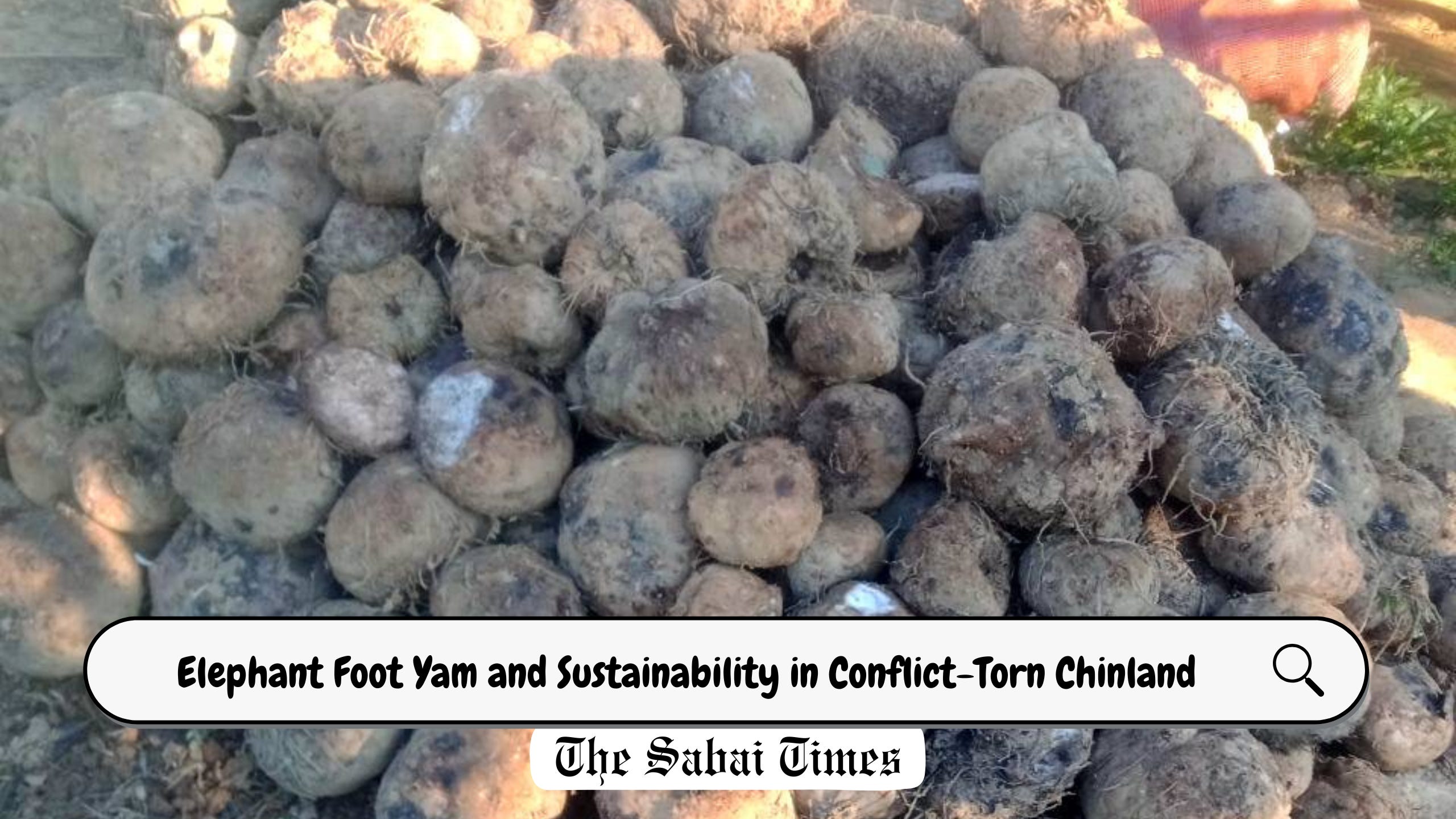
Elephant Foot Yam is a way out for Chinland to build resistance amid the ongoing civil war while sustaining a healthy environment.
Key Takeaways:
Chinland, an upland and landlocked region, had gradually shifted from swidden agriculture to cultivating a more sustainable crop, Elephant Foot Yam, which provided both environmental benefits and financial stability for local communities.
After the coup, the socio-economic situation deteriorated sharply, forcing many households to return to swidden practices, contributing to increased deforestation and environmental degradation.
Ethnic armed organisations in Chin should explore ways to leverage the Elephant Foot Yam sector to achieve long-term sustainability, ensuring both livelihood security and environmental protection.
Chinland is located in the northwestern part of Myanmar, at an elevation of 5,000 to 8,000 feet above sea level. The staple foods of the region are corn and rice, but local communities also cultivate two important millet varieties known as Satni and Satwa. Among them, Satni is primarily used to brew the traditional local alcohol, ‘Khaung’.
Chinland is one of the least developing states in a least developing country like Myanmar. The Chin people primarily practice traditional swidden agriculture in mountainous terrain. This practice causes deforestation in Chin state and has lost 700 sqmi of total forest cover area in 70 years since independence, the total forest cover area. But in 1997, a market for elephant foot yam, also known as Konjac, emerged. Initially, local people, mainly swidden farmers, collected wild yams from natural forests, but by 2003, these became scarce due to overexploitation. As a result, local people began cultivating Konjac in old fallow fields that had been abandoned as the number of swidden farmers declined. The region’s environmental conditions are highly favourable for konjac yam cultivation.
Socio-economic Benefits from Konjac Yam Plantation
After the 2010 political transition, Myanmar opened up to more foreign opportunities, including konjac yam farmers receiving greater access to financial and technical assistance from NGOs and INGOs. The country soon became one of the major exporters of konjac to China, Japan, and Korea. Myanmar is home to three distinct yam types, differentiated by their colour: white, yellow, and reddish-pink. Although the crop can be grown in regions such as Mon, Karen, Shan, Tanintharyi, and Kachin, it thrives particularly well in Chin State as it requires no special fertiliser treatment to grow successfully. Chin State was once the major producer of konjac in Myanmar.
In addition, elephant foot yam (konjac) production can be highly profitable and become a cash crop for local people, and it also generates foreign revenue. In the 2016–2017 fiscal year, konjac exports earned over US$2.5 million. By 2016–2017, many households in the village had cultivated the crop on 2 to 3 acres of land, earning up to US$5,000 per acre at harvest. Konjac is a long-duration crop and can be harvested at various stages of development, from as early as 6–7 months to as late as 4 years. As a consequence, village producers have seen improvements to their farm revenue and standard of living. There is now a rising tendency among upland rice farmers to switch from cultivating rice to growing konjac. It has been an agrarian change for them.
Exporting wet, raw yams does not generate a high price. However, value-added products, such as dried or powdered yams, can provide significantly higher profits. In 2020, the Chin Hill Treasure Company established a konjac yam drying factory, processing 12–15 tons of raw yams per day. The company had planned to produce yam powder in its second or third year and to develop other value-added food products in subsequent years. However, following the 2021 military coup, the factory has become inactive.
Environmental Benefits from Konjac Yam Plantation
The yams not only raised the socio-economic standard, it is also helpful to the environment. Its large underground corm and broad leaves help protect the soil surface, reducing erosion on slopes, especially important in mountainous regions like Chin State. And it reduces water requirements. Drip irrigation combined with konjac cultivation has been shown to maximise water productivity. The Central Tuber Crops Research Institute from India did research over a 5-year period on konjac and improved the water-holding capacity by 28.4% and the porosity of soil by 16.5%.
The leaf litter decomposes easily, contributing to organic matter and improving soil fertility over time and really good for intercropping short term vegetation such as legumes. Thereafter, konjac is naturally shade-tolerant, and it can be grown under existing tree canopies. This encourages farmers to retain existing trees on their land, contributing to agroforestry systems and biodiversity that enhance environmental sustainability.
Some konjac farming systems leave residues or corms in the soil for years, especially when growing seed yams. These residues slowly decompose, contributing to long-term carbon storage in soil. Elephant foot yam thrives without chemical fertilisers or pesticides, making it a low-input, environmentally friendly crop. This reduces the risk of soil degradation, pollution, and dependency on external agricultural inputs.
Story by A local konjac farmer
Southern Chin State experienced the benefits of konjac yam cultivation before the coup. However, the community also faced the negative consequences of the civil war, as the price of yam plummeted from around 3.3 USD per viss to just 0.1 USD due to ongoing clashes between military troops and local Chin defence forces. However, the region came under the control of ethnic armed groups last year, and the price of konjac has increased slightly.
A local Konjac farmer from Kan Pet Let, Mr. Htang Bu, shared his experience with yam cultivation and market changes. “The price of yam is a little bit higher this year. In previous years, the price of wet yam dropped to around 500 MMK per viss, but it has now risen to approximately 1,200 MMK” said Mr. Htang Bu.
According to Mr. Htang Bu, it is found out that the price of yam is a little bit higher this year, from around 0.1 USD per viss to 0.26 USD. Before COVID-19, wet yam was around 1.6 USD and dried yam ranged from 12.5 to 13 USD per viss. The price of seed yam varied based on their size, 3 to 6 USD. The dry yam had dropped to 1 USD, the lowest price from 12.5 to 13 USD. Now the price has increased a bit to around 2 USD.
He explained, “After the coup, we experienced frequent clashes, and it became difficult to sell yam. As a result, many people returned to shifting cultivation, growing corn and rice to feed themselves. Some still continue to cultivate yam and store it by sun-drying, hoping to sell it when the road opens up from clashes. Fortunately, the price increased a little last year. I still don’t know the price for this year because people usually harvest and sell yam from November to March, before the rainy season begins. On average, an acre produces around 300–500 viss of yam.”
He continued by explaining the taxation system of the local revolutionary forces: “By collaborating with the revolutionary forces and local administrative groups, they collect a tax of 30 and 100 MMK (around 0.01 and 0.02 USD) per viss of wet and dry yam from yam sellers and 1,000 MMK (around 0.2 USD) per sack from car drivers or collectors. This money is used to repair and maintain the roads. Because of the current situation, purchasers from Mandalay cannot come to the area; instead, they connect with local collectors and buy the yams through truck shipments. The exact amount of tax depends on the organisation. Some armed groups take 10% of the selling price as tax, while certain checkpoints from revolutionary forces charge around 6.7 USD per truck.” From his account, it is obvious that konjac farmers have been severely affected by the civil war.
Sustainability Sector Degradation
Although the current yam price appears slightly higher, it has still significantly declined compared to the years before COVID-19. In terms of Myanmar currency value, the Myanmar Kyat has lost over 50% its pre-COVID worth. Despite this sharp inflation, the price of yam remains far below its pre-COVID level. As a result, local people continue to struggle to cover their daily expenses, and their income from yam cultivation remains insufficient to match the rising cost of living.
It is evident that, after the 2010 transition, the level of sustainability improves when people have a stable income from elephant foot yam and no longer rely on shifting cultivation. This shift contributed to improved social-economic status for local communities and strengthened environmental sustainability in the region. However, following the 2021 military coup, the yam market declined, local socio-economic conditions deteriorated, and many households returned to shifting cultivation of corn and upland rice, leading to deforestation and a significant decline in sustainability.
To conclude, while the konjac business is one of the proper business ways out for Chin state due to its lack of natural resources and landlocked geographic location, local administration and ethnic revolutionary forces should not use taxes only for road maintenance or military purposes. They should seek solutions that add value to raw yam, such as establishing processing facilities or machinery within safer areas from air strikes. As the civil war is likely to continue for the long term, it is essential to develop sustainable income opportunities for local communities. By supporting these initiatives, local authorities could enhance local sustainability and improve livelihoods in Chinland, a landlocked and economically vulnerable region amid the political crisis.
Hnin Eaindra Khine is a Junior Research Fellow at the Sustainability Lab of the Shwetaungthagathu Reform Initiative Centre (SRIc). She is also currently interning at RecyGlo Myanmar, where she supports various environmental sustainability projects.
“Advocating Sustainability, Shaping Our Future”
Help Sustain The Sabai Times - Myanmar’s Voice for Sustainable Development Support The Sabai Times