


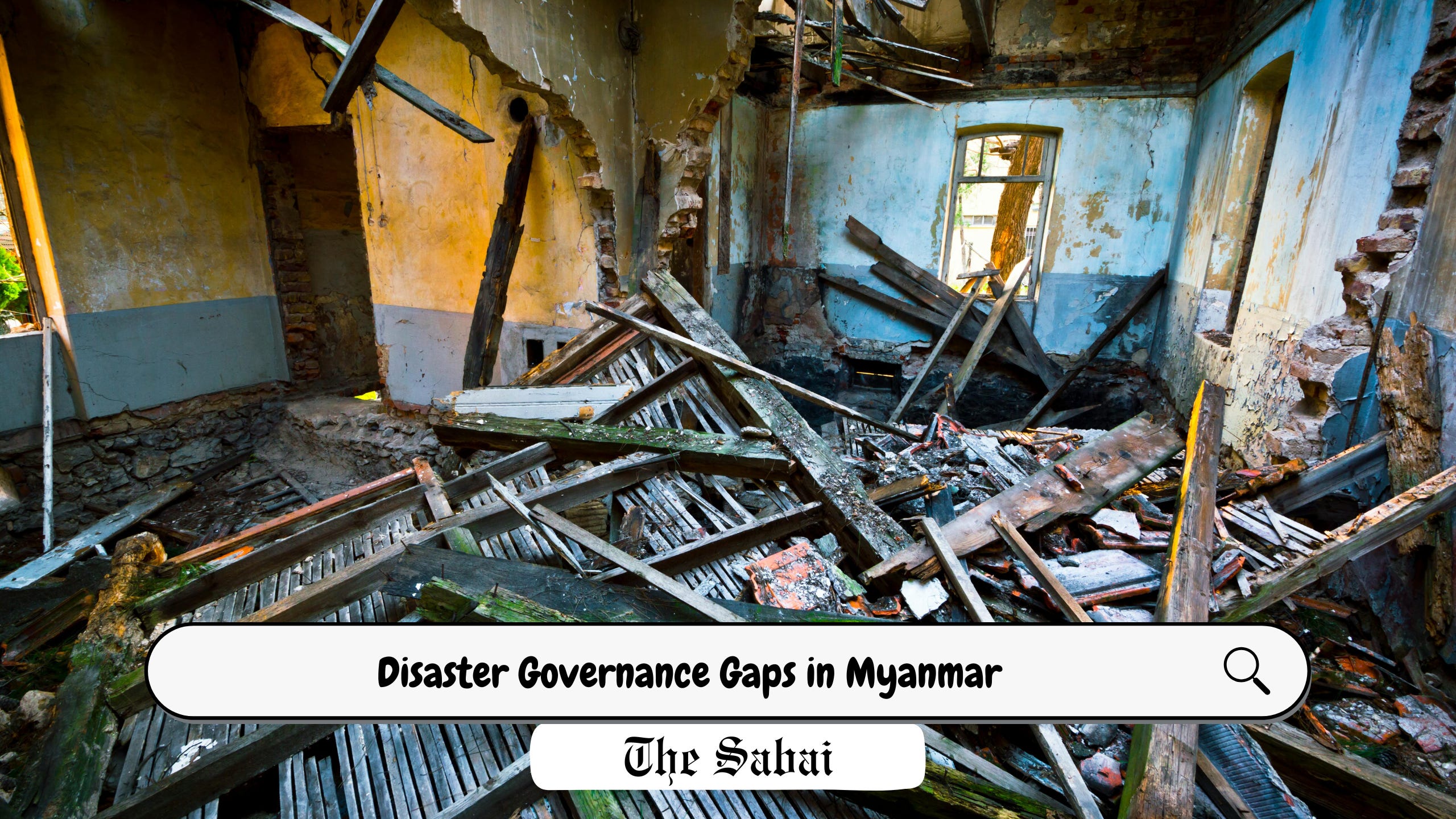
Myanmar’s disaster response is weak due to poor systems, political issues, and lack of coordination, affecting people, the economy, and the environment. At the same time, non-state and international groups bring both challenges and opportunities to improve disaster management.
Key Takeaways:
Disaster impacts are driven not only by hazards but by governance failures.
Non-state actors are essential but face major constraints.
Inclusive and effective governance is critical for improving disaster response.
The common classification of disasters as natural or man-made is misleading. The United Nations emphasises that a hazard becomes a disaster only when it affects vulnerable populations lacking protection due to poverty, exclusion, or social disadvantage.
Myanmar is highly exposed to disaster risks and is the most climate hazard–prone globally due to its geographical location and diverse topography. The country is also highly vulnerable, with weak coping capacity and limited ability to support long-term recovery.
Governance plays a key role in reducing disaster impacts. Evidence shows that higher government effectiveness is linked to lower disaster mortality. Understanding governance gaps is therefore essential to explain failures in disaster management and reduce future risks.
State-Driven Disaster Governance Gaps
1. Restrictions on Humanitarian Aid Delivery
The military regime imposes strict controls on humanitarian aid, especially in conflict-affected areas where needs are greatest. It restricts and monitors aid, limiting access for local and international actors and worsening conditions. After the 2025 Sagaing earthquake, rescue teams were denied immediate entry and required official approval despite urgent needs. Aid was confiscated, preventing delivery to areas most in need, particularly those controlled by the NUG and ethnic resistance groups. Curfews further delayed operations.
Restrictions also affect international organisations. The 2022 Registration Law requires disclosure of staff, funding, and operations, restricts engagement with local actors, and imposes penalties for non-compliance. Since the 2021 coup, hundreds have reportedly been arrested under these rules, while travel authorisations are frequently delayed or denied.
Information control further limits response. Internet shutdowns, media restrictions, and bans on digital platforms reduce public awareness. Similar patterns were observed during Cyclone Nargis (2008) and Cyclone Mocha (2023), where aid delivery was delayed and restricted.
2. State Negligence and Abuse During Disasters
The military regime has failed to fulfil its obligation to protect affected populations. During the 2025 earthquake, military involvement in relief was minimal, with limited troop deployment and reports of looting by soldiers. Support prioritised government and military groups, particularly in Naypyitaw, while vulnerable populations such as IDPs were neglected.
Despite announcing ceasefires, the military continued airstrikes in affected areas, causing civilian casualties and damaging shelters, including religious buildings. In one case, a monastery hosting medical teams was targeted. These actions have been widely criticised as inhumane and indicative of disregard for human rights. Similar patterns occurred during Typhoon Yagi and Cyclone Mocha. Rescue support was limited, evacuation efforts were inadequate, and aid was redirected to military-aligned areas. Entire communities, especially Rohingya and resistance-aligned groups, lacked food and shelter.
Overall, humanitarian aid has been politicised, used to reward loyalty and restrict opposition rather than to save lives.
3. Weak Disaster Preparedness
Despite high exposure to hazards, preparedness remains weak due to limited infrastructure and coordination. Disasters therefore cause greater damage and casualties than in comparable countries. This is evident in Typhoon Yagi (2024). Countries like Vietnam implemented early warnings, evacuations, and large-scale mobilisation, while Myanmar’s response was limited. Although affected only by storm remnants, Myanmar recorded a comparable death toll, highlighting governance failures.
Existing disaster frameworks are undermined by poor implementation, weak coordination, and limited community engagement. Although Myanmar has a formal disaster management structure, gaps persist due to centralised control, weak institutional capacity, and inadequate local resources. State priorities often focus on military operations rather than disaster response, increasing risks to civilians.
4. Fiscal Prioritisation and Underinvestment
Financial allocation remains a major challenge. Military spending far exceeds disaster investment, with defence expenditure nearly 200 times higher. The government relies on limited reserve funds covering less than 1% of disaster damage, while the National Natural Disaster Management Fund provides minimal support. Budget rigidity limits flexibility during emergencies. These issues have worsened. In 2022, disaster funds were diverted to economic support, reducing resources for emergency response. During the 2025 earthquake, shortages of equipment and support highlighted severe underinvestment.
5. Limited Manpower In Disaster Response
Myanmar faces significant human resource constraints. There is a shortage of trained rescue personnel, and state responders are often absent, with some reports of misconduct. Response efforts, therefore, rely heavily on local communities and volunteers.
The workforce has further declined due to arrests, killings, forced conscription, and the Civil Disobedience Movement (CDM). Unlike past disasters with large-scale mobilisation, recent responses involve small, less coordinated volunteer groups. The healthcare workforce is also critically insufficient. Even before the crisis, workforce numbers have dropped below WHO standards, worsened by arrests and killings of health workers. During the 2025 earthquake, limited facilities were overwhelmed, particularly in Mandalay.
Weak institutional capacity and coordination further limit effective emergency response, increasing dependence on local networks.
Role of Political Opposition and International Actors
1. National Unity Government (NUG)
The NUG has emerged as a parallel governance actor since 2021. It provides humanitarian aid in areas under its influence, often working with EAOs, and coordinates through its Ministry of Humanitarian Affairs and Disaster Management, with local communities, CSOs, and international partners.
A key strength of the NUG is its ability to deliver structured and transparent responses despite limited resources. During Cyclone Mocha, it established coordination mechanisms, issued early warnings, supported evacuations, and allocated funds for relief and recovery. Engagement with international actors has also increased since 2024, with actors such as the United States, the European Union, and some UN agencies.
However, its reach is restricted by the SAC restrictions on access, as well as resource constraints, relying on domestic fundraising and diaspora support with limited international funding. Institutional challenges, including limited human resources, technical capacity, and administrative systems, further affect its ability to coordinate large-scale responses and deliver aid consistently.
2. Ethnic Armed Organisations (EAOs)
EAOs have become key service providers in many regions. Their strengths include local access, territorial control, and strong community trust. Organizations such as the Karen National Union (KNU), with established governance structures, have developed dedicated administrative systems to deliver social services and coordinate emergency response for local populations. During Cyclone Mocha, groups such as the Arakan Army conducted early warning, needs assessments, and relief operations. Their efforts are often supported by strong community trust and collaboration with CSOs and NGOs.
However, they face key limitations. Resource constraints limit large-scale response, while fragmentation and lack of recognition hinder coordination and engagement with international actors. Ongoing conflict further restricts operations, and some groups face concerns related to human rights and environmental practices, affecting credibility.
3. Civil Society Organisations (CSOs), Non-Governmental Organisations (NGOs), and International Actors
CSOs, CBOs, NGOs, and international actors are primary humanitarian providers, especially in hard-to-reach areas. Local actors deliver frontline responses, while international actors provide funding and technical support.
However, effectiveness is constrained by access restrictions, funding limitations, and capacity gaps. Tensions between local priorities and international neutrality requirements also affect cooperation. Many INGOs are reluctant to partner with informal actors due to legal and donor constraints, and top-down funding systems reinforce unequal power dynamics and slow delivery. Finally, humanitarian funding has declined due to competing global crises and donor caution, compounded by military restrictions on banking transactions, which disrupt fund transfers and limit operational capacity.
Impacts of Disaster Governance Gaps
1. Social Impacts
Cyclone Nargis (2008) caused over 77,000 deaths. In 2024, Typhoon Yagi affected around 887,000 people, while the 2025 earthquake resulted in about 9,000 deaths and injuries. Health conditions worsen due to damaged water systems, leading to disease outbreaks. Displacement into temporary shelters increases risks of infection, while repeated shocks, conflict, and displacement create psychological trauma, especially for children. Disasters often cause shortages of food, clean water, shelter, medicine, and electricity. Education is also disrupted, with thousands of schools affected, and temporary learning spaces remain insufficient. Disasters have caused widespread destruction of homes, roads, bridges, and communication systems. Essential facilities as well as cultural heritage sites have been damaged. Human rights are often compromised due to restricted aid, delayed response, and attacks on civilian areas. Some communities lack adequate food, shelter, or evacuation support, increasing risks. Restrictions on information further limit access to life-saving assistance. Displacement remains severe, with millions internally displaced and increased migration.
2. Economic Impacts
Livelihoods are heavily affected, with damage to agriculture and fisheries reducing income. For example, Typhoon Yagi (2024) flooded farmland during a key planting season. The 2025 earthquake affected over 3.5 million workers, with losses up to US$36.8 million per day. Infrastructure damage disrupts economic activity and supply chains, increasing poverty rates. Recovery often exceeds initial damage estimates, placing long-term pressure on public finances.
3. Environmental Impacts
Disasters damage water systems, causing contamination and scarcity. Disasters contribute to soil degradation and land loss. Riverbank erosion is a major issue in regions such as Ayeyarwady. Floods and extreme weather damage crops, irrigation, and storage, reducing agricultural output. Disasters harm ecosystems and severely damage mangrove forests and surrounding ecosystems. Disasters alter landscapes through landfall, landslides, and ground fractures, as seen during Cyclone Nargis and the 2025 earthquake.
4. Governance Impacts
Repeated failures reduce public trust, weakening cooperation and policy implementation. Disasters strain already fragile public systems, limiting their ability to respond effectively. All the above impacts are intensified by limited preparedness, weak coordination, and constraints in response and recovery capacity.
Recommendations
Disasters cannot be prevented, but their impacts can be reduced through effective governance. Given Myanmar’s limited institutional capacity and reliance on external support, responsibility extends to the international community. As structural challenges are unlikely to be resolved in the short term, the following recommendations focus on strengthening non-state and international actors.
Disaster governance should be decentralised, inclusive, and effectively implemented at all levels, especially locally. Strong coordination among CSOs, EAOs, NUG, and NGOs/INGOs is key, with a focus on conflict sensitivity and vulnerable groups. Invest in resilient infrastructure, essential supplies, and community preparedness. Strengthen human capacity through training and support, improve early warning systems, and ensure flexible, well-prioritised disaster funding. Support local actors as primary responders and simplify funding access. Strengthen partnerships between local and international organisations to improve coordination and aid effectiveness.
Conclusion
Disaster governance in Myanmar is weak due to poor planning, limited resources, and restricted aid. Non-state actors try to help, but face political, financial, and coordination challenges. As a result, disasters have severe impacts. Improving this requires more inclusive, locally led efforts with stronger international support.
Dr. Jeslyn is a Junior Research Fellow at the Sustainability Lab of the Shwetaungthagathu Reform Initiative Centre (SRIc). She holds a Master of Public Health and has experience in research analysis, remote healthcare services, and community outreach programs.
“Advocating Sustainability, Shaping Our Future”
Help Sustain The Sabai - Myanmar’s Voice for Sustainability Support The Sabai