

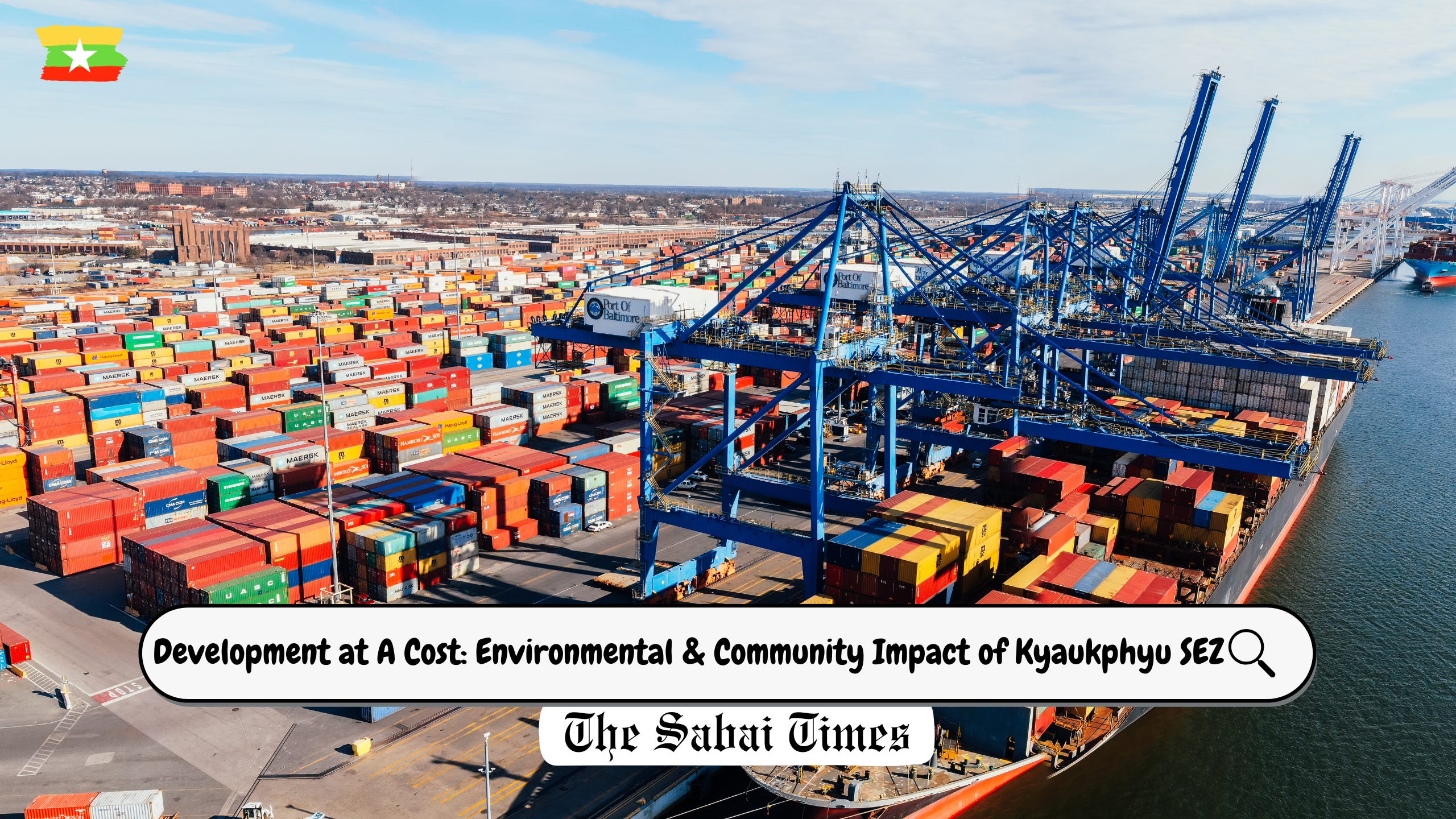
China and Myanmar share a long-standing economic partnership, as Myanmar is considered a strategic location for China to expand its economic power, particularly in terms of trade and investment within the Indo-Pacific region.
Key Takeaways:
Development projects for economic growth may destroy livelihoods for the local community instead of creating employment opportunities and improving living standards.
The Kyaukphyu Special Economic Zone serves as an example of a common problem in developing countries: the pursuit of economic growth at the expense of social and environmental sustainability.
Infrastructural development, ecosystem safety, and local community protection must be balanced in order to achieve inclusive and sustainable progress.
In 2010, Myanmar experienced a dramatic economic transition, resulting in the establishment of Special Economic Zones (SEZs), an important component of the country's modernization efforts. The Kyaukphyu Special Economic Zone is one of these, intending to promote foreign investment and regional economic growth between China and Myanmar.
The Impact of Kyaukphyu SEZ on Local Livelihoods and Environment
Special economic zones are designed to be the driving force of the socio-economic progress of a specific country and play a pivotal role in the development of many emerging economies. However, special economic zones are risky & expensive and produce social and environmental unsustainability in the local livelihoods of the community. In addition, some SEZs are located in remote areas where it is difficult to access environmental assessment. The global experience of SEZs has been uneven, with some countries attaining successful economic outcomes while others struggle to overcome market failures, institutional constraints, and social and environmental consequences. Several SEZs still need to deliver the projected economic benefits while severely impacting the environment and residents.
Kyaukphyu Special Economic Zone is located in Kyaukphyu Township, Kyaukphyu district, in Rakhine State, on the west coast of Myanmar. It is a key area for overall national economic development and Rakhine State development. According to the media outlets, residents in Kyaukphyu Township report losing their rights to fishing grounds for giving spaces to Chinese ships. However, the government neglects to consider the side of the local community whose living is dependent on the sea. 70% of the population in Kyaukphyu Township are farmers and fishers. They mainly depend on their land for agriculture and sea fishing to make a living income. Therefore, the activists claim that the deep sea port is expected to seriously disrupt the livelihoods of local fishermen as fish stocks have been depleted. As a result, they lost 50 percent of their fisheries and now have to rely only on the remaining 50 percent to make income. The cases within SEZs (Special Economic Zones) show that the local livelihoods have declined due to the industrial development of these zones.
The larger and more complex the project, the greater the potential for positive and negative effects on the local community. For example, the deep sea port project, a part of the KyaukPhyu Special Economic Zone, releases waste from ships and other port activities, leading to the loss or degradation of habitat areas and harm to marine life. Fishermen in Kyaukphyu are now experiencing depleted fish stocks and difficulties, as they have relied on sea fishery for their entire lives. Unfortunately, the changes and consequences brought on by the Special Economic Zone have harmed their local livelihoods rather than positive effects.
As mentioned, ship waste disposal significantly threatens marine life and the ecosystem's delicate balance. The region of Kyaukphyu boasts a wealth of biodiversity, and the construction of special economic zones often involves exploiting natural resources and deforestation. This destructive practice can ultimately lead to biodiversity loss and contribute to a broader climate crisis. In addition, the air quality in Kyaukphyu is worsening, and the emission sources are estimated to be industrial facilities, marine vessels, inland transportation, and waste burning. Kyaukphyu SEZ is also a crucial hub for China’s oil and gas industry. Therefore, the increased shipping traffic threatens the natural habitats and marine ecosystems surrounding the ports.
Conclusion
According to the goals adopted by the UN in 2000, ensuring environmental sustainability is one of them. Countries nowadays, whether developed or developing, are trying to advance their economy in terms of utilizing the increased use of technological power, modernization, industrialization, and urbanization, neglecting the potential impact on the natural environment. In the case of the Kyaukphyu Special Economic Zone, the local community has suffered the most in terms of livelihoods and ecosystems. We cannot conclude that every development project would benefit the country and its people without causing harm to the natural environment. As a host country of these large-scale infrastructural projects, Myanmar has been exploiting the natural resources and causing harm to the environment by the powerful countries. Therefore, we must be aware that we must find ways to balance the progress of economic development and the sustainability of the natural environment to protect citizens’ health, livelihoods, and food security, which means inclusive development or sustainable development.
Pyae Phyoe Mon is an M.A. Candidate in Social Sciences at the Faculty of Social Sciences, Chiang Mai University, Thailand.
“Advocating Sustainability, Shaping Our Future”
The opinions expressed in these articles do not represent the official stance of SRIc - Shwetaungthagathu Reform Initiative Centre. The Sabai Times is committed to publishing a range of perspectives that may not align with editorial policy.
Help Sustain The Sabai Times - Myanmar’s Voice for Sustainable Development Support The Sabai Times
The impacts on fishing communities which are described in the article are an impact caused by the pipeline/oil terminal, which long predated the SEZ plans. They mirror the findings in the MCRB Oil and Gas Sector Wide Impact Assessment (SWIA) for which field research was conducted in Kyaukphyu in 2013/4. Shwe Gas might also have covered those earlier still, although they more focussed on land grabs related to the terminal and the pipeline. Of course, if the actual Deep Sea Port , let alone the Industrial Park, ever made it off the drawing board, it’s likely to cause similar impacts on fishing communities unless better planned and managed. But it’s not the SEZ that caused the impacts because that doesn’t exist yet.
It’s also important to understand that China has no strategic interest in developing the Industrial Park, only the port as its the port which serves China’s aim of establishing a transport back door to the Bay of Bengal. But as the Myanmar side under Thein Sein was pushing Kyaukphyu as a third SEZ, they had to also pitch for industrial park. That element of the project is very much on the back burner, and even the port is only proceeding just fast enough to allow China to keep its end of the deal and keep its foot in the door, while the conflict dynamics play out.