


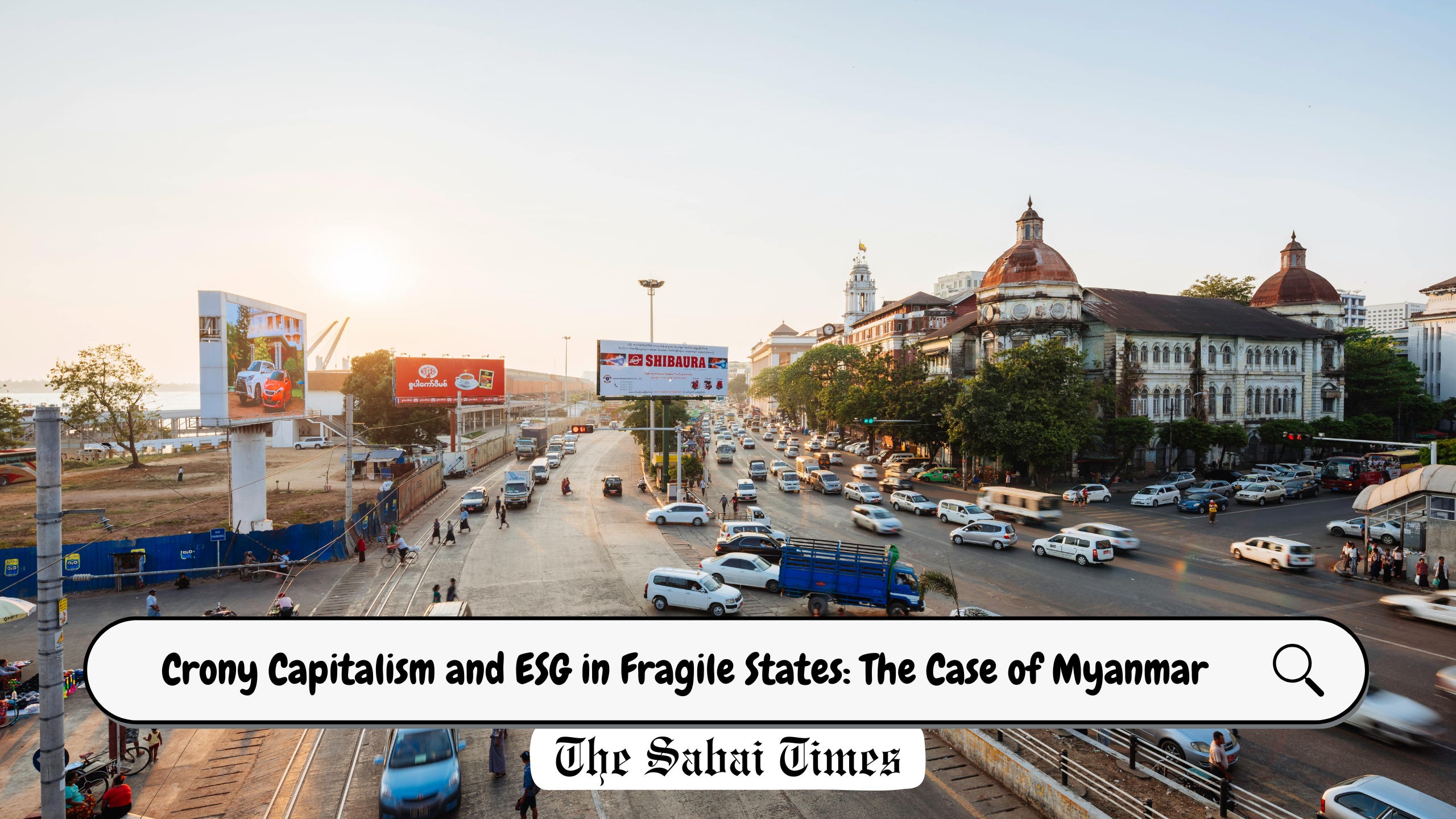
Myanmar exemplifies the structural challenges for Environmental, Social, and Governance (ESG) implementation in a country long characterised by crony capitalism, underscoring the importance of responsible investment.
Key Takeaways
Military-linked enterprises control virtual industries in Myanmar, resulting in expenses to local communities and the environment.
Local businesses frequently misunderstand ESG adoption. Foreign investors risk entanglement with cronies, and reporting tends to be superficial or “ESG-washing.”
Political realities such as sanctions, trade shocks, and reliance on questionable partners complicate responsible investment, transparency, accountability, and block ESG efforts.
Crony capitalism is an economic system in which a business’s success is heavily dependent on the close relationships between business owners and government officials. They receive profits and advantages such as government grants, tax breaks, or permits based on political connections rather than market competition. Wealth and opportunities are concentrated in the hands of the elite, leading to a monopolized and uneven playing field. Furthermore, crony capitalism grows in fragile states where the institutions are weak, the rule of law is ineffective, and no accountability. It is particularly harmful in fragile contexts as it worsens existing problems in governance and economic stability.
Global investors, on the other hand, employ Environmental, Social, and Governance (ESG) frameworks to analyze ethical business behavior and accountable practices that contribute to a sustainable society. Over the last decade, the global investment community has adopted ESG principles as a new model for responsible capitalism. The framework promises to guide investments toward firms that are sustainable, ethical, and well-governed, resulting in a reciprocal cycle of profit and progress. In an era when ESG principles are increasingly being pushed as the standard for responsible investment, implementing them in fragile states is a significant challenge.
Myanmar, particularly after the 2021 military coup, presents a case study of significant tension between crony capitalism and ESG principles as a fragile state. Military-linked cronies long dominated Myanmar’s economy with cycles of authoritarianism and fragile democratization. It also demonstrates how crony capitalism can hinder ESG adoption by perpetuating opaque and corrupt practices.
Furthermore, a recent report from the Myanmar Centre for Responsible Business (MCRB), namely the Pwint Thit Sa (TiME) report 2024, highlights how Myanmar enterprises are evaluated for sustainability and transparency. It also exposes improvements and significant gaps in corporate transparency. Misunderstandings of ESG within local companies, the reality that many businesses must interact with “un-authentic partners” such as cronied banks, and increased US tariffs on Myanmar exports all limit ESG implementation in practice.
Myanmar’s Political Economy and Crony Networks
Myanmar’s crony capitalism is not a recent phenomenon. For more than 50 years, the military, often referred to as the Tatmadaw, has been systematically involved in every profitable sector of the economy. At the center of Myanmar’s crony capitalism are two military-owned companies: Myanma Economic Holdings Limited (MEHL) and Myanmar Economic Corporation (MEC). These are led by active and retired military personnel. In March 2021, the U.S. Treasury Department designated both corporations as sanctioned entities due to their involvement with the military regime. According to that department, MEHL alone oversees industries such as banking, mining, consumer products, food and beverage, tobacco, logistics, and others. Their revenues are diverted to military budgets and paid out as dividends to military personnel. On the other hand, MEC controls numerous subsidiaries in vital areas, including its own bank (Innwa Bank) and assets in telecommunications and manufacturing.
Extractive Industries and Local Impact
The jade, gem, and hydropower industries are well-known for causing environmental damage, corruption, and conflict. For example, in Kachin State, toxic rare earth mining has had a significant impact on forests and streams. Moreover, gold mining in Sagaing Region and Banmauk has been connected to mercury and arsenic pollution.
Corporations with military links and crony companies dominate these extractive sectors. All the profits go to the elites while local communities suffer the environmental costs. From an ESG perspective, it illustrates how crony capitalism undermines ecological and social accountability. Furthermore, these industries address the urgent need for stronger environmental safeguards, transparent governance, and community consultation in Myanmar. Companies working in these areas make little to no disclosures, highlighting the gap between ESG principles and ground realities.
ESG in Myanmar: Genuine Change or “ESG-Washing”?
During Myanmar’s political transition from 2011 to 2021, many foreign companies entered the market with a commitment to ESG. They built schools, funded health projects, and published corporate social responsibility reports. Although local communities benefit from some projects, the companies failed to address the structural corruption inherent in the crony system. They often have no choice but to partner with military-linked enterprises to gain market access. By paying taxes, fees, and land-use payments to the government and economic system controlled by the military regime, these investments provided legitimacy and financial resources to the institutions responsible for systemic human rights abuses.
Additionally, local enterprises often misinterpret ESG initiatives in Myanmar. Many communities view corporate ESG activities as traditional charity work or philanthropic endeavors, instead of a broader corporate framework for accountability, transparency, and sustainable governance. This misconception results in a practice known as “ESG-washing.” It also often allows companies to promote their image of social responsibility rather than addressing deeper, more fundamental ethical and structural issues.
ESG challenges in Myanmar
Pwint Thit Sa 2024 Report assessed 254 companies on sustainability and corporate disclosure. Notable performers include UAB Bank, FMI, and MAHA. Although disclosure has improved, the data presented were from company websites and reports, without third-party verified ESG assessments. Additionally, not all companies adhere to internationally recognized reporting standards, such as the Global Reporting Initiative (GRI). Moreover, local enterprises often misunderstand ESG principles (implications for systemic governance, environmental protection, and human rights) as mere philanthropy initiatives.
In August 2022, Vicky Bowman, the former UK Ambassador to Myanmar and Director of the Myanmar Centre for Responsible Business (MCRB), was detained by the junta. It was a significant concern for Myanmar’s responsible business environment. Many people believed that her arrest was politically motivated, which harmed efforts to promote responsible business practices and corporate accountability in the country.
Following these events, MRCB announced its wind-down at the end of 2024, which was a significant loss for Myanmar’s ESG ecosystem. The closure of this key institution leaves a void in corporate transparency advocacy, creating challenging efforts to align Myanmar’s private sector with global ESG standards.
In addition to this, a lack of trustworthy alternatives forces many businesses to collaborate with “un-authentic partners,” particularly banks with powerful cronies. As a result, regulatory enforcement is weak, allowing companies to produce inaccurate data. Furthermore, watchdogs such as Inclusive Development International revealed that billions of dollars in ESG-labeled investments have unintentionally financed companies associated with the junta. In this way, foreign investors may unintentionally become entangled in these problematic networks, undermining ESG compliance.
An additional challenge is the recent U.S. Tariffs on the garment industry, employing ~500,000–800,000 workers, primarily young women. After President Trump’s inauguration for the second term, the U.S. imposed a 40–44% tariff on Myanmar’s garment, shoe, and bag exports. As a result, factories like the Samsonite bag plant in Yangon closed, orders have dropped, and workers face layoffs. While tariffs align with sanctions, they also raise concerns about collateral damage to labor rights and the implementation of ESG principles in the garment supply chain.
Conclusion
Environmental, social, and governance (ESG) considerations cannot be a solitary exercise, separated from the political reality in fragile states like Myanmar. A corrupt military system has long dominated the country. Unless addressing the root causes of oppression, global efforts for ESG compliance and long-standing crony capitalism would conflict. Although we can see some improvement in corporate transparency based on the Pwint Thit Sa 2024 report, international trade shocks constrain broader adoption, forcing reliance on compromised partners and perpetuating misconceptions about ESG. However, if ESG is localized and strengthened by supply chain pressures, sanctions, and civil society advocacy, it can be a tool for accountability. In conclusion, ESG is not a solution in Myanmar. Still, it can help mitigate crony dominance, increase transparency and accountability, and encourage companies to adopt more ethical and sustainable business practices.
Pyae Phyoe Mon is a Junior Research Fellow at the Sustainability Lab of the Shwetaungthagathu Reform Initiative Centre (SRIc) and an M.A. Candidate in Social Sciences at the Faculty of Social Sciences, Chiang Mai University, Thailand.
“Advocating Sustainability, Shaping Our Future”
Help Sustain The Sabai Times - Myanmar’s Voice for Sustainable Development Support The Sabai Times