


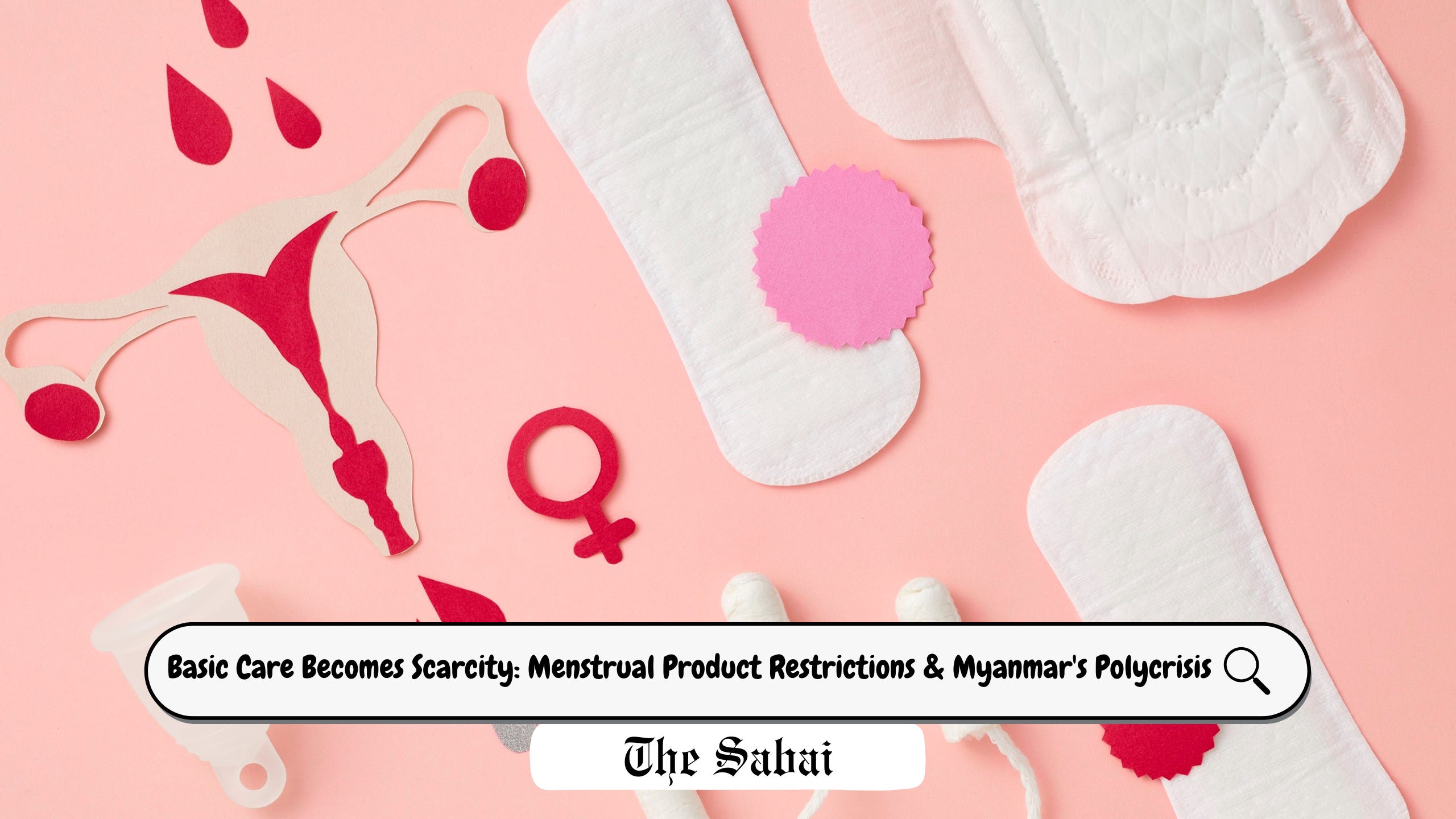
Restrictions on menstrual products in resistance-controlled areas demonstrate how Myanmar’s polycrisis amplifies everyday vulnerabilities.
Key Takeaways
Menstrual insecurity interacts with healthcare collapse, displacement, inflation, and gender inequality to create multidimensional social consequences.
The impacts extend beyond hygiene, contributing to deteriorating health outcomes, economic hardship, reduced mobility, and social exclusion.
Addressing menstrual health should be viewed as part of humanitarian resilience and social recovery rather than solely as a women’s health issue.
Myanmar’s ongoing conflict has led to a complex polycrisis in which political instability, armed violence, economic decline, humanitarian displacement, and institutional collapse reinforce one another. While much attention has focused on military operations, displacement, and humanitarian needs, less visible disruptions to everyday life are also producing significant social consequences.
One such example is the reported restriction on menstrual hygiene products in resistance-controlled areas. According to reports by The Guardian, Myanmar’s military authorities have increasingly restricted the transportation and distribution of menstrual products in conflict-affected regions, particularly in areas under resistance influence. Authorities have reportedly justified these restrictions by claiming that sanitary pads are being diverted to support resistance medical operations. Activists and humanitarian workers suggest that the measures form part of the broader “four cuts” strategy, which seeks to deprive resistance groups of supplies and support networks.
Although presented as a security measure, the reported restrictions have consequences that extend far beyond resistance actors. Limiting access to essential menstrual hygiene products disproportionately affects civilian women and girls, raising concerns regarding the protection of civilians and adherence to humanitarian principles. The policy also highlights how military decision-making can overlook gender-specific humanitarian needs. Despite the military’s public portrayal of itself as a modern professional force that includes women, senior command positions remain overwhelmingly occupied by men. This limited representation of women in senior leadership may contribute to the marginalisation of women’s health considerations in military planning, allowing policies to be implemented with insufficient attention to their gender-specific humanitarian consequences. More broadly, the reported restrictions illustrate how menstrual hygiene products, ordinarily recognised as essential health commodities, become reclassified as strategic resources during armed conflict, with disproportionate consequences for civilian women and girls.
Since August, the transportation of menstrual products has reportedly been blocked along certain routes connecting Sagaing Region and Mandalay. Although the military government has issued no official announcement, activists argue that the restrictions may be more widespread than publicly recognised due to the social stigma surrounding menstruation and the limited public discussion of menstrual health needs.
At first glance, the issue may appear to be a simple shortage of hygiene products. However, in a country already experiencing healthcare collapse, economic hardship, mass displacement, and weakened social protection systems, menstrual insecurity becomes much more than a supply problem. This article argues that menstrual product restrictions illustrate how Myanmar’s polycrisis amplifies existing vulnerabilities for women. By interacting with healthcare breakdown, inflation, displacement, and social stigma, menstrual insecurity becomes a multiplier of health risks, economic exclusion, reduced mobility, and social marginalisation for women and girls. Beyond its health and economic consequences, menstrual insecurity undermines the dignity of women and girls by depriving them of the privacy, safety, and confidence required to participate fully in everyday life.
Menstrual Insecurity and Healthcare Collapse
The first consequence emerges through the interaction between menstrual insecurity and Myanmar’s deteriorating healthcare system.
In many conflict-affected areas, healthcare infrastructure has been severely disrupted by armed conflict, displacement, and shortages of medical supplies. Clinics have been destroyed or abandoned, healthcare workers displaced, and access to medicine remains limited. Under these conditions, restrictions on menstrual products create risks that extend beyond discomfort. Women and girls who cannot access sanitary pads are often forced to rely on unsafe alternatives such as reused cloths, improvised materials, or prolonged use of disposable products. These coping strategies increase the likelihood of urinary tract infections (UTIs), reproductive tract infections, skin irritation, and other preventable health complications.
Under normal circumstances, many of these conditions are easily treatable. However, in areas where antibiotics, medical personnel, and healthcare facilities are scarce, minor infections can develop into chronic health problems. The resulting public health burden is therefore not caused by menstruation itself but by the interaction between material scarcity and healthcare collapse. This illustrates a defining characteristic of polycrisis: multiple vulnerabilities combine to produce outcomes more severe than any single crisis.
Menstrual Insecurity and Economic Hardship
The second pathway operates through Myanmar’s worsening economic crisis. Years of conflict, inflation, currency depreciation, and market disruption have significantly reduced household purchasing power. Within this environment, restrictions on menstrual products have contributed to supply shortages and increased dependence on informal markets.
Reports indicate that the price of sanitary pads has tripled from approximately 3,000 kyat to 9,000 kyat per packet. This exceeds Myanmar’s minimum daily wage of 7,800 kyat. For households already struggling to afford food, transportation, and basic necessities, menstrual products become increasingly inaccessible. As a result, many households in conflict-affected areas are forced to make impossible choices between purchasing menstrual hygiene products and meeting other essential needs, such as food. This dilemma highlights how the crisis compels families to choose between fundamental rights, including the right to adequate food and the right to health, dignity, and menstrual hygiene.
At the same time, Myanmar’s prolonged economic crisis has placed growing pressure on women to contribute financially through paid work alongside their male counterparts. Yet unlike many household expenses, menstrual health is both recurring and unavoidable. Women and girls cannot simply postpone the need for menstrual products during times of economic hardship. Consequently, families often resort to unsafe alternatives or divert scarce resources from other essential needs. For women who rely on paid employment to support their households, inadequate access to menstrual products may also affect their ability to work safely and consistently. What begins as a supply restriction therefore becomes a form of gendered economic exclusion, deepening existing inequalities while undermining household resilience during a period of economic crisis.
Menstrual Insecurity and Humanitarian Displacement
A third dimension of Myanmar’s polycrisis emerges through mass displacement. Since the 2021 military coup, millions of people have been internally displaced, many living in temporary shelters, monasteries, schools, or forest encampments with limited access to clean water, sanitation facilities, healthcare, and privacy. In these settings, menstrual hygiene management becomes not only a health issue but also a humanitarian and protection challenge.
Displacement disrupts the infrastructure needed for safe menstrual hygiene. Women and girls often lack private spaces to change menstrual products, wash reusable materials, or dispose of used pads safely. Many displaced women report waiting until nighttime to change menstrual products to avoid being seen, while others carry used pads with them because there is no safe place for disposal. Access to water is equally constrained, with some displaced communities prioritising drinking water over bathing or washing clothes. Although reusable menstrual products, such as menstrual cups and reusable cloth pads, are often promoted as sustainable alternatives during humanitarian crises, their use in Myanmar is constrained by both practical and sociocultural barriers. Limited access to clean water and private washing facilities makes it difficult to use and maintain reusable products safely, while persistent menstrual stigma, limited familiarity with menstrual cups, and cultural concerns surrounding their insertion reduce their acceptability among many women and girls. As a result, the loss of access to disposable menstrual products cannot be readily offset by switching to reusable alternatives.
These challenges are further intensified by conflict. Ongoing military operations, road blockages, and restrictions on humanitarian access make it difficult for aid organisations to deliver menstrual products to displaced communities. At the same time, insecurity limits women’s ability to travel to local markets even when products are available.
As a result, menstrual insecurity is intensified by the conditions of displacement. The interaction between forced displacement, inadequate sanitation, and restricted humanitarian access transforms what is ordinarily a manageable aspect of daily life into a multidimensional humanitarian challenge. This demonstrates how Myanmar’s displacement crisis magnifies the social consequences of menstrual product restrictions and further erodes the dignity, health, and well-being of women and girls.
Menstrual Insecurity, Social Exclusion, and the Invisibility of Crisis
The cumulative effects of healthcare collapse, economic hardship, and displacement ultimately extend beyond women’s physical well-being to shape their participation in social and civic life. Menstrual insecurity affects not only how women manage their health but also their ability to remain active within their communities. Many women report feeling embarrassed or lacking confidence to attend school, work, displacement camps, or community spaces because they fear visible blood stains, odour, or inadequate protection.
This reduction in mobility can limit participation in education, livelihood activities, community meetings, and political engagement. In resistance-controlled areas, where communities increasingly depend on collective action and mutual support to sustain basic services, women’s reduced participation weakens both individual agency and community resilience. This includes not only civilian participation in everyday governance and social support systems, but also the involvement of women engaged in political organizing and resistance activities, where sustained presence and mobility are essential. What begins as a shortage of menstrual products therefore evolves into a broader form of social exclusion.
Beyond its physical consequences, menstrual insecurity also imposes a significant psychological burden on women and girls living in conflict-affected areas. The constant uncertainty over whether menstrual products will be available each month, combined with the inability to manage menstruation safely and privately, can generate persistent stress and anxiety. Many women experience shame, fear of humiliation, and a loss of dignity when they are unable to manage menstruation according to accepted social norms. For women already coping with armed conflict, displacement, economic hardship, and the trauma of violence, menstrual insecurity becomes another source of emotional distress that compounds existing psychological pressures. Rather than being a temporary inconvenience, it contributes to a chronic state of insecurity in which women must continually worry about meeting a basic bodily need while navigating an increasingly precarious environment.
These challenges are further reinforced by persistent menstrual stigma. In many parts of Myanmar, menstruation remains a sensitive topic that is rarely discussed openly. Women often hesitate to request menstrual products from humanitarian volunteers because aid distribution is frequently managed by men, while camp managers may overlook menstrual needs altogether (see here). This cultural silence discourages women from seeking support, contributes to underreporting, and limits public recognition of menstrual insecurity as a humanitarian concern.
Menstrual Insecurity, Social Exclusion, and the Invisibility of Crisis
The cumulative effects of healthcare collapse, economic hardship, and displacement extend beyond women’s physical well-being to shape their participation in social, economic, and civic life. Menstrual insecurity affects not only how women manage their health but also their ability to remain active within their communities. Many women report feeling embarrassed or lacking confidence to attend school, work, displacement camps, or community spaces because they fear visible blood stains, odour, or inadequate menstrual protection.
Beyond its physical consequences, menstrual insecurity also imposes a significant psychological burden on women and girls living in conflict-affected areas. The constant uncertainty over whether menstrual products will be available each month, combined with the inability to manage menstruation safely and privately, can generate persistent stress and anxiety. Many women experience shame, fear of humiliation, and a loss of dignity when they are unable to manage menstruation according to accepted social norms. For women already coping with armed conflict, displacement, economic hardship, and the trauma of violence, menstrual insecurity becomes another source of emotional distress that compounds existing psychological pressures. Rather than being a temporary inconvenience, it contributes to a chronic state of insecurity in which women must continually worry about meeting a basic bodily need while navigating an increasingly precarious environment.
These psychological pressures often translate into behavioural changes that reduce women’s participation in everyday life. Women may avoid attending school, work, community meetings, displacement camp activities, or humanitarian distributions because they fear visible blood stains, odour, or inadequate protection. Such absences can limit participation in education, livelihood activities, community decision-making, and political engagement. In resistance-controlled areas, where communities increasingly depend on collective action and mutual support to sustain basic services, women’s reduced participation weakens both individual agency and community resilience. This includes not only civilian participation in local governance and social support networks but also the involvement of women engaged in political organising and resistance activities, where sustained mobility and physical presence are essential. For women participating in resistance movements, inadequate access to menstrual products may affect their ability to remain deployed, undertake physically demanding tasks, or participate consistently in political and military activities. What begins as a shortage of menstrual products therefore evolves into a broader form of social exclusion that limits women’s participation in both civilian and resistance contexts.
These challenges are further reinforced by persistent menstrual stigma. In many parts of Myanmar, menstruation remains a sensitive topic that is rarely discussed openly. Women often hesitate to request menstrual products from humanitarian volunteers because aid distribution is frequently managed by men, while camp managers may overlook menstrual needs altogether. This cultural silence not only discourages women from seeking assistance but also reinforces feelings of embarrassment and isolation, causing many women to internalise menstrual insecurity as a private problem rather than a humanitarian concern. As a result, menstrual needs remain underreported and frequently overlooked in humanitarian planning and response.
Within Myanmar’s polycrisis, stigma functions as a force multiplier. By obscuring the physical, psychological, and social consequences of menstrual insecurity, it allows armed conflict, displacement, healthcare collapse, and economic hardship to reinforce one another while limiting effective humanitarian intervention. Menstrual insecurity is therefore not simply a hidden health issue but a multidimensional humanitarian concern that undermines health, dignity, psychological well-being, and social participation. It illustrates how everyday forms of gendered vulnerability become embedded within broader patterns of conflict and social fragility.
Conclusion
The reported restriction of menstrual products in Myanmar’s resistance-controlled areas offers an important illustration of how polycrisis functions in practice. The issue is not merely a shortage of hygiene products. Rather, it reveals how multiple crises interact and reinforce one another.
Healthcare collapse transforms preventable infections into long-term health risks. Economic decline makes essential products unaffordable. Displacement intensifies difficulties in managing menstrual health safely. Social stigma keeps the resulting harms largely invisible. Together, these overlapping pressures create consequences that extend far beyond the original restriction.
Understanding menstrual insecurity through the lens of polycrisis highlights the importance of examining how everyday needs intersect with broader structural challenges. As Myanmar continues to navigate conflict, displacement, and economic instability, ensuring access to basic menstrual products should be recognised not only as a health concern but also as an essential component of social resilience, human dignity, and long-term recovery.
Policy Recommendations
Expand Community-Based Menstrual Health Support in Conflict Areas
Local civil society organisations, women’s groups, and humanitarian actors should strengthen the distribution of menstrual hygiene kits through community-based networks, particularly in displacement camps and conflict-affected areas. Where disposable products remain inaccessible, support should include reusable menstrual products alongside menstrual health education, soap, and sanitation materials to reduce health risks.
Strengthen International Advocacy And Cross-border Aid
The United Nations, ASEAN, and international partners should press Myanmar’s military to end inhumane restrictions on menstrual hygiene products and expand cross-border humanitarian assistance to ensure women and girls in conflict-affected areas have access to essential menstrual health supplies.
Integrate Menstrual Health into Humanitarian and Public Health Responses
Humanitarian agencies should treat menstrual health as an essential component of health and protection programming rather than a secondary hygiene concern. Menstrual products, antibiotics for common infections, and reproductive health services should be incorporated into emergency healthcare responses, especially in areas experiencing displacement and limited medical access.
Reduce Menstrual Stigma Through Community Awareness and Education
Local organisations, educators, and community leaders should promote menstrual health awareness to challenge stigma and improve access to information. Greater public discussion can help ensure that menstrual insecurity is recognised as a legitimate humanitarian and public health issue rather than a private concern that remains invisible in policy discussions.
Htay Su Wai is a Junior Research Fellow at the Sustainability Lab of the Shwetaungthagathu Reform Initiative Centre (SRIc) and holds a Master of Public Policy (MPP) from the Hertie School of Governance in Berlin, Germany.
“Advocating Sustainability, Shaping Our Future”
Help Sustain The Sabai - Myanmar’s Voice for Sustainability Support The Sabai