

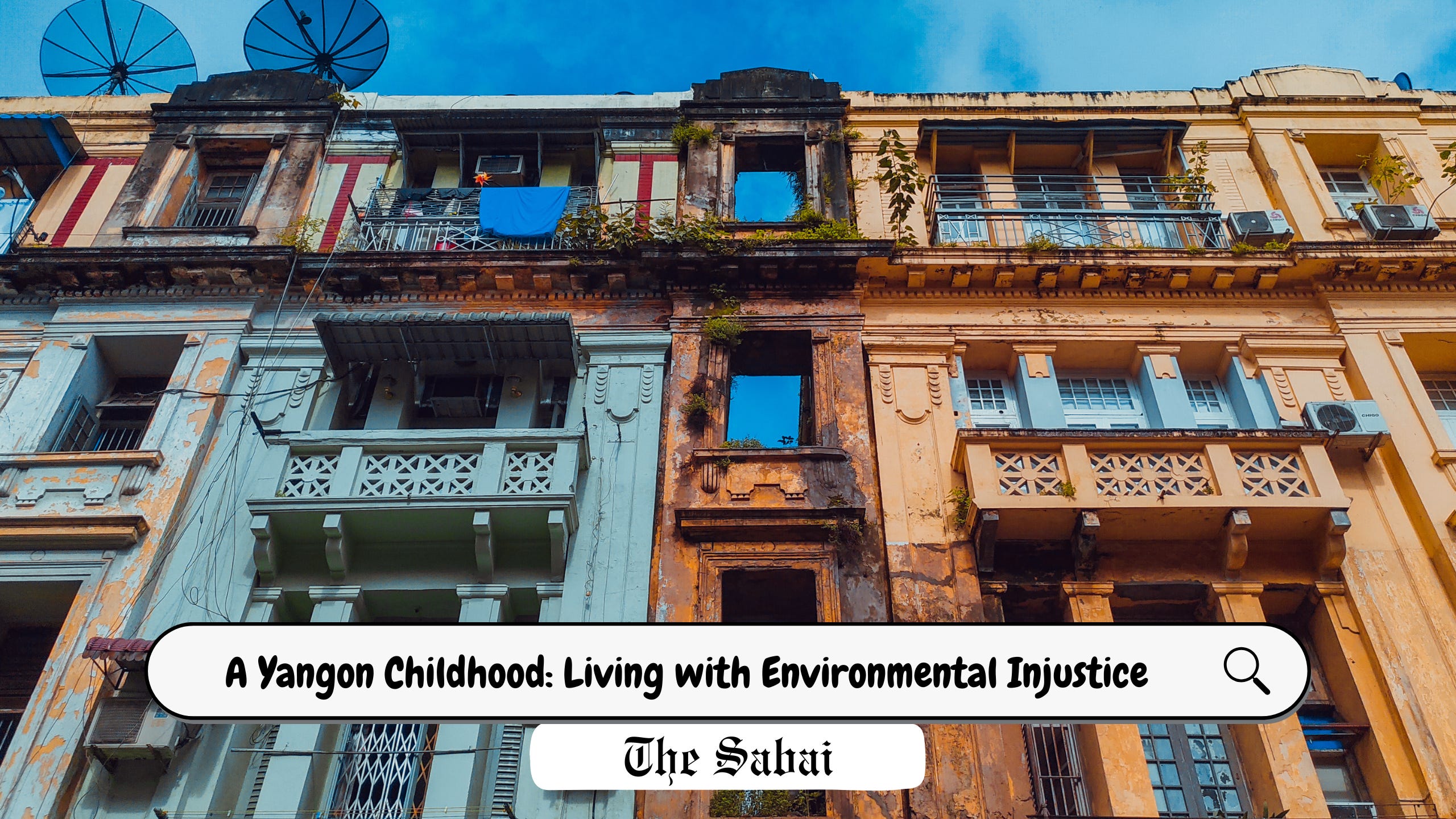
This article highlights the Yangon childhood, revealing how environmental hazards and structural inequalities create environmental injustice among local communities.
Growing up in Yangon, I witnessed firsthand how environmental harm is unequally experienced across communities. In my community, environmental issues were a constant part of my daily life: scarce water shortages during the hot season, frequent flooding in the rainy months, and ongoing air pollution and poor waste management in the neighbourhood. All of this was caused by nearby small manufacturing businesses such as garment printing, welding workshops, aluminium pots factories and shoe production, many of which discharged untreated waste directly into the surrounding environment. This small business began to develop more in my neighbourhood after 1988.
From early childhood until around the age of nine or ten, I was regularly exposed to air pollution and chemical fumes from the garment workshop next door to my home. They disposed of all their waste directly into a nearby ditch, where it accumulated due to poor water flow. At the same time, our entire neighbourhood relied on water drawn from driven and drilled wells, without awareness of potential contamination. These living conditions were part of a broader pattern of structural inequalities, in which communities striving to develop, such as the one where I live, faced ongoing harm due to weak environmental oversight, inadequate public infrastructure and limited access to safe and healthy environments.
Environmental justice refers to the fair treatment and meaningful involvement of all people, regardless of race, ethnicity, gender, or income, in environmental decision-making, law enforcement, regulation, policies and protection from environmental harm. Environmental justice holds that no community should carry an unequal share of environmental degradation or be excluded from the benefits of a healthy environment. Originating from grassroots movements in the United States, the concept has since gained global relevance, drawing attention to the reality that marginalised communities often endure higher levels of pollution and ecological risks while lacking both political voice and legal protection.
Environmental Justice also emphasises equitable access to environmental benefits, including clean air, safe drinking water, and healthy ecosystems. This approach offers a useful perspective that allows me to examine the intersection of my personal experiences related to international human rights standards on health and water.
Environmental conditions in Yangon
Yangon is the most populous city in Myanmar, with a population of more than 5 million. It struggles with rapid urbanisation, inadequate infrastructure, and weak environmental regulations. There is ongoing exposure to environmental risks in many low-income neighbourhoods and suburbs due to the close integration of industrial and residential areas. While I was growing up in such an environment, I witnessed firsthand how poor urban design and inadequate safeguards resulted directly in health risks.
Air quality was a persistent worry, especially due to the nearby small-scale industries like garment printing workshop, welding stations and shoe manufacturing. Many operated informally, frequently avoiding environmental checks through payments to local administrators or connections with military officials. This business discharged fumes, particulates and chemical byproducts directly into the surrounding environment without any filtration. The garment printing workshop next to my home releases strong chemical odours that probably came from solvents, dyes and inks that permeated into our living space. According to the WHO, long-term exposure to these pollutants can cause respiratory problems, skin irritation, and other long-term health problems.
Access to water was another issue, particularly in the 1990s and 2000s. Most households relied on driven or drilled wells, particularly in the summer. These unregulated water sources were exposed to contamination from industrial wastewater, household waste, and septic leaks. During the rainy season, poor drainage and frequent flooding combined sewage with groundwater, while standing floodwater promoted mosquito breeding and the spread of diseases carried by vectors.
Before 2015, solid waste management was almost absent. Although the Yangon City Development Committee (YCDC) provided waste collection services, coverage was irregular in informal neighbourhoods (not residential areas under YCDC law) and the outskirts of the city, leaving many people without reliable support. Consequently, people often disposed of waste in vacant lots, open pits, drainage channels and burned it directly in some places until now. This practice not only blocked drainage systems and worsening flood but also produced foul odours, leachate contamination of nearby water, rodent infestation and increased infectious diseases such as cholera and diarrhoea.
Multiple environmental threats, polluted air, unsafe drinking water, unmanaged waste and frequent floods created an accumulated burden on public health and well-being. Such conditions were not coincidental; they resulted from structural inequalities, weak enforcement of regulation, and the exclusion of low-income suburban communities from environmental decision-making. As environmental justice theory highlights, marginalised communities with limited political and economic resources are disproportionately affected.
The combined effects of environmental degradation and entrenched socioeconomic inequalities in Yangon create serious risks for the protection of fundamental human rights for local communities, particularly threatening necessities such as access to clean and safe drinking water, adequate sanitation, and essential health services, while disproportionately impacting vulnerable and marginalised populations who have limited resources and political voice.
Khin Kyi Thar is a master’s student in the MA program in Human Rights, Peace, and Democratisation, an online program jointly offered by Yangon Cosmopolitan University and Mahidol University, Thailand.
“Advocating Sustainability, Shaping Our Future”
Help Sustain The Sabai - Myanmar’s Voice for Sustainability Support The Sabai