


What role can Black Soldier Fly farming play in addressing organic waste challenges in a least developed country (LDC) like Myanmar?
Key Takeaways:
Solid waste management remains a significant challenge in heavily populated urban areas in developed and developing countries.
The decomposition of organic waste in landfills releases methane, a potent greenhouse gas that accelerates global warming.
An EU-funded Sein Lan project can lead to a sustainable waste solution, BSF farming in Myanmar.
As urban areas grow more congested, the solid waste crisis grows more severe. Developed and underdeveloped countries strive to tackle the solid waste problem and its consequences in their own ways. Do you know the severe consequences of the waste problem? When biodegradable organic and non-biodegradable waste are dumped in landfills, organic waste such as food scraps, garden trimmings, paper, manure, and other natural materials decompose anaerobically (without oxygen).
As a result, they produce methane (CH₄), a greenhouse gas 28 times more potent than CO₂ that contributes to global warming, and food waste accounts for 8 to 10% of global greenhouse gas emissions. These gases trap heat in the atmosphere, contributing to climate change. Approximately 50% of landfill mass in many countries is organic waste. Organic waste seems natural, but it can be dangerous if not appropriately managed, and its consequences can be severe. Several countries have enacted laws and regulations to reduce organic waste, particularly food and kitchen waste, at the national level.
Law Enforcement on Food Waste Management
After the EU set ‘Fit For 55’, a set of laws to reduce 55% of greenhouse gas emissions by 2030, EU countries adopted new legislation to meet the goal. For example, Spain recently legislated its first law on preventing food loss and waste in March 2025. This law forces the entire supply chain to make food waste prevention plans and to sell the imperfect or misshapen food in supermarkets. On top of that, it forced mandatory food donations by large retailers to social organisations. Moreover, restaurants must offer takeaway containers for leftovers without charging.
The UK also enforced mandatory food waste segregation regulations in March 2025, targeting the retail, hospitality, healthcare, and education sectors, and aims to minimise waste generation. All businesses must separate food waste into designated bins for composting or anaerobic digestion, with mandatory weekly collections. Businesses will also cover recycling fees, promote accountability, and encourage more sustainable waste management practices.
In many developing and underdeveloped countries, implementing new legislation on organic waste management seems unfeasible. Despite this, these countries are finding innovative, localized solutions to address the issue. There are many ways of capturing methane from biodegradable organic waste and converting it into valuable resources such as biogas, electricity, and organic fertilizer. One particular promising solution is Black Soldier Fly (BSF) farming. BSF farming is well-suited for least developed countries due to its cost-effectiveness and multiple benefits for poultry farming and organic agriculture.
Black Soldier Fly Farming Global Pictures
The BSF, Hermetia illucens, does not resemble the common housefly and is, in fact, a completely different species with a unique ecological role. The BSF has a complex life cycle which includes five primary stages over 39–47 days: egg, larval, pre-pupal, pupal, and finally adult fly. Furthermore, Black Soldier Fly is a highly beneficial species to our ecosystem. They are rich in protein and thrive on organic waste, making them valuable for sustainable animal feed production and waste reduction.
Notably, Africa is leading in adopting BSF farming, and Southeast Asia comes second. Many African countries also have flexible regulations that allow various types of organic waste to feed BSF larvae. These larvae are then used to feed livestock, fish, and pets, and their by-products (known as frass) are used as organic fertilizer, contributing to a circular and resilient local economy.
In Southeast Asia, Black Soldier Fly (BSF) farming has already been introduced and scaled up to industrial levels through investments from international and local companies. One of the region’s largest insect protein producers is Entobel, a Singapore-based company that established operations in Vietnam in 2015. Other leading BSF companies in Southeast Asia include Nutrition Technologies from Malaysia, Biocycle from Indonesia, and FlyLab from Thailand. These companies are vital in transforming organic waste into sustainable protein, animal feed, and fertilizer.
Black Soldier Fly Farming: A Budding Innovation in Myanmar
Myanmar once experienced a massive landfill fire that broke out at the largest landfill site of Yangon in April 2018. During the heated summer, the fire, fueled by the methane gas, spread quickly and consumed more than half of the disposal site area. Smoke and a burning smell from the fire blanketed the surrounding area and affected nearly 150,000 people. Dozens of people, including children and the elderly, were hospitalized with respiratory problems at that time.
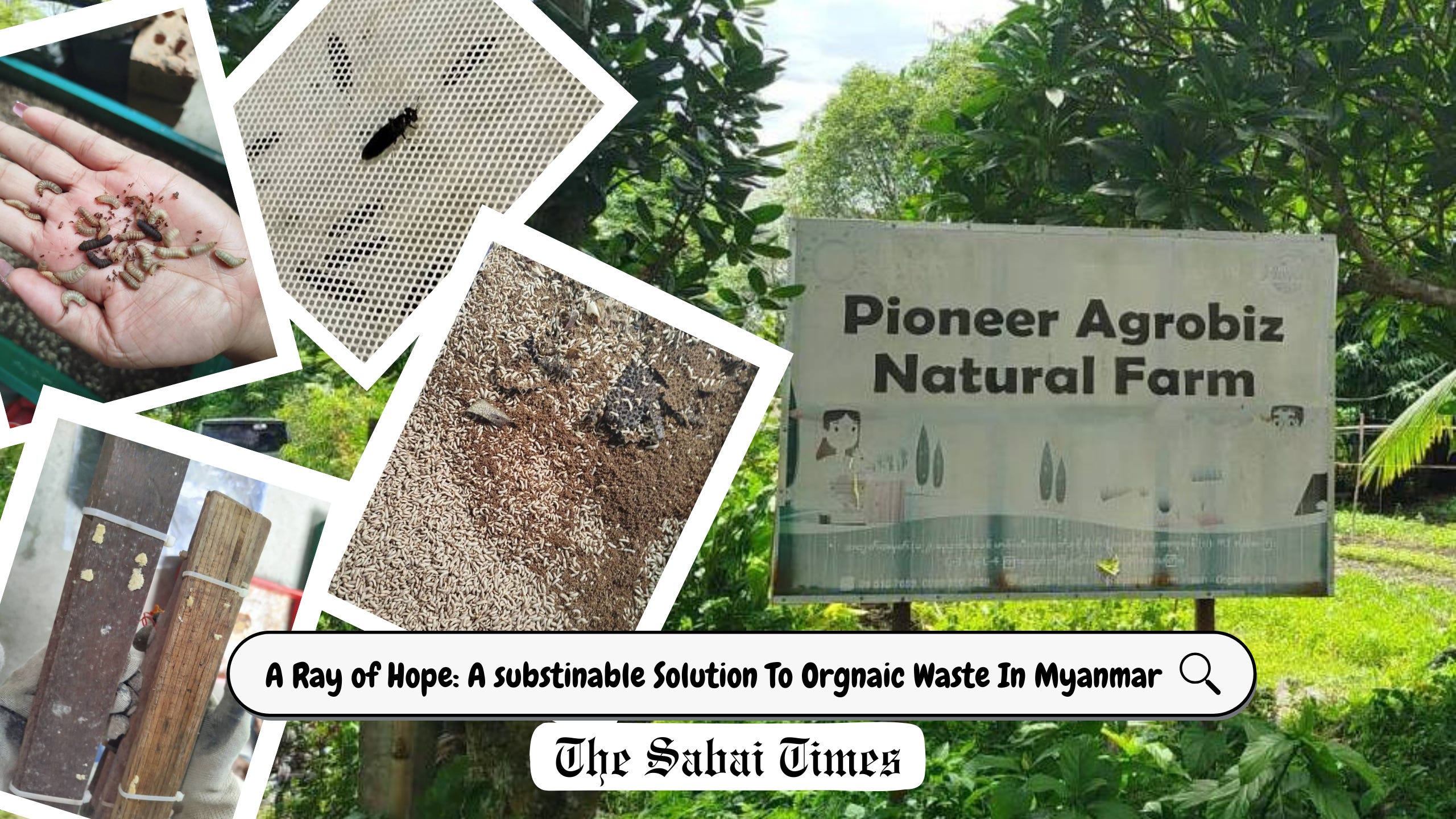
In Myanmar, organic fertilizer businesses could be pivotal in reducing organic waste since we do not have a sound waste management system. Nowadays, some environmental enthusiasts and forward-thinking animal farm owners have begun to innovate by establishing small-scale, household-level BSF farms. However, the number can be counted on one hand. While BSF farming is still in its early stages of innovation, momentum is growing. Additionally, I have observed that some individuals independently do their own small-scale BSF initiatives. For example, I visited Pioneer Agrobiz Natural Farm in Hmawbi Township, where they are breeding BSF as part of their commitment to sustainable agriculture.
A 65-year-old former medical doctor innovated a small household-scale Black Soldier Fly farm in his Pioneer Agrobiz Natural Farm. Today, he actively promotes post-harvest technology and modern sustainable farming practices, educating local farmers and encouraging them to adopt more resilient and sustainable methods to minimize harvesting losses and damages.
By 2050, the global population is projected to reach around 10 billion, significantly increasing the demand for sustainable sources of nutrition. Hence, Dr. Myo Aung Kyaw, a founder of Pioneer Natural Agrobiz Farm, shared his opinion. “Insects, particularly the Black Soldier Fly, are a solution to meet nutritional needs because BSF larvae are rich in protein, containing approximately 40–50%, making them a highly nutritious alternative. This makes BSF a cost-effective and environmentally sustainable protein source for the future,” said Dr. Kyaw.
His BSF farm is only 10 by 12 feet wide. However, this small-scale setup successfully stops approximately 15 visses of organic waste from ending up in landfills daily. “We feed the larvae 10 viss of food waste by mixing with five viss of higher quality waste byproducts such as rice bran and peanut or chickpea meal every day to ensure they receive enough protein and carbohydrate for larval growth," said Dr. Kyaw. While Black Soldier Fly larvae typically consume kitchen waste, food scraps, and animal manure, some farmers enhance their diet by combining lower-quality organic waste with nutrient-rich byproducts like rice bran and peanut meal.
He explained, “An adult female Black Soldier Fly can lay between 400 and 500 eggs before dying shortly afterward. To facilitate egg-laying, bundles of 2*8 inches wide wooden flats are placed inside the ‘love cage’ breeding nets where the flies can mate and lay their eggs. These eggs normally hatch within 3 to 5 days. Remarkably, just 1 gram of eggs can produce up to 5 kilograms of larvae. In the market, 1 kilogram of larvae is valued at approximately 20,000 MMK”.
During the pupal stage, from 14 to 18 days, larvae turn from white to brown or black. At this stage, they become inactive and instinctively burrow into dry and dark areas as they prepare to transform into adulthood. The optimal time to harvest and use the larvae as feed is during the prepupal stage, typically when they are 12 to 14 days old.
On top of that, frass, a byproduct of Black Soldier Fly (BSF) larvae rearing, is composed of larval excrement and leftover feed. This nutrient-rich material serves as an excellent organic fertilizer. He uses BSF frass in his organic farming and feeds the larvae to support his poultry farm of nearly 100 chickens. Since he has only started the farm almost 10 months ago, it remains at a household scale, producing for his chickens rather than for commercial sale.
Another initiative for BSF farming is the ‘Sein Lan’ BSF farming project. With the EU funding, in January 2025, Mercy Corps Myanmar launched a four-year project called the ‘Sein Lan’ project, collaborating with RecyGlo Myanmar and Village Link, to promote BSF farming and technologies in Myanmar. This initiative aims to reduce environmental degradation caused by Myanmar’s animal feed sector while improving economic outcomes through a more sustainable and resilient value chain.
To conclude, after introducing the ‘Sein Lan’ project to local livestock farmers, I wonder whether it will successfully attract local MSMEs and foreign investors to grasp potential business opportunities in BSF farming in Myanmar. While the four-year project emphasizes successful implementation, I wonder if providing access to modern technologies will strengthen and support household-scale BSF farms like Pioneer and other livestock farm owners across Myanmar. By doing so, could this project be a significant starting point and a revolutionary change for Myanmar's future organic waste recycling solution, Black Soldier fly farming?
Hnin Eaindra Khine is a Junior Research Fellow at the Sustainability Lab of the Shwetaungthagathu Reform Initiative Centre (SRIc). She is also currently interning at RecyGlo Myanmar, where she supports various environmental sustainability projects.
“Advocating Sustainability, Shaping Our Future”
Special Request for the Sustainability Literacy Survey in Myanmar
Help Sustain The Sabai Times - Myanmar’s Voice for Sustainable Development Support The Sabai Times